Fitting the fleet for hacking

8th February 2010 – 5.59 pm

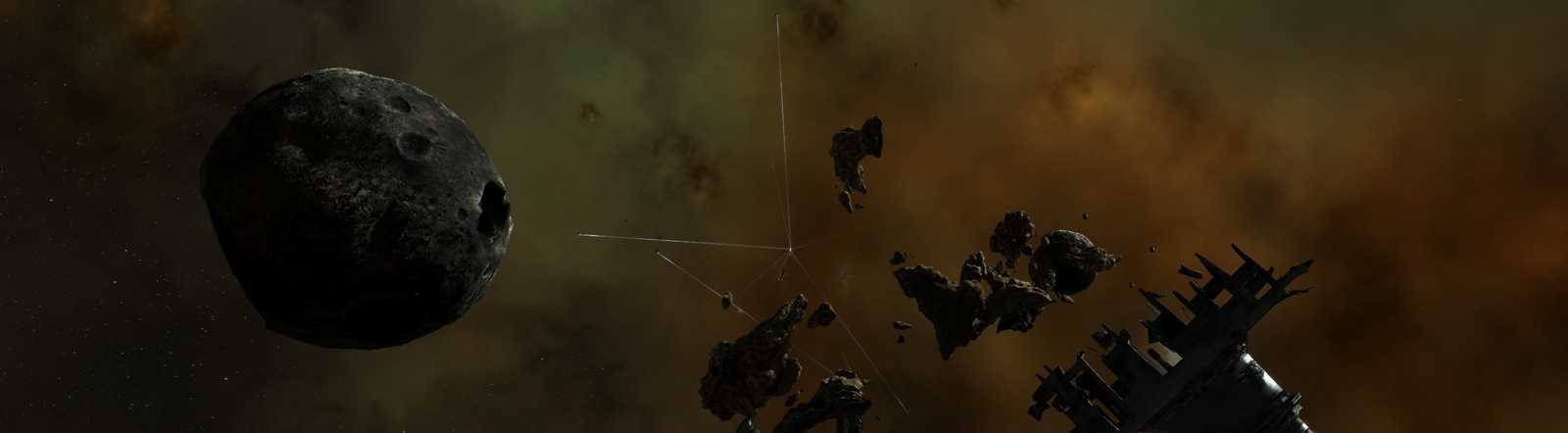
Our daily scanning finds some lucrative magnetometric and radar Sleeper sites in a neighbouring system. The only question now is how to reap the profits. Forming a fleet to clear the sites of Sleeper ships is simple enough, we have our battleships and twin Guardians ready. But we can't quite work out how to hack databanks or analyse artefacts effectively. That's not to say that we don't have the ships, modules or skills available to hack and analyse, it's more a matter of how the Sleepers protect their information.

Salvaging is easy. We blow up Sleeper ships and come back at some point to grab loot from the wrecks and salvage them. Ship wrecks last for two hours before breaking up in the harshness of space, independent of when the site despawns, letting us complete several sites before breaking for one of us to get a salvaging boat. We only need to make sure that no one steals from the wrecks, as it is the only source of income from w-space combat, there being no bounties on Sleepers. But accessing databanks and artefacts can trigger a new wave of Sleepers, which means we need a full and active fleet at the same time as one of us is hacking or analysing, and we don't have a pilot to spare.

We can't use a Guardian pilot to access the loot, as we will need both Guardians actively repping when the new Sleeper ships warp in and start firing. We could have a boat dedicated to recovering the loot, but it would need to warp in and out on demand. Leaving the loot boat, or battleship it is swapped for, adrift in space is unwise, even in a safe spot. Having to leave the system in a hurry would effectively abandon the ship, and a battleship or boat filled with Sleeper loot is a relatively expensive loss to risk. In the end, a battlecruiser's configuration is compromised slightly to fit a suitable hacking or analyser module, the smaller hull also allowing more passes through the wormhole without destabilising it. It is time to start attacking.

The fleet jumps in to the neighbouring system and warps to the first site, as our Myrmidon battlecruiser busily squeezes an analyser module in to a mid-slot. By the time the Myrmidon joins us, the initial wave of Sleepers is destroyed, at which point the battlecruiser needs to head back to the tower anyway as miscommunication means he needs a hacking module and not an analyser. Of course, a battlecruiser is not going to have much success in hacking Sleeper databases, not having the bonuses of specialist ships, but we aren't planning to recover all the loot this way. The idea is to provoke the extra waves of Sleepers to attack, by hacking a database or two, and get a dedicated boat once the site is completely clear. The extra waves of Sleepers arrive once the Myrmidon accesses a databank successfully and we are back in to the fray.

With a site empty of Sleeper presence we still have a problem. Unlike wrecks, the databanks and artefacts are part of the site itself, and the site despawns quickly when completed, unless we maintain some presence there. So our dedicated hacking boat is brought in. It turns out to be useful for our fleet to be sitting idly by watching the lone ship access the databanks, as an escalation occurs. A Sleeper battleship warps in and starts attacking, bringing with it a deserted Talocan cruiser! The fleet quickly swats the Sleeper aside and we finish hacking the databanks and salvaging the wrecks, including the Talocan hull.

There are more sites to plunder, and we seem to have a reliable method for inducing the extra Sleeper spawns. Having a set of more challenging encounters makes a refreshing change of pace from all the anomalies we have been clearing recently, even if the Sleepers are a little harder hitting. 'Are you getting some good pictures, Penny?', asks our Scorpion pilot. Oh, stop whining, your armour barely reached 95%. And yes I am, thank you.

Radar and magnetometric sites are cleared with a ruthless efficiency. So effective is the fleet that I lose count of the sites we visit. I need to be reminded of the second magnetometric site, it somehow blurring in to the first in a haze of explosions. Two radar and two magnetometric sites are cleared in total for the evening, with two Talocan cruiser hulls looted as well. We return home with plenty of loot, salvage, and Tech III materials, which amounts to a good evening's profit.

Music of 2009, part three

6th February 2010 – 3.05 pm

Better late than never is my final review of the music I bought in 2009. I have mashed together what was originally going to be two posts in to the one, lest I find myself reviewing some of last year's CDs in June.

After getting Slow Club's single Let's Fall Back in Love, I really look forward to the release of their debut album Yeah So. Unfortunately, my first impression isn't quite as enthusiastic, as the songs seem to have abandoned much of the whimsy included in the single in favour of more traditional pop and folk music. That's not to say the album is bad, far from it, the songs are jolly and cute, I think I was just expecting more. Luckily, seeing Slow Club live at the Scala shows just how much the band can deliver, easily bringing the album to life and energising my appreciation. I'm not quite sure what I was expecting from Yeah So that it took seeing Slow Club live to realise, but the album is a wonderful collection of songs from a passionate and entertaining duo.

Three Fact Fader is the long-awaited second album by Engineers, a band who appear with a brilliant, eponymous debut, promise a second, and then disappear. The new album doesn't disappoint, even with the expectations that a four year wait weighs upon it. The band have managed to keep their wonderful shoegazing sound whilst showing progression, creating an obviously modern album that remains undoubtedly an Engineers release. Opening song Clean Coloured Wire's snythesiser backing sets the mood for the album as udpated and energetically laid back, a track you can vigorously relax to. It sounds paradoxical, but the beauty of shoegazing is being able to create maelstroms of music with deceptively little effort, and Engineers prove they are masters of the genre with songs like Crawl From the Wreckage and Emergency Room. Three Fact Fader has been well worth the wait.

Combining my attraction to a certain rôle in MMORPGs and an apparent desire for more rude words in my music library, I pick up the second album from That Fucking Tank. Yes, sometimes my musical choices can be fairly arbitrary. The Leeds guitar and drums duo create a bunch of instrumental tracks with pun-based names for Tanknology, starting after a brief introduction with Keanu Reef, before moving on to Dave Grolsch, and Stephen Hawkwind. The names are not entirely unconnected to the songs, as Bruce Springstonehenge, for example, has undertones of Springsteen's Dancing in the Dark. But mostly the songs are energetic and interesting riffs and beats, making an unconventional but enjoyable album.

Even more rudeness with Fucked Up Friends by Tobacco. First track Street Trash is a catchy but short lo-fi introduction, leading in to what seems like the entirely disimilar Truck Sweat until the signature synth sound kicks in. Tobacco's mostly instrumental music switches between sparse beats to fuller synthscapes. The heaviest track is Dirt, because it features an Aesop Rock rap, otherwise the album is fifteen tracks of fairly similar synths over a drum track, ignoring the five seconds of silence that is the thirteenth track. As long as you like the general feel of the music there is plenty to be appreciated, and Fucked Up Friends doesn't sound repetitive. The up-tempo Grease Wizard gives the impression that the most distinctive tracks bookend the album, though.

Thriller is Part Chimp's third original album, and with it they are up to their third bass player. Opening track Trad promises more of the same heavy guitars heard previously, but it is as deceptive a start as it is catchy. The band's progression of becoming less frenetic and more measured from their first to second album is also present on Thriller, Part Chimp somehow managing to slow their sound down a little bit more. But this isn't maudlin reflection, there is an impressive intensity to all the songs, an energy released through controlled explosions, Super Moody being a prime example. Part Chimp are clearly honing their skills, refining their style, and by the end of the album Starpiss is raining down, building up from a drizzle in to an epic storm. But all the way through is the rainbow that keeps you mesmerised.

Hope Sandoval & The Warm Inventions return after their 2001 debut with second album Through the Devil Softly. Hope's wispy vocals float above the appealing mostly acoustic music as before, and it isn't until third track For the Rest of Your Life that the album shows its first unorthodox and haunting echoes. Yet even without reverb or delay the music can be strongly evocative, as Thinking Like That shows, its twin guitars creating an unsettling effect against Hope's calming voice, a voice that relieves any amount of tension in gems like There's a Willow and Fall Aside. It has been a long wait for the second album, and the result is a beautiful collection of songs that continues and expands on the maturity of the songwriting seen in the first.

I didn't like Kids by MGMT at first. So irritating did I find the repetitive squawling snythesiser that I reached a point where I turned off the radio rather than listen to it. I was fully prepared to dislike the band's following single, so it came as quite a surprise that I quite enjoy it. Indeed, Time to Pretend is a fantastic song, with powerful music and lyrics that are both catchy and compelling, a song strong enough to make me reconsider their previous single and even to buy the album, Oracular Spectacular. It's a shame, in that case, that Time to Pretend is the first track on the album, as it turns out to be the only song I want to listen to. The few times I've listened past the first track, mostly skipping the horrbly bland second one, I encounter some awful compression artefacts, and whether it is intentional or a problem with the mastering process the sound quality is unappealing for the genre. There could be some good songs hidden on Oracular Spectacular, but I simply don't care to find them.

More profanity catches my eye when Fuck Buttons gets a good review in NME with debut album Tarot Sport. My first impression is that I really ought to read reviews more thoroughly, or use various resources to sample music, as I am taken a little by surprise by the electronica that greets me on a first listen. Not that I don't like electronic music, I simply wasn't expecting it, and indeed Tarot Sport is a brilliant album. All seven tracks merge in to one, flowing seamlessly from one track to another whilst retaining individual and recognisable identities. The steady, repetitive beats over which are layered evolving, progressing harmonies and electronic additions, combine with the ebb and flow as each track flows in to the next to create an engaging and compelling soundtrack to... whatever you happen to be doing. Tarot Sport is what to play when you want to feel like you are the centre of attention. The glorious music is positive and uplifting, yet suitably understated.

The opening of Why There Are Mountains, debut album for the excellently named Cymbals Eat Guitars, starts off raucously, before settling in to a more subdued and standard rhythm, returning to the energetic opening for the refrain. The song seems to be a suitable metaphor for the album as a whole, offering short bursts of inspiration and passion but generally treading familiar ground. Why There Are Mountains is a pleasant enough album, but there isn't the spark that sets it apart from many other albums in the same genre. There is certainly promise found in Cymbals Eat Guitars, which will hopefully be realised in future releases.

The Drums start their debut EP Summertime! with an effervescent number about the spirit of surfing, and continue the happy theme with more whistling and finger clicking. It seems like The Drums are trying to see how jolly they can make any lyrics seem, however negative the theme, by adding bright almost fifties-style music. And it works quite well, until the pace is slowed down to a miserable crawl with Submarine, at which point the veneer of positivity is displaced. Happily, the hand-clap augmented beat of Down by the Water picks up the pace again, although it perhaps should have been swarpped with final track I Felt Stupid, to give the EP an ending more aligned with its start.

Every time I start listening to Local Natives debut album Gorilla Manor I get the impression that I am in for a treat. Compelling music and well-measured vocal harmonies greet me with Wide Eyes and continue with the delightfully sparse Airplanes, making it no surprise that these tracks are also tagged as single releases. But by the time I get half-way through the album, to other single Camera Talk, all the songs are blending together in to something curiously forgettable. Gorilla Manor isn't bad, but nothing really stands out beyond the opening tracks and it all ends up feeling rather bland.

The opening few seconds of jangling guitar on Versions, from the deliciously named Au, teases me in to being thoroughly optimistic. It's unfortunate then that when the vocals quickly come in they are a miserable drone, that whilst not tuneless nonetheless leave that impression. It is a shame, as the music is lively and enjoyable, but what sounds like a cat and a fox having a heated competition to make the most annoying wail can hardly be ignored. Versions is another album where I would really enjoy an instrumental version.

First You Have to Get Mad is a recording of The Joy Formidable live at The Garage. The set contains most of the songs from debut album A Balloon Called Moaning with a few changes. But, most importantly, First You Have to Get Mad captures The Joy Formidable in all their energetic and extended glory. You even get to hear the amp blow up all over again, and the band finishing the encore without the guitar. Simply producing a live album is quite a bold and generous recording for a band still so young, making it even more of a treasure to listen to.

Trying to find wormholes in w-space

5th February 2010 – 5.39 pm

Initial training is complete, I can fly another new ship. I don't have the new ship yet, as not being able to fly it until now has made it difficult to bring one in to our home w-space system. Now seems like a good time to go shopping. First, I must scan an exit to New Eden. As is generally the case, I find the wormhole leading out of our home system quickly and easily, and this gets me thinking about the possibilities of spotting wormhole signatures early. I can't repeat a specific task too many times without trying to make it more efficient, which often results from spotting patterns, and scanning is no different.

It seems that, on a scan of our system, the static wormhole gives an initial reading of a little under 5% scan strength. I have probably used this information each time I begin to scan for an exit to New Eden, just not explicitly recognising so. Signatures with higher strengths on an initial scan tend to result in common mining sites. Those with weaker signals will result in uncommon or rare deposits, as well as magnetometric and radar sites. At least, this is my intuition. As I jump through the new wormhole to find an unoccupied neighbouring system full of signatures, I wonder if I can apply my intuition to find wormholes or specific types of site more quickly. When I want time in known space, I don't want to spend ages looking for wormholes, and if a fleet will form later it is good to find the best sites to plunder. But maybe there are other aspects to scanning to consider.

I start thinking about the random nature of wormholes, and where they appear. They could be truly random, or they could be more likely to appear in certain regions of space. Maybe they lurk close to planetary bodies, or rarely lie on the ecliptic plane, or prefer to be further from the star than nearer. Maybe two wormholes cannot form close to one another. That I haven't noticed any pattern doesn't really suggest anyting, unfortunately. By the time a signature is resolved to the point of recognising it as a wormhole, the solar system map is magnified sufficiently to account for the high resolution of the scan probes, and any relative locational information of the wormhole's position is lost. Now that I recognise this, I could probably start to pay attention to wormhole locations, if not for another factor.

When a signature is first scanned, its position is enormously vague. It is a risk to reduce the scan resolution of the probes by two steps, centre the probes on the signature's estimated position, and hope to get a better reading. That a site can feasibly be over 4 AU away from its first scanned signature suggests that even if a pattern of wormhole locations can be found it will not be a reliable method for choosing initial signatures to scan. I can continue to try to locate wormholes based on my 'most likely percentage' method, although I will need to adapt it based on solar system size. Our home system can be scanned entirely by a probe pattern at a resolution of 16 AU, but other systems are larger and require half that resolution. The relationship to scan strength is probably non-linear, and maybe something I ought to research if I want to modify my initial number of 'almost 5%'. The scan strength also needs to take in to account skills, probe type, and ship rigs, but these generally remain static.

My research and practice in to locating wormholes goes a bit awry when Tranquility, the EVE Online server, crashes. When I can get back in to space all of the signature references have been changed. And, of course, my list of ignored signatures, those that I had identified as gravimetric or ladar mining sites, has reset. I need to scan the whole system again. Another problem with trying to determine signature attributes of wormholes is that after resolving two dozen signatures I tend to want to progress from scanning on to a more interesting activity, like flying AFK on auto-pilot. The twenty-fourth signature I resolve turns out to be a wormhole, and I gladly jump through it.

On the other side of the wormhole I find an occupied system, complete with miner, but it too is full of signatures, which is peculiar. Normally, the more profitable sites are cleared first, before the less-challenging and easier to find anomalies. But when I find the Covetor and mining drones that appear on the directional scanner, I learn why there are so many sites. Despite the presence of the drones, the mining barge is not busy mining but sitting inside a tower's shields. I was quite hoping to grab my Manticore if he had actually been mining. The drones are nearby, in a warp disruption bubble, possibly being used as a weak trap. A colleague points out that the pilot of the Covetor is in a two-man corporation, where the other member may well be an alt, so it's no surprise that the Sleeper sites remain undisturbed.

Luckily, in this wealth of opportunity, my first choice of signature to resolve, a most-likely percentage scan result, turns out to be another wormhole, this one leading to a low-sec system in New Eden. An exit. I go back to the tower, drop off the bookmarks, and grab my Crane. I head back to corporation HQ to refresh my BPO ME research jobs, but I don't pick up a new ship. Scanning has taken so long that I don't have the time to research and buy all the fittings for the ship, so I may as well wait for a more opportune day. As it turns out, a colleague continues scanning and finds a high-sec wormhole in a class 1 w-space system neighbouring the one with the low-sec exit. But more wormhole engineers are arriving, and we have sites to plunder.

Repping ain't easy

4th February 2010 – 5.32 pm

Another new pilot gets thrown in a Guardian logistics ship to accompany me. In a bid to make me more nervous, our small cadre of wormhole engineers can only field a fleet tonight if this new pilot dual-boxes to simultaneously fly a battleship. Whilst straight DPS superficially requires little focus beyond switching targets and activating weapons, repairing a small fleet of ships against Sleeper fire demands a little more attention. Sleepers don't pick one target and keep shooting it until it explodes, like we do, but switch targets dynamically. Having an ECM boat in our fleet also makes the incoming damage variable, as jamming cycles occasionally drop. The state of the fleet needs to be continually monitored and remote repair modules moved between ships actively.

I suppose there is unlikely to be a problem dual-boxing a battleship and Guardian if the logistics ship is given priority. A dumb DPS machine would certainly be helpful, and it reduces the amount of panicked distress calls every time the battleship's armour is scratched. The new pilot in the Guardian is also quite knowledgeable, and his understanding of the ship should help. But when we get started, combat doesn't go quite as smoothly as I like. I get close to running out of capacitor more than once, and on one occasion my ship runs dry. The Guardian's tank becomes unenergised, my energy transfer arrays drop, and the reppers can't be brought on-line, putting the whole fleet at risk.

It's good that we are only engaging relatively unchallenging anomalies in a class 3 w-space system. The Sleepers aren't causing any problems for us and I am soon fed a bit of capacitor from the other Guardian, allowing me to activate one of my transfer arrays to return the compliment. It is not long thereafter that all my systems are fully operational again. But it worries me a bit that the shutdown occurred. I think it shows the difference between technical knowledge and experience, and the value of good communications.

I am flying in training mode, keeping everything as simple as possible and reserving the intricacies of Guardian fleet repairing until later excursions. Paired with a new pilot, I consider it better to have both energy transfer arrays running constantly, so that all four reppers can also be run constantly. It may be possible to run only the one transfer array and use reppers as needed, but in times of heavy incoming fire I would rather not have to worry about trusting my twinned Guardian to understand that the second transfer array needs to be activated for us to run all of our reppers. Besides, the extra energy transfer array is only otherwise used to keep capacitor-hungry battleships from running dry, and I also maintain that our fleets should be as cap-stable as possible when we have a new Guardian pilot. Balancing transfer arrays between Guardians and battleships is certainly possible, but it's an added layer of complication that can be avoided in early flights.

My twinned pilot, on the other hand, is flying in theoretical mode. He is assuming that I am competent and experienced and trying to be as efficient with his systems as possible. Whilst admirable to aspire to such levels, I feel it is unwise to attempt to be an expert on a maiden voyage. Without experiencing how the Guardian's capacitor drains and fills, how many reppers it takes to keep a battleship or the other Guardian afloat under heavy Sleeper fire, or the mobility of remote repair modules, it cannot be fully appreciated and remains theoretical. Keep it simple, I say. Learn how the systems interact at a fundamental level, adding incremental levels of exposure, before trying to finess high levels of efficiency.

Essentially, communication is key. If we had both kept a simple configuration running, or both taken a more progressive attitude towards pairing logistic ships, we probably would have been fine. But we both made assumptions about the other. My communication can be lacking much of the time, a result of my shyness and lack of confidence in not wanting it to seem like I am telling smarter people than me what to do, and I need to overcome this somewhat to avoid misunderstandings. Communication is easier in certain arenas and with some people, I simply need to build on my positive experiences. And once we have the initial troubles between the Guardians resolved, two anomalies are cleared of Sleepers easily enough. The fleet then has to dissipate.

I get to jump in to a Catalyst and salvage the two sites of loot, which lets me end the sortie doing what I do best. The wormhole engineers also end with another pilot getting some flight hours in a Guardian logistics ship. The more pilots we get with Guardian experience will allow us to be more flexible in fleet configurations for future sorties, which should increase our operation capabilities.

Sleepers meet the new Guardian

3rd February 2010 – 5.58 pm

Our new logistics pilot is thrown in to an anomaly for some experience in the Guardian. Luckily, he's not by himself, with my Guardian for support and a couple of battleships to take care of the Sleepers. Anomalies are the least challenging of Sleeper combat sites, but still require attention and focus to ensure our fleet's survival. The first task upon warping in to the site is to get the Guardians twinned together. There is a moment of consternation after I lock on to the second Guardian, begin the energy transfers and start pre-emptively repairing the Scorpion, when my capacitor runs dry. It turns out only to be the lag induced from dropping out of warp preventing the other Guardian locking on to me in time. Once the logistic ships are twinned, systems run smoothly.

Because it is the pilot's first active engagement in a Guardian I try to keep the operation simple. Both transfer arrays exchange energy between the two ships constantly, and 'safety' reppers are maintained, one each on the Guardian and Scorpion. Perhaps Sleepers really don't like the jamming ECM it generates, preventing them from locking on to us, or they find its pilot a bit too smug, but the Scorpion certainly tends to take a beating. And being Caldari in design it doesn't have a strong armour tank, so it needs all the help it can get from our reppers. And without both Guardians the fleet is ineffective, hence that safety repper on each of us. Unfortunately, I make a mistake.

The Megathron in the fleet is a little hungry for capacitor, and occasionally asks for a few cycles from our transfer modules to keep his guns firing. The pilot also needs to get within optimal range of his guns relative to the Sleepers, so he checks with us to find out the maximum range of the energy transfer modules. But instead of calling up the datasheet for the fitted module I accidentally put the module off-line. That isn't good. Whilst it is possible to take a module off-line anywhere, putting it back on-line away from a fitting station can be difficult. I feel clumsy, but hopeful. The limiting factor of bringing a module on-line in the field is having enough energy in the ship's capacitor, and Guardians are designed to supply ships with large amounts of energy. A handful of transfer cycles pass, and my capacitor blinks to full for a moment. Before the reppers or my own transfer array cycles again, draining the capacitor from full, I punch the control to get the second array back on-line in time. All systems are functioning again.

The anomaly is cleared without any more drama, both Guardians working together and the battleships happily destroying the Sleeper infestation, and we warp to a second anomaly. Having smaller hulls, the logistic ships reach the next site first as usual. The Sleeper battleship waiting for us knocks my shields down to nothing in one shot and starts scraping away at my armour. My Guardian companion has me covered, though, repairing any and all damage inflicted whilst the rest of our fleet warps in to return fire. Despite the competence of the new logistics pilot, it is awfully peculiar not having Fin in the other ship. There is a certain element of mutual understanding and trust that is built up over many months of working closely together, and although I trust my new Guardian pilot to do his best the rapport isn't quite the same without my normal wingman. My curious unease is quelled by how well the anomalies are being run, with the twin Guardians operating smoothly throughout.

Warping to the third site, there is a spike of incoming fire before the Scorpion's ECM kicks in, taking seven large remote armour repair modules to keep the Megathron afloat. If I were more cynical I may think the Scorpion pilot deliberately breaks jams occasionally, to remind us how brilliant he is. Then again, he reminds us in other ways occasionally. Taking time to clear all the lovely salvage from the previous anomalies, after receiving a peculiar traffic advisory warning out in w-space, he calls a general command during our approach to the next site. 'Make sure hardeners are on', he starts, ensuring the fleet have their tanks working, 'and rep me fast'.

On dropping out of warp, instead of reaching an anomaly we find ourselves in empty space. 'Do you still need repping, sir?' He doesn't respond, and even breaks his own orders by warping the fleet elsewhere, thus dropping my target lock on him and disengaging my reppers. But at least when we next come out of warp we are back in a Sleeper-filled anomaly, and he starts getting shot as desired. I could have just set my drones on him. Another fun salvaging effort ends the evening and we head back to the tower. With the evening's profits paid out quickly I even reach a new milestone, finally exceeding 1 billion ISK in cash! I should buy something to celebrate.

Return to Blackrock Mountain

2nd February 2010 – 5.38 pm

Listening to Livya raving about Blackrock Depths for fifty levels was amusing. I'm sure when I started running the instance years ago I was full of wonder and awe at the sheer size of the dungeon and convoluted corridors and connected rooms. But after many visits, most notably to rescue Marshal Windsor for the Onyxia attunement quests, Blackrock Depths became a tedious grind, a necessary chore to get to the more interesting adventures. Livya must be in a nostalgic state of delusion, I chuckle to myself every time she recalls that Blackrock Depths is the best dungeon ever built. Either that, or there is a secret Horde version with rainbows, unicorns handing out epic loot, and hunters replaced by competent players. But seeing the dungeon with fresh eyes and friendly companions, I begin to appreciate Livya's passion. Of course, a lot has changed since the early days.

Blackrock Depths was built with same design as the Deadmines, Gnomeregan, and Uldaman. Instead of the sleek three-wing design of Scarlet Monastery, the monolithic instances are long and demanding. Antithetical to their monolithic nature, the dungeons were also designed for progression, resulting in a spread of mob level far beyond what a party could realistically defeat in a single visit. The mobs at the end of the dungeon could be eight levels higher than those at the start. A party would either have to make the early mobs trivial to defeat and offer no rewards, or be unable to defeat the final boss. At least after the Deadmines some content could be bypassed, if you had the key.

But now the monolithic dungeon design has been eschewed in favour of shorter dungeons. The commitment to play for several hours has been reserved for raiding, with quicker sessions available for more people to enjoy. And although the old world has not been torn apart and rebuilt—at least, not yet—some of the guiding principles of shorter, more enjoyable sessons have been implemented in the monolithic dungeons. The level disparity of mobs has been reduced, making it more likely that all mobs throughout the dungeon will offer some reward and sense of achievement in defeating them. The mobs themselves have been weakened slightly, so that each combat is quicker, increasing the overall pace of progress through the dungeon. And that's not all.

Classes have undergone significant changes and adjustments over the years, with enhanced and extended talent trees, new and more effective spells, as well as overhauls to the game mechanics in general. It is not just that the dungeons are more inviting, adventurers are better equipped to wreak havoc and survive. For the tank and healer to finish most fights on full health and mana seems peculiar, but that the protection paladin and tree-form druid do so undeniably helps with survival. So it is that the drudgery Blackrock Depths had become is lifted in our recent runs, offering me opportunity to enjoy the scenery and admire the way everything is constructed, from the architecture to the fights. Whilst it may be fun to revisit Blackrock Depths, there are plenty of Azerothian instances left to conquer, and before too long we will be heading to the Outlands to experience the first evolution of the World of Warcraft. But fate shines down on the Filesystem Checkwits. With one person missing this week we aren't going anywhere new, and we can revisit Livya's favourite dungeon. It's just a shame that it is Livya who is absent, leaving us to reflect on our absent friend.

Vulzerda still remembers all the wipes of previous visits, admittedly mostly from last week. 'We're going back to Blackrock Depths?' Yep! 'I'll go and get the alcohol then.' But I've probably learnt my lesson! Even so, it is best to be prepared. Although I mention in my previous report that we no longer have to visit the cell block of Blackrock depths, I am mistaken. Having visited the King's chamber in Ironforge we are all now on the mission to free the princess, which involves first finding a prisoner. But even this isn't too much of a chore any more. The general nerf of the mobs means the occasional adds aren't too threatening, and cautious prevention of runners keeps fights manageable. Plucking the key from the warden's still-warm body and picking the right direction towards Kharan Mighthammer's cell means we have to fight only half the mobs in the block, which slightly reduces the frustration of having to head back to Ironforge to continue the quest chain.

We use our hearthstones to return to Stormwind quickly, then courageously ride the Stormwind tram public transit system to Ironforge to speak with the King. On hearing that he wants us to rescue the princess, I can't help but feel we, as heroic adventurers, could have come to that conclusion ourselves. This is an occasion where dynamic questing would be beneficial. Indeed, I am surprised the King doesn't go in to a rampage. 'You learnt from talking to Mighthammer, in a cell in Blackrock Depths, that my daughter is deeper in the dungeon, held in some mad fool's thrall, and your instinct is to return to tell me? Not to go and rescue her?! What kind of heroes are you?' Well, quite. Instead, we have to deal with an unfortunate effect of normalising only the tangible dungeon content. I am reminded that much of the anguish with Blackrock Depths was caused by the interminable quest chains, sending you out of the dungeon only to have to return to repeat the content for no good reason. At least with accelerated experience gains we have the luxury of being able to ignore quests, and our current visit is specifically to rescue the princess properly this time. We head back in to Blackrock Depths for the fourth time in three weeks.

There are two quests in our logs guiding our adventure tonight. Saving the princess is one, the other is another quest demanding our return to Blackrock Depths, this one to slay Incendius. We were happy to ignore this second quest, not planning to come back solely to complete an unnecessary task, but as we are here and Incendius is close it seems like a good idea to gain some extra XP and try to catch up with Livya. Ah yes, Livya. She may not be here in person, but she is in spirit. Vulzerda's fire totem spews AoE everywhere, and Qattara notes it is about the right height. And my new add-on simulates Livya's encyclopaedic knowledge of the dungeon. Outside of the dungeon, party chat is occasionally interrupted with shouts of 'Blackrock Depths is glorious!', and once inside any question about direction or tactics is met with either 'I dunno', or 'yeah, maybe'. It's like she's fighting beside us.

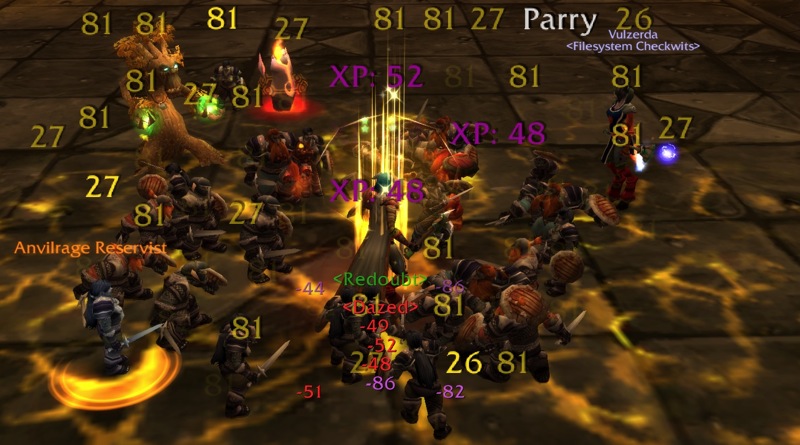
Making our way to Incendius is straightforward enough, opening the locked gate and turning right at the end of the first corridor, ignoring Bael'Gar to our left. One of the dwarves we fight runs straight to the fire totem, but as he is a Fire Marshal it is probably because of some health and safety mandate. We also question the wisdom of Qattara fighting fire elementals whilst she is in tree form, so she instead focusses on trying to give the dwarves nasty splinters, hoping they get infected. Incendius is defeated and we come back to open the Shadowforge lock to gain access to the rest of Blackrock Depths. Beyond the dense cluster that is the cell block area, it is surprising to see how few extraneous mobs there are to fight between the different and interesting areas, even more so if you are willing to ignore a couple of bosses, which we are. Despite having to beat some gnomes off with a stick, we quickly reach the Grim Guzzler again.

We ply a dwarf with some ale, keeping the rest for ourselves to get the pet from the Darkmoon Faire, and Phalanx gets upset about the dwarf destroying his door again. We get past the construct without fighting the whole bar this time, running around the corner in to Ambassador Flamelash and all his little minions, who are just as quickly despatched. Before we know it, we are back in the Summoner's Chamber, facing the seven ghostly dwarves. Missing half our DPS is most noticable here, where on a couple of occasions the next dwarf joins the fight instead of waiting his turn, but we cope easily enough and at the end of the encounter grab our loot from the chest. The Summoner's Chamber links directly to the Lyceum, and we are charging in to interesting and exciting challenges one after another.

My consecration and Vulzerda's fire totem AoE is enough to take care of the paper dwarves in the Lyceum, which is handy considering the mess they make of my screen. The torch bearers are found reasonably quickly, and the two beacons lit to open the exit ahead. With no more of an introduction, Magmus stands before us again. After our trouble last time with the flamethrowing statues, we try to find somewhere safe to stand, but we don't find one. It looks like the fight will end as it did before, but some emergency mutual healing keeps shaman, druid and paladin fighting to the molten giant's demise, where we once again have to grab the loot and scarper as the room continues to burn. All that is left is the throne room.

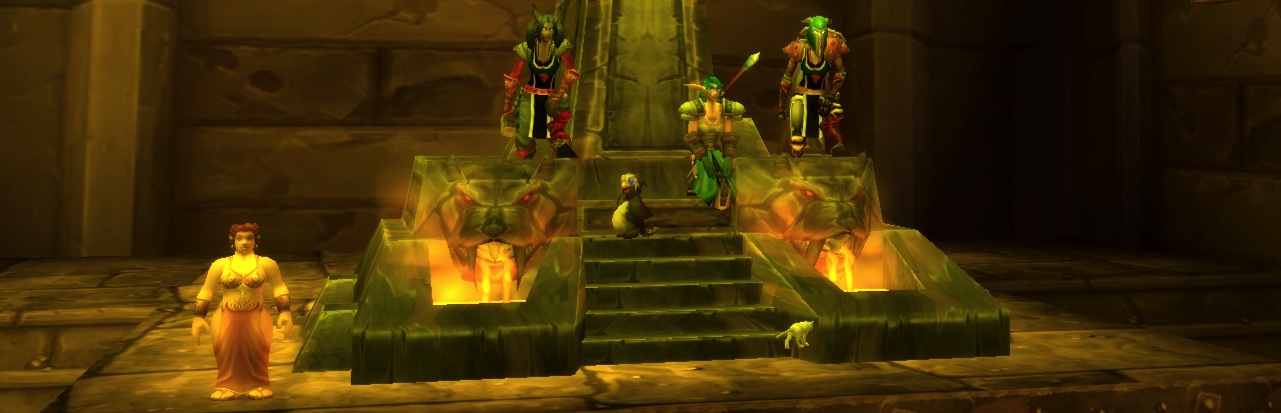
The emperor's minions are soon dealt with, only a few elite guards amongst the frail nobility of the court, before the emperor launches himself in to the fray. We aren't quite ready for the concluding battle, but no matter. I keep the emperor's attention on myself, the princess remaining in his thrall, whilst Vulzerda takes care of the stragglers in the throne room. Once we regain complete control of the encounter the emperor is easily defeated. This time, the princess is rescued properly, for her father, King Magni Bronzebeard. The Filesystem Checkwits, and one proxy, stand on the throne of Blackrock Depths and survey all that we have conquered to get here. Perhaps Blackrock Depths is a little easy now, but it certainly is magnificent again.

Chasing a Cheetah

1st February 2010 – 5.40 pm

Twin Guardians have converted our fleet. Instead of each battleship or battlecruiser relying on its own tank, carrying additional armour plates or hardeners and perhaps supplemented by a small amount of remote repair, the logistics ship supply all of the repair capabilities of the fleet. Having no need to fit a tank removes all the bulky fittings in favour of modifications to improve the fleet's firepower. We end up with more optimised ship configurations that greatly enhance our efficiency during PvE Sleeper engagements. The only problem with the fleet relying on the Guardians is the specialised skill training required to pilot one. When one of the two capsuleers capable of flying a Guardian is not available, the fleet remains docked.

Knowing that no Guardians means no combat, other pilots have been on the training path towards logistics ships, and now our first new Guardian pilot is ready to get his pod in the ship. Rather than throw him right in to battle, an overview of the logistic ship's systems and capabilities is due. I jump in to my Guardian, the new pilot in to the spare, and we navigate outside the w-space tower's shields. Locking on to each other's ship, we start both of our energy transfer arrays and all four remote armour repair modules, all systems staggered for optimal benefit. Then a colleague arrives in a Megathron and starts shooting me.

My armour is barely dented by the Megathron's sustained attack, the reppers easily countering the battleship's DPS. The pilot turns his attention to the other Guardian, asking 'can I get some cap?' before starting his attack, cheekily wanting one of our transfer arrays to energise his capacitor depleted from the previous barrage. Another colleague joins the fray in his Scorpion, wondering aloud if he would be able to jam me with his ECM. As a successful jam will break my target lock and thus disrupt all the ship's systems, I point out that we are currently flying Fin's spare Guardian, and no one will be happy if anything happens to it. He jams the frustrated Megathron instead, still hardly scratching the Guardian's armour. With no incoming fire, the Scorpion tries to jam my systems but fails, quickly trying to blame my ECCM or his fitting of only one Amarrian jammer.

Our twin Guardian configuration with the new pilot is operational and stable. We head back to the tower and plan a field test against some relatively simple w-space anomalies. But just as we are preparing, a Cheetah covert operations boat appears in the system. Whilst the presence of a scanning boat may not be a cause for concern, it is wise to treat it as a threat until shown otherwise. Our Sleeper operation is postponed and we move instead for reconnaissance and deterrence. Our own Cheetah is deployed, ready to follow the intruding ship back to its base. I jump in to my Manticore stealth bomber, happy for any excuse to pilot it. Other ships are readied or dumped out of the hangar to give a more active appearance and threatening presence to our system.

Both our Cheetah and myself jump in to the neighbouring system, where the intruder must have come from. I park my Manticore 30 km off the wormhole and wait, our cov-ops boat warps to a second wormhole in the system. It is not too long before the wormhole in front of me, connecting to our home w-space system, flares to indicate a ship passing through. Curiously, I don't decloak and launch a bomb, partly because I am not entirely sure how much damage it would do to such a small ship, and partly because the intruder has not made any hostile actions so far. Let's hope I don't regret this decision. The intruder warps off, predictably back to the wormhole our scanning man is stealthily monitoring, and jumps to the next system.

I warp to the wormhole the intruder just jumped through, repositioning myself for his re-entrance. I call to the corporation for anyone passing through that wormhole to announce themselves first, as I am now fully ready to launch a bomb as soon as the wormhole flares and don't want to hit a friendly target. It's fine for a target to go home, but coming back is to be discouraged. Our man in the Cheetah follows the intruder back to a class 5 w-space system, where he sees a fleet preparing for an operation. Three Dominix battleships, a Guardian logistic ship, a Tech III Tengu, a Zealot HAC, and Phobos HIC are all recorded, indicating more of a PvP composition than PvE. With a real possibility of being ambushed by experienced pilots, it doesn't bode well for us to get involved in combat with Sleepers. I also am not entirely sure my lone Manticore on the wormhole two systems across will be enough to deter the fleet if it comes this way.

But I don't waver. I hold my position on the wormhole. Only when the call is given that we will not be forming a fleet for Sleeper combat do I warp off, returning to the tower. I make it known that I am jumping back in to our home system, so that I don't cause panic or get shot on my arrival, and when everyone is back safely the tension levels lower somewhat. Perhaps we don't see any combat action today, but there was certainly some excitement. Anticipation can be everything.

Shuttling ships to market

31st January 2010 – 3.24 pm

An exit is found to New Eden. Although it leads out to my manufacturing region, the wormhole is reaching the end of its natural lifetime, giving only a few hours before it collapses. 'Only a few hours' sounds like a long time—and it is—but the timing all depends on when the wormhole enters its end-of-life state, which isn't known. I may have three hours to take care of business, or I may have thirty minutes. Although it should only be a handful of jumps to reach my production plant, delivering goods to market will take time. It's possible that by taking this exit I will be stuck in New Eden, waiting for a new link to our w-space home to be found. But I take that risk, as I have some exciting products to ship.

The last time I returned to my manufacturing base, I took my first Badger Mark II off the production line and to market. Soon after, it sold, and for a good profit. All the time spent researching the material efficiency of the blueprint looks to be paying off. Before I went back to w-space I installed a larger run of Badger IIs for production. It is still a small run, limited by my small mineral stocks, but delivering ships for others to buy, instead of modules for ships, feels like an important step. Requesting the production run to be delivered whilst I am en route, I reach my manufacturing base to find a number of pristine industrial ships sitting packaged in my hangar. Now to get them to a suitable market.

Even packaged, a Badger Mark II is rather more voluminous than many ships can carry. And even if a ship could carry one, there is little to be gained from taking only one ship to market in another. Not much time is saved unless two or more ships can be hauled at once. It looks like I'll be piloting the Badger IIs to get them to market. Luckily, a good opportunity to undercut a decent price is available only one system jump away, which will cut down the tedium of transporting the ships one at a time. I also have a plan to make it a little quicker.

The Badger Mark II is an industrial ship, with a fair-sized cargo hold that can quite easily carry a shuttle. Taking a shuttle doesn't seem to add efficiency, as travelling in a naked pod is viable in high-sec. But whereas a pod has no cargo hold, the shuttle can fit a couple of small modules. A couple of inertia stabilisers can be fitted to the Badger II I am piloting, making it enter warp more quickly and thus reducing travel time, and carried back in the shuttle to my manufacturing base to repeat the process with the next Badger II. This saves me a little time, without having to pick up stranded modules after stripping the ships for sale on the market. Of course, the time saved may be only a few seconds, lost again by having to fit the modules and move them between cargo holds, but the psychological effect is positive.

I get all my Badger Mark II industrial ships to market in good time. The rest of the modules coming off the production line are taken to various reliable markets using my Crane transport ship. Being back in the Crane lets me appreciate its agility and speed all the more after piloting standard Badger IIs for a while, so I take Tigress III for a spin down to corporation headquarters to refresh ME research on my next batch of BPOs. The trip may not take long, but I am perhaps pushing my luck if I want to get back through the dying wormhole. I suppose I have resigned myself to fate for the day, and today I am lucky. When I return, both the wormhole back in to w-space and the connecting wormhole, which was also nearing the end of its lifetime, are still available to use. I make it back home safely.

Design a better map, not a quest helper

30th January 2010 – 3.51 pm

With the recent patch, a new quest helper has been integrated in to the main World of Warcraft client. As is typical when a feature is added for convenience, I am sure there have been detractors of the quest helper, probably even before it was used, complaining about making the game too easy. Any such complaints are understandable, as there could be less and less of an actual game to play the more a player is told exactly what to do. At least the quest helper can be turned off, allowing individuals to choose their own level of immersion.

I turn the quest helper off myself, preferring to explore and experience the world more vividly to remember locations. But then I find an old quest in my log asking me to seek someone 'at Dawn's Reach in Dragonblight'. I don't know that place, nor can I find it on my map, which is curious because I have the 'Explorer' achievement. I have uncovered every region of every zone on the entire map, poked my nose in to all the hidden areas of the world, yet I am foxed when trying to find location with a quest NPC. My fully explored map of Dragonblight does not show me where Dawn's Reach is, even if I carefully move my mouse of every area.

It is not just Dawn's Reach that sits anonymously in the Dragonblight region. The Bronze Dragonshrine is a rather important quest objective location, one quite memorable for meeting your future self, and is of considerable size. Yet the Bronze Dragonshrine also does not have a legend on the map of Dragonblight, even though it appears graphically. For such a significant element of the region, one that is shown on the map, it is odd that there is no textual reminder of its location.

The problem with the lack of text to identify locations wouldn't be so curious if it weren't quite so inconsistent. There are plenty of areas and locations that are revealed on the map that can be found by name, either directly on the map itself or appearing on mouseover. There are also plenty more areas that do not appear on the map that are named when you pass through them, which is fine for presenting elements of a populated world, but causes issues when those areas are not simply descriptive and are actually significant to the player. When I am told to visit Dawn's Reach and I have a complete map, I expect to be able to find Dawn's Reach by following the map.

I like exploring in games. I was wandering around the world and being inquisitive even before the achievement of 'Explorer' was introduced. But I am not a fan of aimless wandering when I have a purpose. I do not relish flying over an entire compass point on a map trying to find an outpost that should rightfully be marked. In the end, I turn to the new quest helper to find my destination, which it points out quite helpfully. But I am not about to claim that the quest helper is necessary and welcome. If the map were adequate to begin with, I wouldn't need help to find my way.

I don't see the addition of the quest helper as making the game easier, but rather a failure of the current tool. The quest helper is merely an extension of the map, adding extra information that would otherwise not be included. But we don't need a new feature if the map fails to record and show simple quest hubs, we simply need the current one to be fixed. A patch with a note stating 'all named locations now added to the in-game map' would have been sufficient.

Idle thoughts

29th January 2010 – 7.25 pm

I still don't have a titan.

R: 'What are you supposed to do with a titan?'

Me in particular, or in general?

R: 'You.'

I can bump your AFK Helios out of the shields and pod you, for a start.

Maybe I don't need a titan for that.

W: 'It would be cooler, though.'