
Filesystem Checkwits survive Gnomeregan

10th November 2009 – 5.49 pm

We stand outside Gnomeregan, contemplating the arudous path before us. We could just turn around and go to punch boars in their Heisenburg snouts, only determined to exist when we are specifically not on a quest to gather them. But, no, Vulzerda is adamant that 'we are here as adventurers in Azeroth to experience everything, even if it hurts'. As I'm the paladin tank, I'll be only too happy to make sure our time is painful. Besides, Gnomeregan is the capital city of the gnome race, it sounds like a dream come true to slaughter hordes of the big-headed, pink-haired freaks. The deviant gnomes are even sprouting fast enough inside to continually have some dash out of the entrance every few seconds. This clearly needs to be stopped, so we head in to do our duty.

It seems we've been lied to. There are few gnomes in here, encountering instead mostly trogs, and irradiated trogs at that. But popping around an early corner finds us a gnome, separate from all the blasted trogs around, but sadly we can't kill this one. Instead, she offers us an opportunity to watch her try to cause an industrial accident with explosives, which we readily accept. This leads to fighting more troggs, including a minor boss who drops rubbish loot, and no one gets blown up. I am sure that this gnome used to offer a quest, and thus extra experience points, for helping her secure the tunnel, just as I am sure that the quest always used to bug and start without everyone in the party being included. I consider it better that no one gets the quest XP than only half of us, and we move on.

We get back to killing trogs that aren't coming out of tunnels, and it seems to be going rather well. When we get our third punch card from the gnomish machines, the alarm bots wandering around have apparently been reprogrammed and don't start shouting warnings and exploding. Before we progress to room of slime monsters, we find a goblin who has the simple request to be released from being stuck in Gnomeregan, and we accept his task to guide him out. Perhaps it is the lack of gnomes so far, but it all seems rather civilised. 'I'm not sure why Gnomeregan has such a bad reputation', muses Vulzerda.

'Maybe it is because we are over an hour in to our run, not even making it half-way in to the instance, and have just accepted a quest that sends us back to the entrance' and, as it turns out, in to the clutches of mobs that have respawned far too quickly. We could have skipped the escort quest, but I did earlier promise some pain. And we have only scratched the surface, needing to dig much deeper and for longer until we can claim our goal. Luckily, after the trogs and then the slimes, we eventually start feeling more involved, as the inner sanctum of Gnomeregan is full of critters. 'We're killing gnomes!' I cry, which is replied by a chorus of 'finally!'

Gnomes with spanners, gnomes in diving suits, gnomes on mechanical chickens, gnomes wearing cowboy boots, none escape our attention. Livya breaks out the AoE attacks for the larger groups of vermin we attract, for more efficient gnome slaying, although she admits that she'd 'be happy to do it with a potato peeler'. We've all felt that way at one point, I'm sure. The efficiency of the AoE spells lets our warlock get to their 'silky goodness', which I presume to be for her tailoring efforts, but Vulzerda has other ideas.

'Does this mean you can wipe your arse on a gnome?'

'It's worth a try', Livya says, after a moment of reflection, 'face up', of course. It is only moments later that a couple of party members die quick deaths against gnomish opposition, which Livya attributes to us 'all standing there watching' as she tries the conjecture. Death is a good alternative, frankly.

The gnomes may produce some fancy vehicles, but when I realise it is only Mechano I suggest that perhaps we could use the dismantled pieces to build something to help us. The stress of spending so long in Gnomeregan begins to show as Vulzerda replies, 'a decent instance?' I fear that is beyond our capabilities, but the sight of dark iron dwarves heralds the proximity of the final room. Despite starting out with an intention to clear every path and room of all danger, we now take the shortest route to Mekgineer Thermaplugg's chamber, being cautious and strangely professional about the annoying mines the dwarves drop. Some of us remember abandoning runs after wiping on the mines, not wanting to face half the instance again because of respawns.
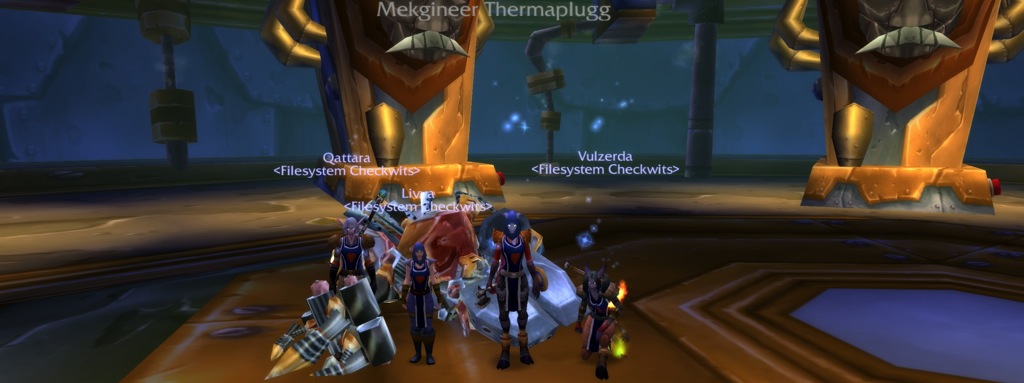
Thermaplugg turns out to be less of a threat than we anticipate, even after sacrificing maybe a tenth of our DPS by assigning our warlock to hit all the emergency stop buttons of the bomb makers. The stupid gnome boss drops a ring of nature resistance as the ultimate loot in the instance, which we give to our enchanter to destroy and pretend it never happened. We survive Gnomeregan, and have the achievement to prove it! Now let's get the hell out of here.

Not so micro transactions

9th November 2009 – 7.44 pm

There is currently a lot of commentary on micro-transactions to be read in blogs and journals, but I am perplexed, as none of the transactions mentioned seem to be particularly small. As I understand it, and would define it, a micro-transaction is a cost that is too small to be paid in physical currency1. Micro-transactions should be tiny and many, building up to a normal transaction over time. Because of the problems associated with charging fractions of pennies, I may stretch my definition to include costs of less than a pound, but anything larger is definitely not a micro-transaction. I wouldn't call buying a packet of crisps a micro-transaction, so paying an order of magnitude more surely cannot be one either. Calling it such strikes me as employing marketing jargon to manipulate buyers in to perceiving the cost as being smaller than it actually is.

It is particularly odd when the cost of the transaction is a significant fraction of the cost of a monthly subscription to a game, because I consider one aspect of micro-transaction systems is to differentiate themselves from subscription services. Buying 'points' for games or services in a normal transaction and then spending those points is a way to realise micro-transactions, as it allows for spending pennies or less at a time without incurring prohibitive processing costs. For example, it is possible to buy thousands of points in a single transaction and then spend those points over a period of time. Buying a large chunk of points could leave the buyer with points unspent, but the overall cost to buy the points can be set to be similar to a single monthly subscription for a game, making the points affordable and offering a guideline as to how long a period of time over which they are expected to be spent.

The problem with points systems, in my experience, is that the points are never spent in micro-transactions. I may be able to buy a thousand points for a game or platform, but I am rarely encouraged to spend one or two points at a time, instead offered items costing hundreds of points, an equivalent cost of several pounds. Again, a system designed to allow micro-transactions is being used to disguise the cost of normal transactions. There is opportunity to create micro-transaction systems to compete with subscription-based systems, but there will be considerable resistance to current so-called micro-transaction systems until the costs become much further removed from a typical monthly subscription fee.

1. Note: the converse doesn't hold true, as £π can not be paid in physical currency, and is also not a micro-transaction.
Return to post.

Hope Sandoval and the Warm Inventions at Queen Elizabeth Hall

9th November 2009 – 5.39 pm

Hope Sandoval is wonderfully talented but equally shy and reclusive, leading to playing far fewer concerts than I am sure she could attract audiences to. Her shyness is reflected in the arrangements of the performance at the Queen Elizabeth Hall on the South Bank. There is a screen at the back of the stage on to which looped films are projected during songs, presumably to divert attention away from the singer; vignettes of musical energy are played between songs, removing the feeling of having to communicate with the audience whilst also relieving any sense of awkward silence; even the stage lighting is subdued, barely illuminating the band. Yet the performance itself is uncompromised, full of warmth and emotion, perhaps because of the considerations made.

The projections on to the screen are manually controlled and changed, and consist of two projectors overlaying images on to the single screen. The operator dynamically changes the visual mixes as the music surges and wanes, offering not a distraction but an accompaniment. The musical interludes between songs serve to keep the audience, as much as the band, from becoming uncomfortable in any silences, keeping us in the moment of the concert. And the songs performed by Hope Sandoval and the Warm Inventions are why we are here, some extended and augmented from the studio recordings and all sounding vivid and beautiful.

Most of the songs played are from the second and current album, Through the Devil Softly, including Wild Roses and Blue Bird. The acoustics of the hall and live performance of the band bring a fabulous energy to Trouble in particular. Both Thinking Like That and There's a Willow are quickly becoming personal favourites of mine, making them a delight to hear tonight. And I get shivers hearing the opening notes of one my favourite songs, not just of the band but from my entire collection, as Charlotte makes an appearance from debut album Bavarian Fruit Bread. Also played from the first album is the dreamy Suzanne.

The set ends with an extended version of For the Rest of Your Life, a massive crescendo of sound that effortlessly pulls the audience with it before releasing us all back in to the melody. Hope Sandoval and the Warm Inventions leave the stage to enthusiastic applause, and despite some people making a rush for the exit the applause continues until the band reappear several minutes later. We are treated not only to two more songs but also a demure 'thank you' from Hope as she comes back on stage. The encore finishes with Feeling of Gaze from the first album, another song made more powerful from a live arrangement. It has been a wonderful evening in the company of Hope Sandoval and the Warm Inventions, a rare opportunity to hear the band's beautiful music in a live performance.

Ramming speed, ensign!

8th November 2009 – 3.02 pm

I've rigged my Damnation, Bad Badtz Maru, with trimark armour pumps. With fleet bonuses, warfare links, and all systems running, my command ship has over 168,000 effective hp.

I remove my launchers and fit some tractor beams in the high-slots, as I'll probably do more damage pulling the Sleepers in to the Damnation's armour than firing missiles at them.

A spaceship worthy of cuddles

7th November 2009 – 9.35 pm

Now that I have my gorgeous Damnation, all I can think about is giving it a big hug. As pretty as the battleship model collection is, I want something softer.

I wonder if I can convince CCP to start making a Damnation plush toy.

Revising the local system channel

7th November 2009 – 3.32 pm

As I am reminded recently, w-space feels more threatening because of the lack of intelligence offered from the local system channel. Unless the capsuleers bravely or accidentally announce their presence, the local channel remains completely devoid of information in w-space. In known-space, the local channel displays full information about every capsuleer present in the system, updating whenever someone enters or exits.

I remember reading some capsuleers calling for similar local channel functionality as in w-space to be implemented in null-sec known-space and, after having recently popped in to a null-sec system and felt quite secure because of the local channel, I must add my voice to the call. There may be some concerns about increasing the gap between secure space and null-sec, but I think it could merely be a matter of gradations.

The null-sec local channel can work like w-space, giving no information that is not directly communicated in the channel. Low-sec space can default to show the number of capsuleers in a system only, with no information about who they are, so it can be seen how populated a system is, but not if those present are friend or foe. For that, you need supplemental intelligence channels. The high-sec local channel remains unchanged, offering full information about capsuleers in the system. As the security status of a system decreases, the less information becomes available from open channels, keeping low-sec more dangerous than high-sec whilst keeping it distinct from null-sec.

It may not be entirely desirable to remove all intelligence from the null-sec local system channel, though. Judging from independent reports, there are many battles in null-sec that involve hundreds of ships, which could lead to problems when relying on the directional scanner. Being able to tell when a further hundred ships jump in to a system when five hundred already show in the scanner is not a straightforward matter, particuarly when those five hundred are in the heat of battle. However, revamping the directional scanner to show counts of objects could alleviate this concern and make relying on the d-scanner less stressful, particularly as it can already be configured only to display objects based on the current overview settings. Seeing a hundred more hostile ships enter the system can be achieved by relying on a modified d-scanner.

Some interesting new features and mechanics have been introduced with w-space, some of which have the potential to benefit the game if brought back to k-space.

Popping in to null-sec space

6th November 2009 – 5.54 pm

It's time to hit null-sec. Or, at least, make a hit-and-run in the null-sec system where a wormhole spits us out. The C3 w-space system connecting to our home w-space system is lacking sites for us to run. But the null-sec exit from the C3 system is empty of other capsuleers and has a radar site and anomalies to explore. Null-sec is probably rather more dangerous than w-space, because of the easy transit between systems by the usual stargates instead of needing to scan for transitory wormholes, each one potentially leading to a different system and level of security. There are also large alliances, small roaming squads, and some heavily experienced pilots in null-sec, making us suitably wary during our excursion.

One feature of null-sec space that makes it far safer than w-space is the simple intelligence gained from the local channel. In w-space, no capsuleer appears in local unless they transmit a message, making stealth a far more valuable resource in w-space, forcing continual checks of the directional scanner for foreign ships in order to stay safe. The local channel in null-sec space acts just as it does in high-sec, giving full information of any and all capsuleers in the system. When we exit the wormhole in to the Y-1W01 system to see the local channel populated only by our fleet members we feel relatively safe. Indeed, I feel somewhat safer than in w-space. Simply keeping an eye on the number in the tab of the local channel shows at a glance whether anyone is entering or leaving the system, making it a valuable early-warning system, particularly when we can escape through the unorthodox exit of the wormhole.

The fleet is already clearing the radar site when I enter the null-sec system to join them, and my Damnation drops out of warp to help destroy a few remaining rats. But Sleepers these ain't. Despite initial concerns about the difficulty of some null-sec complexes, the cruisers and battleships pop quickly and easily under concentrated fire, and our drones don't need to be micro-managed to stay in one piece against the more simplistic rats. The greater challenge of Sleeper ships, with their increased damage, armour and threat management, is highlighted effectively. And although missions would become more difficult, I can't help but hope that NPCs rats will learn some Sleeper tactics at some point, at least to put up more of a fight.

All of the rats are destroyed and our codebreaking ship is called in to decrypt the databanks and mainframes in the complex. Getting close to one of the databanks spawns a few more rat frigates, which are quickly despatched. My Damnation, being the fastest combat ship in the fleet, is then called upon to act as bait. I hit the reheat and burn my way to each of the encrypted containers in turn, provoking one more spawn of rats to appear, after which our codebreaker can work in peace. With the radar site complete we turn our attention to an anomaly, which turns out to be just as easy to clear as the radar site.

Our initial motivation for the null-sec excursion is to make good profit from resources otherwise unavailable to us. But the relative lack of difficulty of the null-sec sites compared to w-space is also reflected in the quality of loot recovered and salvaged, not being nearly as profitable as from the challenging Sleepers, causing the fleet to consider it not worth the time to continue. Instead, we head back through the two wormholes to our tower in w-space, where we will wait for a new connecting system to appear, hopefully one rich with unvisited sites.

Even though the hostile ships aren't as threatening and the loot not as valuable, I find it fantastic to be deep in null-sec space! It may ultimately be a superficial experience, but simply that I am out there in the middle of nowhere, somewhere I never expect to find myself, is enough to spark a thrill inside me. It's all part of the wonder of going where the wormholes lead you.

Avoiding an ambush

5th November 2009 – 5.49 pm

There is some excitement in the wormhole engineers channel. It seems I turn up shortly after a Curse is popped and its pilot podded, and there is much adrenaline being pumped around. I would be more excited if I knew what a Curse is, still not really doing proper research in to ship identification, but successfully defending our w-space system is always cause for celebration. It actually may have been more of an opportunistic kill, but I am not going to discourage that either.

With the virtual pats on the back complete, and not much else happening, I grab a Retriever from the ship hangar and head out to mine some more arkonor. I appear to be mining more often, as a productive pastime whilst in w-space, so perhaps I should heed a sage's wisdom about training to get in to the pod of an exhumer. If I am going to be spending my time shooting rocks, I may as well make it as profitable for the corporation as is reasonable. I can also share an exhumer instead of investing in my own, if I am only mining part-time. It's something to think about.

'Run!' My Retriever is already aligning to the corporation tower when the shout comes over the communication channel. I have been monitoring the directional scanner as normal, spotting the Curse and Malediction turn up, not ships our corporation pilots use, but it's always good to have someone else watching my back. It seems that the clone of the podded pilot has come back for revenge, and with a friend. Our own killer is still around, and is happy to run this fellow out of our system again, and along with myself there are two more pilots available to help. As we review our options, a Manticore briefly appears in our system. Presumably it cloaks as soon as it can.

We aren't using our death squad cruisers, as there aren't enough capsuleers around for the squad to be effective, but we feel there is enough tank and firepower in the ships we can fly to act at least as a deterrent. I grab my Drake, and two of us head out to the asteroid site, expecting that to be the obvious place for the intruders to spring an ambush, perhaps hoping to catch us mining unawares. But the absence of the Retriever and appearance of combat ships on their directional scanners no doubt indicates our awareness of the situation, and no one reveals themself.

In the end, I grab a Crane and make a couple of trips to pick up the jet-canned arkonor, zipping back and forth between the site and the tower. There is still no sign of the intruders. There is no revenge fight, nor the expected ambush, but there is a concern that the pilots shut down whilst in our w-space system, with the intention of waking up and catching us hours or even a day later when our guard is dropped. A quick message is sent to all the wormhole engineers alerting them to the possible risk. It turns out to be an evening without an encounter after all, but even a little threat in w-space requires some action to be taken.

Damnation test flight

4th November 2009 – 5.32 pm

W-space beckons my new Damnation. The new connecting w-space system to our own leads out to high-sec space, so it is an easy journey to pilot Bad Badtz Maru to the corporation tower. So far, though, all I have done is fit the Damnation and fly it through stargates, and I am a little wary of throwing my new toy directly at Sleeper battleships. Luckily, my corporation is only too happy to try shooting me, so we taxi out of the tower's shield and power all systems to battle conditions.

I am quite keen to test the range of the heavy missiles, because of the Damnation's bonus to missile velocity. Hitting to 66 km in my battlecruiser impressed another Drake pilot, but 100 km seems too far to be effective. One member of the fleet appears just outside the 100 km range, which I can target out to with the sensor booster running, so I loose a volley of missiles and wait. It takes a while, but my systems report a solid hit on his shields. My calculations were correct. Even if the flight time is a little unwieldy, and missile damage slightly lower than in the Drake, fitted with warfare links in a support rôle I can hopefully sit at a range that is out of immediate danger and still be entirely effective.

Then the bastards shoot me back! I've barely warmed the pod in the Damnation and they are already scratching my paint. It is quite distressing for this Caldari to see shields deplete quite so quickly. Armour is not meant to be sloughed off and renewed, it is science's warning sign that the ship is in danger and the hull is next to go. Shields are the obvious way to resist damage. But instead of the Damnation's armour dropping as quickly as the shields, the armour withstands the two-ship onslaught easily. 'Yes, 'scratching' is a good description', says one corp mate, as the hits from his gardes, bouncers, hobgoblins, and guns all but bounce off my hardened armour.

I may not be used to armour tanking, but it should come as no surprise that the Damnation is tough to crack. I check the fitting screen for more detailed information. I have a damage control unit, armour hardeners, and a passive defence armoured warfare link all powered and running. My fleet skill training and the command ship skill benefit are also both boosting my ship's armour. With all the bonuses applied, Bad Badtz Maru has over 132,000 effective hit points, although it is purely as a buffer tank, as no repair modules are fitted. I am relying on my fleet to provide repairs if needed, in return for which the three armoured warfare links run continuously to help them tank through Sleeper damage more effectively.

With the controlled flight test complete, we return to the tower. There is not much else happening, and I can only admire the powerful curves and glinting hull of the Damnation for so long before admitting I have a problem, so I pull out a Retriever from the ship hangar. I make my way to a gravimetric site in the system to mine some arkonor, in an effort to be productive. I keep an eye on the directional scanner again, and again it is trouble from Sleepers sending my scarred Retriever back to the tower. It is probably more convenient to take the passive shield-tanking Drake out to despatch the handful of frigates, but I jump back in the Damnation instead.

I throw the command ship at the weak Sleeper contingent and use its missiles and drones to destroy the frigates easily enough, a colleague's Dominix flying out to shoot a straggler and effect minimal armour repairs. It is far from being a dangerous encounter, but I still think it is an important one, because I want to get used to taking the Damnation out in to the field, and not keep it wrapped in plastic, scared to see it come to harm. I also need to get used to the shields being little more than an incidental indicator of initial damage, and not my main defence system. Settling back in w-space, I am sure to be in facing greater Sleeper threats soon enough.

Filesystem Checkwits subdue Stormwind Stockades

3rd November 2009 – 5.43 pm

Aggro is a curious mechanic. Many are the times you can fight within sight and sound of nearby mobs without drawing any attention to yourself. Fireballs can sunder the air, roaring a scorched path to their targets; mighty weapons will clang off armour, or draw howls of agony when slicing through flesh; pets and demons howl and growl, magically imbued missiles swishing swiftly to thud at their destination; all this, yet no reaction from other mobs nearby, happy to keep patrolling their ten feet of grass. A new insight in to this behaviour may be forthcoming from the Filesystem Checkwits' visit to the Stormwind Stockades, where riots have displaced the gaolers with inmates.

Despite breaking from their confinements, the prisoners are content to remain within the Stockades itself, probably because of their lack of strength to take on the might of the entire Stormwind army. And as long as the prisoners remain within the Stockades it seems that the army is quite happy not to interfere. The warden, however, is understandably concerned, although 'concerned' is probably the wrong word. A better word for a grown man blubbering like a pusillanimous kobold is 'panicked'. I don't know what he's worrying about. For a group of highly co-ordinated and well-equipped adventurers, heading in to a gaol to quell an uprising is like shooting fish in a barrel. It should be okay for the Filesystem Checkwits too.

The prisoners look confident enough when we enter, some patrolling the corridors, others lounging in the cells, all the doors open and bars broken apart. Their confidence is shaken when they start attacking us, hoping to force us out of their little slice of criminal paradise, when we cut through the first few prisoners and they try to flee. But there is nowhere to go, only out to the city and the Stormwind army, or deeper in to the gaol. Although we attract a little attention from the other inmates early in our quest, some other prisoners joining in the excitement of a fray, extra resistance soon diminishes as we are seen to prevail even against overwhelming odds.

It dawns on us that the prisoners can, in fact, see and hear us, they simply choose not to act. For what choice do they have? If they are seen to notice us they are expected to fight, and then they have little hope of surviving another day. So instead they feign ignorance, standing in their own little world, rocking nervously on their feet whilst quietly saying 'La la la, don't mind me, I'm not with these other ones' to no one in particular. But if we get too close they can no longer pretend to look the other way, and it is impossible not to get too close in the confinements of a gaol.

As for running away in fear, this too can be explained. Some of them put up a good fight, but they are just putting on a show, taking a few hits to make it look like they are serious before running back in to their cells and promising to be good from now on. Unfortunately, they broke all the doors and bars, and the only way out is in to the city, so they run around in circles until resigning to their fate and returning to face our justice. Not even the prisoners' leaders can help. Kam Deepfury, being a dwarf, doesn't care much for the gaol's almost entirely human population, and although Dextren Ward puts up some resistance he relies on ineffective normal prisoners for aid.

By the time we reach the Defias Brotherhood's highest ranking member in the Stockades, Bazil Thredd, we have struck fear in to anyone left alive in the gaol. We achieve this partly by taking token body parts from previous bosses, to prove to various NPCs scattered around the Eastern Kingdoms that we have slain the foes, and lopping limbs off cadavers is a little unsettling for the onlookers. It is also an interesting progression from our earlier trip to Blackfathom Deeps in Ashenvale, where we were tasked to gather brain stems from naga.

We're not entirely sure, but after we chop off what we need from Thredd to prove his death at our hands, we think we may be able to create a Frankenstein boss of our own with the various hands, heads and brains we are accumulating on our adventures. But if the romp through Stormwind Stockades shows us anything, it is that staffing a dungeon with dedicated footsoldiers to hold at bay any unwelcome adventuring threats is more difficult than gathering a bunch of criminals with weapons to provide a defence-in-depth strategy. Maybe we'll stick to being the assaulters.