Tank/healer/DPS

28th March 2010 – 3.18 pm

I find it interesting that my PvE fleet activities in EVE Online have me gravitating towards piloting logistics ships repairing the rest of the fleet, effectively being a 'healer', because it is not a role that has appealed to me in previous games. Admittedly, my experience with MMORPGs is quite limited, so it perhaps shouldn't be surprising that different games have different approaches to similar situations, but I still find the comparisons noteworthy. My main point of reference is World of Warcraft, where the tank, healer and DPS roles are strongly defined.

My first character incidentally turned out to be DPS and luckily, as a warlock, was self-sustaining. I had little wasted time replenishing resources, as they could be regained during combat, and I had a mobile tank in the form of a pet for solo play. My second character was a tank, although I had no understanding of the archetype for many months, only learning when being able to observe tanks when my DPS character raided actively. Once I understood tanking it became highly appealing. I have tried to play healing characters a couple of times but I never got far with any of them, partly because the necessity of being a somewhat hybrid class—needing some damage spells in order to be functional outside of a group—and partly because the style of gameplay didn't appeal to me.

The strong threat mechanics in World of Warcraft maintain my appeal to be a tank or DPS. Threat is strongly defined, being the basis of the PvE game, and is used heavily in tanking and incidentally in DPS. The task of the tank is to ensure none of the mobs are attacking anyone they shouldn't, nominally by keeping them controlled by maintaining the highest threat of the group. The appeal in tanking for me is its active nature, needing to switch between all of the mobs in combat to ensure they are focussed on my character and using my various abilities to best effect my high threat. The level of success is clearly and dynamically displayed by the reactions of the mobs and lack of damage to the rest of the party. My tank is active and engaged in the fight, with evident results.

DPS appeals to me also. Although it doesn't appear to be as active as tanking, the mechanics of ensuring optimal damage output keeps the fight dynamic. The varied abilities that cause damage, combined with their different cool-down timers, makes finding an efficient 'rotation' of abilities rewarding, which is complicated when fighting multiple mobs where spreading or focussing damage, or switching targets at certain times, adds to the small level of complexity of the fight. Attention needs to be paid to the most vulnerable targets, as well as those most likely to cause most damage in return, whilst taking care not to pull aggro from the tank.

Healing, however, fails to get my attention. It is quite possible that I simply haven't progressed a healer far enough to understand their mechanics, or I fundamentally misunderstand the complications involved in healing. It seems to me, though, that in a group with good DPS and a good tank the healer only needs to keep the tank healed, for the most part. All of the mobs are focussed on the tank so he is the only one taking damage. I'm sure being a good healer isn't that straightforward, as there is resource management to consider, but in a competent group there doesn't seem to be much more to do than heal the tank. Of course, when situations go awry the healing gets much more complex, but the same is true for tanking and I would rather not play in poor groups all the time just to get an interesting experience. Yet I am enjoying being a healer in EVE Online.

The differences between World of Warcraft and EVE Online are likely to be caused by the fundamental PvP nature of the latter game, resulting in a much weaker threat mechanic. It is only relatively recently that a more dynamic threat system has been incorporated, and it was only introduced to the Sleeper ships of w-space and not to the PvE game in general. Even with the new threat mechanics, the general mechanisms remain unchanged. Of course, PvP combat negates any overt threat mechanics, so my observations can be assumed to apply to PvE situations. And as the only dynamic threat mechanism applies to Sleeper combat I can be considered to be discussing these encounters in general.

Tanking in EVE Online is based on being able to absorb the damage you receive. Although this is arguably a part of tanking in World of Warcraft, where large amounts of armour and a big health pool help reduce the difficulty of the healer's task, the threat component is missing from the spaceships. Threat in EVE Online seems to be based mostly on the damage output of a ship, or the ability to disrupt the opponents' systems. There are no systems or skills that expressly increase the threat of a ship. And, because of that, in order to increase the threat of a ship, the addition of extra firepower or disruptive systems comes at the cost of removing armour and other defensive systems that are essential for absorbing damage. Effectively, to increase the amount of damage a ship can absorb means to reduce the amount of threat it can generate, and the converse is also true, which is antithetical to archetypal MMORPG tanking.

DPS and tanking in EVE Online are not separate roles but different points on a continuum. It is quite normal for ships to be fitted with both DPS systems and a tank, compromised more one way or the other depending on the type and amount of resistance expected to be encountered. The more DPS fitted the quicker the hostile ships will be defeated and less tank is required, because of the reduced incoming damage. A bigger tank can handle more ships at the expense of reduced DPS, with the encounters then taking longer as a result. Normally, the compromise is to fit as much DPS as possible that retains a tank that is good enough. But tanking is not just damage absorption, or a 'buffer' tank, as active tanking repairs damage received. This effectively also makes the ships their own healers, as well as tanking and DPS. Piloting a ship is understandably an active process. The mechanics only separate more when flying as part of a fleet.

In a fleet, the healing can be distributed amongst the tank/DPS ships, with remote systems able to provide more resources to individual ships than any one ship could provide for itself. Or the healing can be removed entirely and transferred to a completely separate ship, which is where the role of logistic ships comes in. The logistic ships carry all the remote repair modules and need to monitor the status of the ships in the fleet to ensure their integrity holds. Whilst this is superficially similar to being a healer in World of Warcraft, the lack of strong threat mechanics in EVE Online changes the role considerably.

Because tanking and DPS are points on the same continuum, it is not possible to create a ship that can maintain threat whilst having the greatest damage mitigation, as this would involve outputting the highest DPS and having the biggest tank. If there were such a ship, everyone would be flying one. As such, the ship being shot at is unlikely to be the sturdiest, and will require more concentrated repairs than one with a bigger tank. Meanwhile, the ship with the biggest tank is unlikely to be shot at because it rarely does enough damage to attract attention. As enemies are destroyed and new targets switched to, the incoming fire is directed to competing DPS ships, requiring the repair boats to remain alert and maintain active application of repair modules where needed.

DPS/tanking in EVE Online seems relatively straightforward in general, particularly in a fleet with logistic repair ships. As long as the right target is being shot, all is well. And although I like dealing damage and causing explosions, trying to increase my damage output as much as possible, the generally passive nature of fleet combat doesn't appeal quite so much as being the healer. In my new role, I need to keep all the friendly ships locked, actively monitor their status, watch for changes in incoming fire, and re-allocate my repair modules to where they are most needed. Added complications arise when the ships compromise their capacitor stability for increased damage output, needing me to feed them energy with separate modules whilst maintaining my own energy stability, as well as having to keep both quick and slow moving ships within range of my modules.

The differences in mechanics between World of Warcraft and EVE Online make for some interesting comparisons between established role archetypes. Outside of PvP, the level of activity and involvement required is surprisingly different across similar roles. There is a richness in the two environments that allows me to appreciate different perspectives and adopt unfamiliar roles, whilst keeping me equally engaged. I never knew healing could be as involving and require quite as much awareness of the whole field of combat, and I am glad I have been introduced to it.
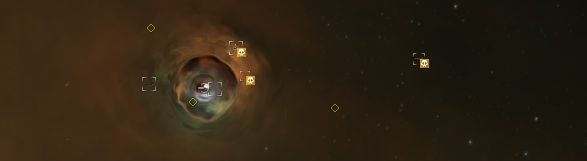
Seeing a Buzzard pop on d-scan

27th March 2010 – 3.24 pm

No one is around. I'll head out scanning in my Buzzard to the sounds of disco. The previously destabilised wormhole has disappeared, creating me a new one to find, which I manage easily enough. I jump through to the neighbouring system, punch the directional scanner, and warp to a planet. Oops, I forgot to bookmark the wormhole home. Oh well, at least it appears on the system map so I don't need to hunt for its signature. There is a Covetor, Iteron and Orca on d-scan too, but although they'll see my probes on d-scan when I look for the return wormhole I wouldn't have been able to find them without probes anyway. I may as well look for their tower first, to see if they are active.

Finding towers in w-space is relatively easy using d-scan. Towers need to be anchored to moons, and the angular resolution of d-scan can be narrowed finely enough to locate the right moon. Point d-scan at each planet in range until the tower is revealed, and warp to that planet. Then sweep around with a 60° resolution, reducing it to 30°, 15°, or lower, until the tower only shows on d-scan along with a single moon. That moon must be where the tower is anchored. Warping to the moon at range normally reveals some good information. In this case, all the ships on d-scan are inside the tower's shields. There is now a Harbinger battlecruiser visible too, and both it and the Orca are piloted. The Harbinger warps off and, as it disappears from d-scan and the system is relatively small, jumps out of the system. I'll start scanning.

I grab the wormhole home first, for safety, then a wider scan reveals the system to be almost empty. There are only two anomalies present and one further signature to resolve, which must be the system's static wormhole. I scan it down and jump through, remembering to bookmark both sides this time. The Harbinger is present in this system, as are a handful of probes. It seems unlikely that the battlecruiser is scanning, though. I drop some combat probes to try to find the uncloaked ship, and he soon exits the system again. I'm not sure what he was up to, but scanner probes are still present in the system. There must be a few of us in here. And now for some combat to break the monotony, but with the interface and not other ships.

The probe range bug bites me, I chase a signature around for no apparent reason, then my cloak drops for some reason without my noticing. The latter glitch is made worse by my sitting at range on the wormhole at the time I have no active cloak, as the Harbinger comes back through. He doesn't engage, and I get my cloak up within a few seconds, but I must look like a dreadful newbie. The Harbinger comes and goes, so I wonder if he's mining gas. I start looking for and bookmarking ladar sites, just in case, visiting each one to see if I can find him. I quite like that the ZAP signature is a ladar site with two Sleeper Sirius gun turrets installed, and am glad to be cloaked when I warp in. I visit half-a-dozen ladar sites without seeing the Harbinger before deciding to get combat probes out again to find the ship directly, as well as to gain some practice in using them.

I get an initial hit for the Harbinger using the combat probes, then he warps out and I wait until he returns before continuing the scan. Of course, this is when he decides he's finished whatever he's been doing and doesn't return. I recall the combat probes and swap back to scanner probes to look for wormholes. I keep an eye on d-scan anyway, in case the Harbinger returns and because it is good practice. I note the appearance of a Buzzard, and then a few seconds later an elite frigate wreck and Valkyrr's capsule, oops. I wonder what he bumped in to. My scanning reveals a low-sec exit to empire space, and a wormhole leading in to dangerous w-space, and that looks like it from here. I have spent long enough scanning that I shan't head deeper in to w-space for the moment, so I'll go back to the tower to watch a DVD instead.

On the way home I stop off at the neighbouring system's tower, where I find Valkyrr now sitting inside the shields in a Manticore stealth bomber. I pause for a minute, wondering how any enquiry would be received, before asking in the local channel what happened to his Buzzard. Unsurprisingly, I get no reply. The Manticore moves out of the tower's shields and cloaks, shortly followed by a colleague of his boarding a Nemesis stealth bomber and warping off. Something definitely ruffled their feathers, and it doesn't look like it was Sleepers judging by their choice of ship. Perhaps they will continue their day's adventure, I'll just head back home to our tower.

Scanning for and collapsing wormholes

26th March 2010 – 5.32 pm

There is no one around and no bookmarks in the can, so I'll take myself out scanning to see what adventures I can have today. My first adventure is in UI frustration, unfortunately. For convenience, I tend to interact with the virtual spheres of the probes not only to move them around but also to change their scanning ranges. By selecting an edge of the sphere and dragging, the range can be increased or decreased, and if the shift modifier key is held down the ranges change on all active probes instead of just the one. However, sometimes it doesn't work, it only looks like it does. All the spheres visibly change size but when I start the scan the images of all the probes except the one I actually dragged to effect the change pop back to their previous size. For some reason, the change in scan range doesn't work.

It is a simple matter to alter the scan ranges properly, but it takes several seconds for the scan to complete and then I generally have to run a second scan to get the result I initially wanted. The first scan becomes dead time, sitting waiting for a process to finish that I didn't want to start. I could check the ranges of each probe, listed in the scanning window, to ensure the change is reflected across all probes, or just change it directly from the scanning window, selecting multiple probes to change at once through a context menu, but both these options take additional time. Besides, if the scan ranges are not changed the graphics should reflect this and not display erroneous information. It is a minor glitch, but one that wastes my time in an interface that already has its flaws.

When my probe scan ranges are corrected I find our static wormhole quickly enough, jumping through to see a Scorpion, Abaddon, Drake and Rifter on the directional scanner. There are no Sleeper wrecks to be seen, and the system is small like ours—a single 16 AU probe encompasses the whole system—so there is no hiding on d-scan, the wrecks cannot be in a distant anomaly. The ships are either inside a tower's shields or roaming. A quick scan reveals two anomalies and two signatures, as well as the wormhole home, whilst d-scan now shows a Typhoon, Raven, Drake and two Abaddons, all Russians judging by their Cyrillic ship names. I locate the system's occupants' tower using d-scan, and warp to it to find an Abaddon and Drake in its shields, the other ships evidently elsewhere in the system. The Drake promptly warps off, but I don't know where to. And then they all disappear from d-scan, to return within a minute. I'm going to find out what's happening.

A quick scan finds a wormhole in the system. I warp to it, but bouncing off a planet first. As I start at their tower I don't want to drop out of warp on the same line as the other ships, even warping at range to the wormhole. Bumping in to another ship would drop my cloak and end badly for me. And there they are, sitting on the wormhole. They may not know about the wormhole connecting to our home system yet, and although it's flattering to think they are reacting to the appearance of my scanner probes it is more likely that they have been active for a while, in whatever they happen to be doing. Their jumping back and forth through the wormhole indicates that they are involved in more than visiting sites of specific Sleeper interest, but I see no explosions, only wormhole flares.

The wormhole collapses with another ship passing through it and associated flare. I could be wrong, but it looked like it collapsed when someone went through to the other side, not coming back in. Either way, the other ships warp away, no doubt thinking the job's a good 'un. I bounce off a planet back to their tower and, indeed, the ships are all present inside the shields. A Cheetah comes out and starts scanning, no doubt looking for the new static wormhole that has popped in to existence at the other's closure. They must surely find the entrance to our system now too, so it seems like a good time to run home. Then again, it's also a good time to find the new static wormhole myself and explore. The Russians aren't likely to spend all day collapsing wormholes.

I find the new static wormhole and jump through to a lower-class w-space system. I expect the Russians' Cheetah to be here too, and the presence of a good number of probes would indicate that it may not even be just the two of us. The system is occupied, no ships appearing on d-scan, and there are a dozen anomalies and eight signatures to resolve. I resolve a wormhole on my second attempt and find an exit to low-sec space, which is reaching the end of its life. A Helios covert operations boat jumps back from low-sec just as I drop out of warp, and warps off. I find another wormhole, which leads to dangerous w-space, and although I don't think I'll find another, after resolving a single gravimetric, magnetometric, and radar site each the last wormhole is located, also leading to dangerous w-space. There is no convenient exit and, particularly with busy intermediate systems, no good system to raid, so I head home.

Illustrious leader Fin turns up before I get back and I relay my scanning intelligence to her. We decide to destabilise our static wormhole to discourage any attempts to visit us. I make five round trips in a Scorpion battleship, then Fin takes over in an Orca industrial command ship. We collectively push the wormhole until it is 'on the verge of collapse', at which point its size shrinks dramatically, which is pretty neat. The wormhole is left in this highly precarious state, which I consider to be an effective way to prevent incursions. Collapsing the wormhole completely would only spawn another elsewhere in the system, and although it won't lead anywhere until we visit the wormhole we may as well wait to do so until we have a fleet capable of engaging what we may find. Leaving the wormhole on the verge of collapse prevents any sizable force from entering in the first place, and creates a significant risk that any ship jumping through may end up isolated. We return to the tower to relax safely.

Protecting our home w-space system

25th March 2010 – 8.28 pm

A pilot pipes up in local. 'Friends?', is his terse question. It is more common to use the mask of the anonymous w-space local channel to hide, so it is curious why this fellow announces himself. It is not curious enough to stop me warping to our exit wormhole in my Buzzard to explore the neighbouring system, if only because a more social colleague is around to pick up the conversation. But shortly after I have jumped through the wormhole I get an alert that our tower is under attack. I am told that the fellow uncloaked in his Nemesis stealth bomber and launched a bomb at us, apparently to wake us up. This is hardly friendly behaviour. I immediately warp back to the tower and swap ships, launching my Onyx heavy interdictor.

I don't like the way the HIC comes out of storage with only 17% shields, if only because it causes a delay before I can be ready for combat. I warp out of the tower to a safe spot whilst the shields recharge sufficiently, but not fully, so that I appear on the directional scanner but won't be found without scanning, hoping that my Onyx presents at least a minor deterrent. And when my shields are healthy I warp to the wormhole and sit on it. I am confident the HIC can survive much more than a bomb, and if our 'friend' wants to leave the system he will have to come through me. I doubt I will be able to stop him completely, but at least I can give him a little spanking.

There is also a non-corporation Cheetah in our home system, but again I'm not worried about a covert operations scanning boat and maybe I can make him panic a little about leaving. I note that combat scanning probes have been launched, though, which are used for finding ships rather than sites. My view is zoomed out considerably, the tactical overlay revealed, and I watch for incoming ships and wormhole flares whilst punching d-scan to look for changes in activity. In the meantime, I wonder aloud in the corporation channel if there is a second wormhole in the system. If there is, my efforts sitting on this wormhole may well be wasted, as well as keeping us ignorant of threats from another direction. My answer comes soon enough, albeit indirectly.

Another check of the directional scanner shows a Stiletto in the system. I have no idea what type of ship a Stiletto is but it sounds awfully pointy, and before I find out what it is the hard way I start the process to warp back to the safety of the corporation tower. As the Onyx aligns, I scroll down the results of the d-scan and see a Scorpion and two Raven battleships are also present in the same scan. My path crosses briefly with the Stiletto, him dropping out of warp just as I enter it, no time for him to get a lock and point on my ship to hold me for his battleship chums to blow up. We must have a second wormhole spewing aggressive ships in to our system.

I find out that the Stiletto is an interceptor, just the ship to scramble enemies for bigger ships to shoot, so my intuition and vigilant d-scanning pays off. Now we need to work out what to do. The second wormhole is found and reconnoitred, for at a minimum we want to find their tower and launch a bomb at it in revenge. I jump in to my Manticore stealth bomber and warp to the wormhole, getting in range for a bomb launch as our Buzzard jumps through to scout. Before the Buzzard can warp away from the wormhole the Nemesis reappears and launches a bomb her way, so she jumps back in to our home system to avoid it, returning to our tower. I'm not going anywhere.

My sights are firmly fixed on the wormhole. I know that all my allies are on this side of it, so any flare indicates hostile activity. I am not going to wait for identification before launching. And the wormhole flares. Before the flash of light from the jump through dies down, I have decloaked and launched my bomb, pushing my Manticore in to flight as soon as the bomb leaves its bay. The bomb explodes revealing a Cheetah, which I target and lock. I can see that the bomb has knocked down its shields and halved its armour, although it still flies, and it jumps back through the wormhole before I can launch a volley of torpedoes. I wonder if perhaps he saw the bomb but made the mistake of trying to jump back whilst his cloak was still holding, but at least I have forced him back to his system. It also shows we mean business.

A corporation Cheetah sees my Manticore bomb the hostile Cheetah and heads through the wormhole himself. I reposition myself and ask for anyone jumping either way to identify themselves first, as I have an itchy trigger finger tonight. Our Cheetah jumps through and warps away safely, as a friendly Drake drops down on top of the wormhole. The hostile Cheetah comes back, but I don't want to launch a bomb at our Drake, and for some reason the Cheetah warps almost instantly and without any chance of us being able to target it. Shortly afterwards, two hostile Drakes and a Jaguar assault ship jump and engage our Drake. Still not wanting to bomb colleagues I head back to the tower to swap back in to the Onyx, not knowing what else may be effective, and warp back to the wormhole.

Our Drake pilot has jumped through to the other system and is warping around trying to shake her tail. I urge her to come back, noting that the hulls of the hostile ships will be polarised, but she is worried that hers will be too. At least we can warp off to our tower, if we are not scrambled, the hostile ships are unlikely to have as reliable an escape route, and they'll have a HIC in their midst. She comes back, and the other ships don't follow. They may be concerned about polarisation effects, but personally I think their Cheetah is sitting at range from the wormhole monitoring our movements and relaying the intelligence. If they come back, it will be on their terms, and I don't see how we can flush out the spying Cheetah to stop the flow of information. We enter a stalemate.

Our small fleet warps back to the tower for a rest, a chance to settle our nerves a little. The Drake swings by the wormhole for one last look and encounters a Raven. She calls out to warp to her, as we should be able to take on the one battleship. Still being squad leader I warp the fleet to her location, but this turns out to be a mistake. The pilot of the Abaddon battleship hasn't finished refitting for the engagement and doesn't cancel the warp, and dropping in at zero range is the worst place for it to land. Meanwhile, either the hostile Cheetah or Raven has relayed the information back to the other system and more ships have jumped through to engage our Drake, drones chewing through its chunky shield. And we drop in to present a couple more juicy targets to what are now two Ravens, a Drake and a Jaguar.

The Drake is destroyed, the Abaddon shortly afterwards as it flails around in the vacuum far within the optimal range for its guns. The pods get away cleanly. Overpowered and under-gunned, I call to warp out, my remaining colleague and myself returning to the tower. The enemy Cheetah is seen to swoop in and loot our wrecks before jumping back in to its system, where the other ships already returned.

I made mistakes. For an engagement on a wormhole our tactics should have been entirely different. My Onyx HIC could not contribute effectively to such a fight where the main tactic was jumping through wormholes, and maybe I would have been better off sitting at long range in my Damnation field command ship, providing bonuses and covering missile fire. I should have been more aware of the range of ships in the fleet and not warped us all as one, instead letting each pilot warp to his optimal range. This was easily possible with both a wormhole and our Drake as a reference point. But we are still learning and with this experience we will do better next time. We always do. And at least we put up a fight!

The Joy Formidable at Electric Ballroom

25th March 2010 – 5.31 pm

Playing to London's Electric Ballroom in Camden it's The Joy Formidable's largest gig yet, and Ritzy is clearly thrilled to be here. But she is trying hard to hide her smile, keeping a cool demeanour for all the cameras pointing at her as the first song of the set comes thundering out of the speakers. The Greatest Light is the Greatest Shade is a blistering track to start with, and I am reminded just how much I enjoy live music, and music in general, when it can be this good.

Rhyds welcomes everyone to the gig and hopes we're all having a good time, which we are, before Ritzy introduces Cradle, suggesting that the set list hasn't changed a great deal over the months. But that's just fine, as albums don't tend to change their order and they get better with time too. And even if the set list hasn't changed, some songs have been rehearsed to be extended further, creating an amazingly evocative experience. The whole audience is energised, and where the support act could hardly get some hand-clapping enthusiasm going it comes spontaneously now. But then the support had the relatively limp band name Fun, whereas this is the rather more emphatic The Joy Formidable.

Austere and The Last Drop are played from A Balloon Called Moaning, but there are problems when it comes to Ostrich from the same EP, as Ritzy's guitar keeps cutting out during the song. 'Was anyone at our Garage gig?', she asks, recalling how it ended with her amp blowing up and needing to finish the final song sans guitar, 'this is round two'. Whilst Ritzy and the band's technician try to fix the problem with the pedals, wiring, or amplifier, Ritzy asks drummer Matt to 'play the 'something's fucked-up' interval music', which he cheerfully does, drumming along to the theme from Gremlins keyed in from his sampler. The problem with the guitar seems to be fixed, and we are treated to The Magnifying Glass and Anemone.

The fabulous Whirring is next, but the electrical problems clearly haven't been fixed, as the fuzzy guitar audibly cuts in and out unpredictably. Ritzy is understandably getting really frustrated and stops the song half-way through. Apologising, she calls for a five-minute break for them to fix the problem and to bear with them whilst they do. It's like an encore break between songs. And it looks like taking the time works, the wiring problem being resolved and The Joy Formidable return to play Whirring in its entirety. The band then treats us to a preview of their new single Popinjay, from their forthcoming debut album they finished recording only recently, and the new song is received well.

Greyhound in the Slips is played as an encore, after which Ritzy once again thanks us all for coming down and being patient with the guitar problems. Despite the frustrations, the band have had an excellent time at the Electric Ballroom, and so have I. The Joy Formidable make amazing music and are fabulous to see live. And they haven't quite finished, as they gives us While the Flies as a parting song. The exuberance of band and audience combine to encourage some crowd surfing, a few bodies being carried to the sadly sanitised gap between the audience and stage. But Ritzy doesn't need protecting from us. She jumps down from the stage, discards her guitar, and climbs in to the audience to crowd surf herself, before returning to the stage and finishing the song. This is what live music, and The Joy Formidable, is all about.

Ensuring a return to the home system

24th March 2010 – 5.46 pm

An unoccupied class 5 w-space system beckons our fleet to pillage it of profit, but sadly we don't have enough time to dedicate to the challenge. Instead, we'll plunder the neighbouring class 4 system, flying with an Ishtar heavy assault ship fitted for salvaging to speed along our progress. We warp to the adjoining wormhole and jump through. The system may be unoccupied but there are a few wormholes littered around carelessly, so the directional scanner needs to be monitored vigilantly. It would be careless to be ambushed by an evident threat.

The fleet warps in to a magnetometric site, containing Sleeper artefacts. Although it is a shame to see all the artefacts go to waste, we are only here to take advantage of the greater number of defenders the Sleepers employ to protect their secrets. More Sleeper ships means more loot and salvage, which means more profit. But to get all the ships appearing we need to analyse the contents of at least one of the artefacts, which sends a signal that causes further waves of Sleepers to warp in, and so a Guardian is refitted with an analyser module. And seeing the bounty that is gathered from the artefact convinces us that perhaps we should not let the other artefacts go to waste.

Combat is straightforward enough, even if the Sleepers warp in at long ranges in different directions. The Guardians need to ensure the battleship and HAC are kept within range for energy transfers and remote armour repairs, but there are no complications. The Ishtar pilot soon warps away on completion of the site to swap in to a specialist-fitted frigate to analyse the rest of the artefacts, the rest of us warp off to tackle the Sleepers in an anomaly in the meantime. Even missing a ship from our small fleet, the anomaly is dealt with smoothly. The only problem is that I find myself feeling wooly, which dulls my senses a little and can't be good for w-space adventures. Clearing this anomaly will be my last participation for the evening. The Ishtar pilot returns to help finish off the Sleepers and clear up by salvaging behind us, and we prepare to warp back home. But it seems that a pilot has become unexpectedly unavailable.

My Guardian gets targeted in the final wave of the anomaly and takes some armour damage that remains unrepaired. We survive easily enough against the one or two Sleepers that remain, but my companion Guardian going missing makes it difficult to bring her home again. It would be simple if we were in our own system, as the squad leader could warp the fleet back to the tower, but although we can lead the Guardian to a wormhole we cannot make it jump. With my unrepaired armour I realise the situation is amiss, so I cancel the fleet warp and collect the drones that the other Guardian hasn't been available to recall, then I shake the wool from my head and start thinking.

I jump back to our home system and warp to the tower, swapping in to a Buzzard covert operations boat and jumping back to the adrift Guardian. If the worst happens, I can stay in the system and scan our way out to empire space, which will let us be guided back in to our home system more easily. But even before then I ought to get the Guardian safe, as sitting AFK on a wormhole presents a bit too much of a target. I ask for and get promoted to squad leader, which with the Guardian still in the fleet lets me warp it away safely. I also make a couple of safe spots and take the Guardian to one of them, making us difficult to find. The other offers an escape route. I'm not sure how long I can wait, but at least we are relatively safe.

Luckily, the pilot returns before it gets too late and we are able to warp and jump back home without any further danger. Even if it is inconvenient, it is interesting to be presented with these logistic complications of w-space life and having to find the best solutions. It certainly keeps us active.

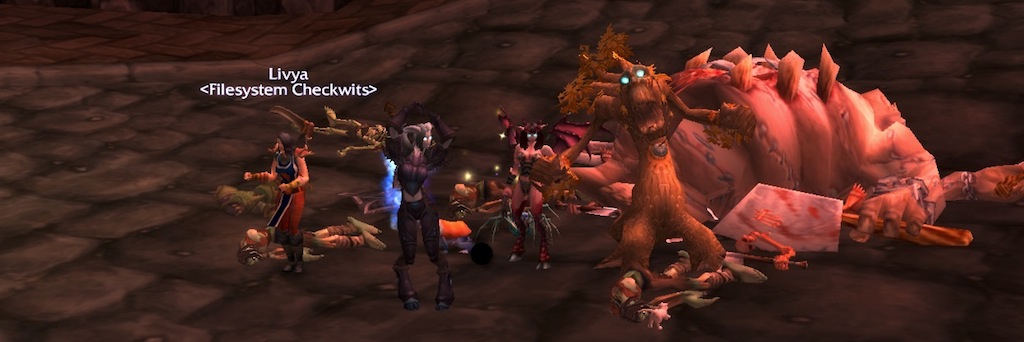
Filesystem Checkwits strike Stratholme

23rd March 2010 – 5.33 pm

With the key to Scholomance forged and ready to be used, it's the perfect time to visit Stratholme. A full evening of dungeon-delving seems suited to the more expansive Stratholme, its two effective 'halves' offering greater options within the one dungeon, although the multiple diversions to visit all of the many bosses in Scholomance may prove to be equally time-involving. But first I have to work out why I am riding in to Tirisfal Glades. It seems I remember that I need to get to a flight point in the Plaguelands and head north-west, but I get my east and west confused again and start in the Western Plaguelands when I wanted the eastern zone. My woeful navigation wouldn't be as embarrassing if I hadn't started almost on top of Light's Hope Chapel in the Eastern Plaguelands, where I need to ride from, having used my death gate to return me to Acherus. Luckily, I can re-use the death gate ability and start my journey again, admitting my mistake to no one.

The gates to Stratholme are easily found, once headed in the right direction, and the diminished Filesystem Checkwits assemble before venturing inside. The gates close behind us once we are in, preventing any easy exit, unlike just about every other dungeon. I remember when I first discovered Stratholme in the Plaguelands and poked my nose through the dungeon door to see what awaited me, only to find that, because the gates blocked the exit, my exploratory efforts were rewarded with my having to return to Stormwind by using my hearthstone. I can't remember if I could use the hearthstone immediately or had to wait for some of its then one-hour cool-down to expire. But at least I had it, even if returning to the Plaguelands meant a long and interrupted sequence of gryphon rides back north. Making dungeon entrances one-way is an interesting idea, but it makes unknown swirly portals less enticing to explore.

Our Argent Dawn commission trinkets are donned, allowing us to gather scourgestones for redundant faction reputation, and we start hacking through the early skeletons and zombies that infest the broken and burnt city of Stratholme. I also realise that my death knight's frost presence may be useful, the tanking presence granting increased armour and, more importantly, greater threat generation to enable me to hold the mobs' attentions. It's brilliant how the death knight's presences don't change the abilities available, only their relative effectiveness, even if most death knight mistakes come from tanking in blood presence or trying to DPS in frost. My demeanour becoming even more frosty helps focus the mobs on me and we start ploughing through the undead. We find Fras Siabi and try to buy some cigars from him for some Argent Dawn lackey, but Fras wants them to himself. Demonstrating how 'smoking kills', we slaughter him and take the cigars anyway.

I make an executive decision to tackle the undead side of Stratholme first, culminating with Baron Rivendare, now moonlighting between here and Naxxramas in Northrend like a surgeon putting in his hours with the NHS. The plan would work better if we don't go the wrong way, turning a corner to find the Scarlet Bastion. Oh well, let's introduce the Scarlet Crusade to the light whilst we're here. The courtyard is soon cleared—even with Livya continually being charged and knocked back twenty feet by the crimson guardsmen—heralding the appearance of Timmy the Cruel. Surely this is a different Timmy from the kid in Stormwind selling the white kitten. But it doesn't make sense that he wants to get rid of a cute white kitten, nor that he pretends there is only one but keeps coming back several hours apart. Timmy the Cruel and Timmy in Stormwind are one and the same, alternating between chewing on adventurers and threatening to throw cute kittens in to canals if no one buys them. What a bastard.

Once inside, the confined quarters of the Scarlet Bastion alternately makes fighting easier and more awkward, providing better-defined pulls and combat areas, whilst preventing us from seeing what lies around the corner and causing line-of-sight problems when the mobs flee to get help. At least the strictly linear path means we can't go astray, with only the single diversion to visit Cannon Master Willy, the boss who apparently creates a big enough impression that everyone remembers the fight with the cannons but not quite big enough to let people remember he's in the scarlet side of Stratholme. Not only did I long forget about Cannon Master Willey, Livya mentions how she had forgotten this is where he is, sharing the delusion I once had that he must be somewhere really well hidden in Scarlet Monastery. This makes me wonder how many others there are confused about the cannon master's location, which isn't helped by him lurking in an ante-chamber that can be avoided for a quicker run at the main boss. But we defeat Willey, taking the unconventional approach of ignoring loading and firing the cannons and engaging the reinforcements in melee combat instead.

The once-important strategy to defeat Cannon Master Willey is not the only fight that is grossly simplified by the powerful changes to class talent trees, caused by the twice-increased level cap and efforts to address overall class utility, as well as the general nerfing of all old content. The final boss of Stratholme's scarlet side, Balnazzar, feels little different than the similar fight with Arcanist Doan in the Scarlet Monastery's Library, and further fights in Stratholme, culminating with defeating Baron Rivendare himself, have all become straightforward to the point of blandness. Gone are the days of needing to know what special abilities and powers the bosses have, in what order to kill them and their minions, and how and when to avoid their biggest attacks. Healers can now heal all of the damage across the whole party without running out of mana, and the DPS drops the boss's health quicker than ever. Having to throw yourself at the boss a couple of times to learn how the encounter works can be frustrating, and raid encounters may take the idea of specific mechanics several steps too far, but I, for one, miss the days of needing a strategy and having to stick to it.

It seems that the only spanners the mobs can throw in to the works are the various controlling status effects that get piled on to characters, which only add levels of frustration. Being stunned, silenced and immobilised may well complicate encounters, but it does so by removing power from the character. Working your way up through dozens of levels to gain new abilities makes you feel more powerful as a character, which seems to be the whole point of a game involving progression, so it makes no sense to then remove these powers in an unsubtle attempt to prevent encounters becoming too easy. Spending most of the time in combat polymorphed in to a frog was not fun in Zul'Farrak, and spending half the time unable to do anything because I am stunned for five seconds several times a fight gets boring quickly in Stratholme. I am here to be active and heroic, not passive and ineffective. To counter this negativity, an interesting use of a status effects is when corpses spew toxic clouds that must be moved out of, requiring characters to be active and agile to avoid taking additional and maybe fatal damage, instead of preventing the character from taking action. More effects like this that require active participation, rather than needing a specific class to dispel the effects, or simply enduring them, would increase the level of enjoyment considerably.

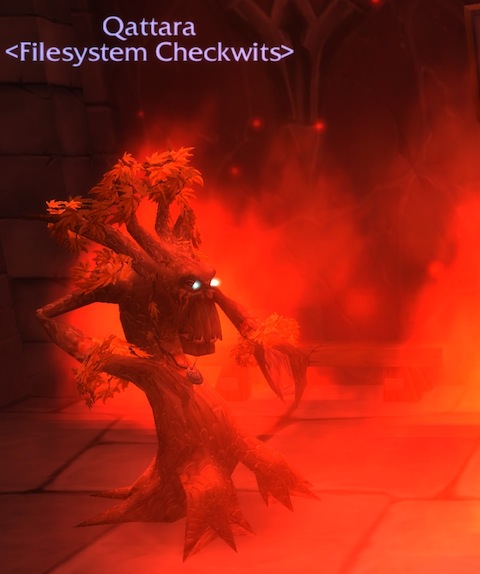
We defeat the archivist in the Scarlet Bastion, setting fire to his archive and, unfortunately, Qattara in tree-form, moving on to kill Balnazzar with no problems. Fighting our way back out of the Bastion, through the undead that have moved in now the Scarlet Crusade have been driven out, lets us get back to the undead side of the city. Magistrate Bathilas is encountered and we pluck the key to the city from his even deader corpse, although there is only one to share between us. Even though the key is needed for the 'keymaster' achievement, one is enough to open the rest of the gates to reach the Baron, as well as offering an escape route through the back door that can now be unlocked. Postmaster Malown is also summoned, after opening the previous postboxes and Livya repeatedly getting lynched by angry postmen, and the postmaster drops his trousers for us. It's not terribly impressive, and I instead pay a visit to the chapel where I hand in my medallion of faith to Aurius, a paladin inside who is willing to assist us in fighting Baron Rivendare. It looks like we accidentally adopted a more sensible strategy by completing the scarlet side first, where the medallion is found inside a chest.

Opening the gate to the undead side of Stratholme now has Baron Rivendare shouting a challenge to us, starting the forty-five minute timer to get to and defeat him before he kills an NPC, part of an old quest to gain the tier 0·5 class armour. We don't need the armour, but the timer sets us a target. There are undead creatures crawling, flying, and lurking everywhere to start with, although Livya's succubus is keen to set a good pace from the start, grabbing extra mobs to join the fight whenever possible. 'Don't blame my woman', says Livya, '...hey, what's she doing? She just ran off and aggroed everything!' Even in the openness the streets afford, the undead are so prevalent that it would be difficult to get a clean pull of a single group, but it is clear we can cope with two or more groups at a time anyway. Baroness Anastasi is the first of the undead bosses we encounter, guarding one of the three ziggurats needed to be disabled to open the way to Baron Rivendare himself. The Baroness is known to dominate party members, and it was once a valid strategy to use all powerful abilities with long cool-downs before or right at the start of the fight in order to prevent her from doing the same and hitting allies with our most powerful spells. But now it doesn't seem to matter. Livya is controlled, I hit the demonic spirit out of her, and the Baroness is defeated before she can control anyone else. Thirty-two minutes remaining.

The packed streets and my casual attitude to combat cause multiple groups to aggro on our way to the second ziggurat, and Livya's succubus runs off to help in her special way by grabbing even more mobs. It's fine, though, as it makes reaching Maleki the Pallid quicker. The boss of this ziggurat encases me in ice, but he is immune to my hungering cold and so doesn't feel the same chill in return, but as far as status effects go that one doesn't last quite so long as to be annoying. Livya continues to DPS and Qattara is available to heal, and Maleki is defeated. We pop inside the ziggurat to disable it by killing the cultists, and we move on with twenty-four minutes left on the clock. The third ziggurat is reached, and I pop off to get a drink as I am silenced, silenced, webbed, and silenced, reducing me to simple auto-attacks of my weapon, but only when I coincidentally happen to be in reach of the boss. The undead spider is brought down and the final ziggurat disabled with sixteen minutes left.

Through the final gate and many abominations await. Fought one-by-one before, making use of the timer between fights to heal and recover mana, I stride in to the courtyard and challenge the undead head-on, taking on two or three at a time, Qattara's tree-form druid powers easily healing through the additional damage. Rammstein the Gorger comes for us and is knocked down without ceremony, leaving six minutes to get to the Baron. A few more waves of undead minions are despatched before we can head in, and then we face Baron Rivendare. I don't know how many times I must run in to his room before I remember that the doors close the moment the Baron is engaged, but luckily Livya is already inside and hugging a wall and Qattara was alertly waiting and manages to dash in in time. Rivendare is attacked in the middle of the room, instead of being pulled to one side to spare the rest of the party from his aura that was once a serious continuous source of damage. But now the aura is trivial and with some enhanced AoE damage his occasional skeletal minions are also easily dealt with, the Stratholme holy water found inside crates within the city no longer a huge help for this final fight. Aurius comes to help, as promised, and even if he's not needed it is good to see the encounter played out fully.

Baron Rivendare is quickly defeated, within the forty-five minute target, and the Filesystem Checkwits get the achievement for Stratholme, having cleared both the scarlet and undead sides. Even if the bosses have been greatly weakened, Stratholme remains an appealing instance, with a wonderfully immersive location playing host to a variety of mobs. It is a shame that it is let down by now-defunct ideas of stacking annoying status effects, but picking a way through the burning streets crowded with undead of a fallen Alliance city is quite an experience, and makes me want to experience a classic class-raid through this dungeon again, in the same circumstances when it was once a real challenge. Even if it weren't a challenge today, it has been great to visit Stratholme.

In bloom

22nd March 2010 – 5.35 pm

Scanning of the neighbouring system is already complete. There are two towers set up, with a Cheetah covert operations boat, Arazu force recon ship, and Ishtar heavy assault ship visible in the shields. If the occupying capsuleers can leave those ships lying around they are capable of defending themselves, at least from a mostly carebear fleet. By the time we manage to rustle up enough pilots to hit a site of specific Sleeper interest the neighbouring system appears empty, the inhabitants maybe having gone to plunder a different system. But even if they simply fell asleep it is probably wise not to try to sneak in to steal their anomalies, in case the occupiers come back and take offence.

It is probably best today to stay in our own system, particularly as our combined fleet time is short. At least we have a few anomalies to investigate for Sleeper activity, and we head in to one of them. As the battleships close to engage the Sleepers, the secondary Guardian pilot and myself crawl along behind. Although it is only occasionally that our DPS boats get out of range of our heavily bonused systems, we still need to take care that it doesn't happen. And my companion Guardian pilot has worked out why our paired ship speeds are different, something that was confusing us recently. My armour rigging skill is slightly higher than his, negating the rig velocity drawback a little. That's a good catch, as we scratched our heads a bit comparing skills previously.

Sleeper combat is smooth enough. Sometimes we roll along like a well-oiled machine, although some grit gets in to the workings in other ways. Whilst the module activation glow works well in the murky inkiness of space, the contrasting glow highlighting which modules are currently activated most effectively, it is not quite as obvious when flying deep in the overly bright bloom of an anomaly. It may not matter too much to ships picking the primary target and shooting, but when the remote repair modules of the Guardian and ECM of the Scorpion need to be actively switched between targets it can make a difference. The bloom can easily swamp the module activation glow, making it difficult to tell which and how many identical modules are active or not.

I draw my viewpoint back tens of kilometres until the glow of the anomaly no longer interacts with the modules on my HUD, but doing so dissociates me from combat rather. It could be possible to include a separate border to each module, but I think I would prefer more dully lit pockets of space, as the sharp contrast between Sleeper anomalies and the rest of space is rather like staring at a sun. The brightness also upsets the impressive nature of ship explosions, masking the colours and smoke of the incandescent debris hurtling in multiple directions. I don't know how I am supposed to grab some good pictures if the whole vista is glowing white.

Whilst mentioning explosions, I think it would be neat if the final ship in any PvE site exploded more cinematically than the others. Little puffs of smoke here and there for frigates is fine and dandy, and battleship explosions can be big and satisfying, but the last ship could signal the end of the engagement with several chained explosions of increasing magnitude. It's the perfect time to be able to sit back in your pod and enjoy the fruits of your firepower. Having the last ship disappear in a puff of smoke that looks no more impressive than breathing out on a cold day is a little anticlimactic. At least I have some salvaging to do! It doesn't take long to loot and salvage the dozen or so wrecks, and we only have time for the one anomaly this evening. We return to the tower to rest for the night.

Penny the explorer

21st March 2010 – 3.58 pm

It seems like I am having to find a hundred ways of making scanning sound interesting. It must be interesting, otherwise I wouldn't be out in w-space spending many a quiet evening in a Buzzard trying to find wormholes. But I don't particularly look forwards to scanning, the interface often frustrating me one way or another, so I find myself wondering why I keep doing it. On reflection it seems that the answer is not that I enjoy scanning as such, but the exploration that comes from it.

Although there is financial gain to be made from resolving any of the Sleeper sites that can be found, whether mining rocks or gas, or destroying Sleeper ships for loot, I am generally looking for wormholes. My initial aim was to find a route back to the empire space of New Eden, maintaining a tenuous link with what passes for civilisation when unceremoniously dumped out near Amarr, and to take care of production or sales of my own little industrial efforts. But more recently I am leaving w-space less often, yet I still look for wormholes. It is possible that I simply lack the time to make use of an exit to empire space. But this lack of time is either shaping my motivations, or my true motivations are made clearer by having to focus my available time. I just want to explore as many systems as I can.

I start making a record of which systems are connected to our own, ostensibly to uncover any sign of a pattern that probably doesn't exist. But I have found keeping this record rather more appealing than I thought I would, keeping it updated with every jump that I make in to a new system. I check thoroughly whether I have visited this system before, on what date, whether the system is inhabited, and what activities I engage in whilst in the system. I really need to get this information stored electronically, particularly as it is continually growing, but that I am still interested in this little list after weeks of exploration is revealing.

I like to find out if a system is occupied and, if it is, where the tower has been anchored. I naturally then visit the tower to see its configuration and defences, and what ships are sitting inside its shields. The information I gather can be important, as it offers insight in to the relative threat of the system's inhabitants and whether they are currently active or AFK at their base. And it is clearly beneficial to know if the system is uninhabited, because then any sites can be plundered with less threat of being ambushed.

But just seeing how everything connects, which systems the wormholes are joining today, fascinates me, as does watching the capsuleers come and go, what ships they are in, which way they travel, how they react to seeing probes or ships in their system. And, of course, if they can be made targets. All this is possible because of the dynamic nature of w-space. Each day, a gateway will appear that is almost guaranteed to lead to a new system to explore. And, indeed, if the current wormhole leads to a dull system or one deemed too hostile it can be closed and a new one will appear that leads elsewhere, such is the nature of static connections. A new system to marvel at, different capsuleers to spy on and observe, new pathways and routes leading to different regions of New Eden.

Scanning is a necessary task, a means to an end. It isn't my favourite pastime, but it certainly enables me to see and explore many more new places and interesting sights than I ever imagined I would. And the nature of w-space that entails the ever-changing neighbourhood, and forcing capsuleers to live a relatively transparent life in the shields of towers instead of stations, provides a rich environment to indulge the explorer in me.

Stalking no one

20th March 2010 – 3.43 pm

Scan man mines gas, and lets me know that the wormhole signature is RYE. Mmm, rye. I find the wormhole quickly enough and jump through to J113456. Again, so close to harmony. The system is unoccupied and quite big, my probes having to be split to cover maybe a third of the system. My attention is grabbed by the GCU signature, wondering if I'll find a Banksian mass of artificial intelligence, but I just get gas. A wormhole follows more gas, but it is at the end of its natural lifetime and not worth risking jumping through. I keep scanning.

Gas, gas and more gas. I think CCP overestimates the amount of gas reserves any one capsuleer needs, or at least the motivation to mine it. A few more scans still doesn't get me a wormhole, but at least I find some rocks, which are somewhat more tangible than gas clouds and provides a change of signature to resolve. After six ladar and two gravimetric sites I finally get another wormhole, my intuition about likely wormhole signatures clearly failing me today, and I jump through to an occupied class 2 w-space system full of anomalies. This looks like a good place to clear sites, if enough capsuleers to make a fleet turn up. We may even be scary class 4 w-space system pilots to these class 2 inhabitants.

I find the tower in the system. There is a piloted Raven inside the shields, which shortly gets swapped for a shuttle and he warps off. That's a good indication that there is an exit to k-space nearby. I start my scanning and find three wormholes in quick succession. One leads to dangerous w-space, the second also continues in to w-space, the last is a low-sec exit. I don't check where the exit leads, as I doubt I'll be using it today. With only one unresolved signature left in the system I scan it to be thorough. Its initial strength is too low for it likely to be a wormhole, and the last signature unsurprisingly turns out to be a radar site. And with that I return to our tower to change in to my Manticore before coming back to loiter on the low-sec wormhole.

By the time I am back in the exit system the Raven is back at the occupier's tower. I shouldn't really mind, as I realise it would be a little extravagant to throw a million ISK bomb at a shuttle worth maybe ten thousand ISK. I quite like flying my Manticore, though, as it combines the stealthy and agile nature of the Buzzard with a deadly payload of bombs and torpedoes. There is still no one else around for a fleet to form, so I'll sit on the low-sec wormhole for a while and see who comes through. But how patient am I? The wormhole may lead to New Eden, but I still haven't had the good sense to see where it leads. If it throws me back out in to the deep low-sec of Aridia there may not be any travellers, and there are two other wormholes leading outwards of this system. One of them may lead to a high-sec exit to New Eden. If I am to be an effective stalker, I really need to be more thorough with my reconnaissance.

I ponder my options, sitting on the low-sec wormhole. Nothing comes through, and the directional scanner shows that the system remains undisturbed as a whole. Sometimes w-space can feel very quiet indeed. I take one last look at the tower in the system and, finding no activity and no ships, head home for the night. I've had another exploration adventure at least, and I certainly enjoy finding these new systems, towers, and wormholes.