Rook looks like a Sleeper

23rd December 2009 – 5.52 pm

We have a radar site to pillage, located in the class 4 w-space system. Radar sites have stronger opposition defending them than the simpler anomalies, and the higher the class of a system the defences get stronger again. Both of the twin Guardian logistic ships are available, which will help with the operation, but I doubt we'd even attempt the class 4 radar site without them. An anomaly in a class 3 system was potentially troubling enough with just the one Guardian.

The first wave of Sleeper ships isn't posing any problems, although they normally leave the big guns as their last line of defence. To help bolster our fleet's damage output, the drone bays of the Guardians are opened and drones launched to add their damage to the smaller Sleeper ships. I have been reluctant to use my drones so far whilst piloting the Guardian, partly because being responsible for keeping others intact is a new experience for me, and partly because of the possibility of the confusion that can arise from needing to target both hostile and friendly ships.

My concern is two-fold. First, I may inadvertently target a fleet member I am supposed to be repairing for a drone attack instead, which won't help his armour. Second, my remote reppers may end up on a Sleeper vessel, reconstructing their already immense armour that we are striving to break down. Both concerns can be assuaged by careful monitoring of my current target, and further mitigated by identifying my drone and repper module icons next to the locked ships. Drones can easily be recalled as a group, and individual reppers can helpfully be disengaged from the icon directly, rather than guessing which of the four active modules I need to power down.

Wrongful targeting can still occur, though, even when care is taken. Perhaps the module cycle time means it doesn't activate when you expect, and when you realise it still needs to be activated you don't also remember that you have since switched active targets. And sometimes the icons can just plain get mixed up, particularly when Sleepers are being blown up and new locks need to be acquired, the auto-selection of newly locked targets causing occasional confusion. Whatever the cause, accidental friendly fire happens. Having been on the receiving end a few times, it is normally a matter of pointing it out and the capsuleer correcting his target choice.

Knowing that fleet ships can be targeted accidentally in combat makes it rather tempting to poke someone's ship, perhaps because they get their weasels to gnaw on my Tech II BPCs, or scratch the paint on my beautiful Crane transport ship in a reckless fly-past. I think about 'accidentally' sending my drones on to Riyu's Rook, chipping a bit of the paint off his new purchase. Of course, he'll notice and say something, and everyone will know what really happened. But this kind of playful banter is what solidifies relationships, being confident that silly actions will be taken in good humour. You gently tease friends, not enemies, because you know you can get away with it.

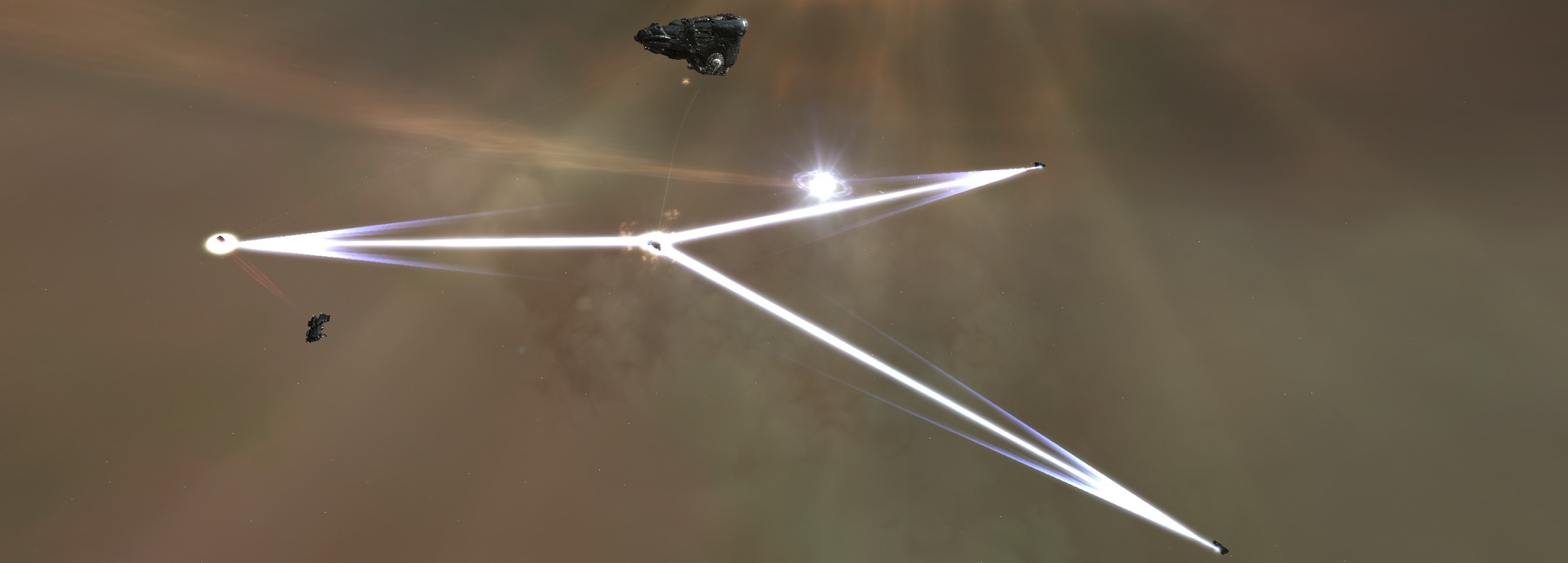
Whilst I am looking for the right moment to play my prank, the second wave of Sleepers arrive. A handful of Sleeper battleships and an entourage of cruisers warp in and decide that my Guardian is an affront to physicists in any galaxy, targeting my ship with most of their firepower. My shields disappear like Amarrians when it's their round, and the Sleepers start blasting the plates off my Guardian, missile barrages and laser sears close to ripping the ship apart. And then it stops. The Rook ECM boat has jammed three of the battleships and the incoming damage is now a trickle instead of a torrent.

Maybe he teases me a little, and maybe his Rook can test my Guardian's repping powers, but it is clear that Riyu's ECM can make a big difference to our fleet capability. What we don't get hit with I don't need to repair, which is even more welcome when the damage is taken off my ship. I'm not sure I can pretend to mix my targets up now, it doesn't feel right attacking him after he protects me, even if the protection wasn't specifically directed at me. But this feeling will pass, and there will be more opportunities to mistake him for a Sleeper, whereupon I'm sure hilarity will ensue.
Filesystem Checkwits upset Uldaman

22nd December 2009 – 5.38 pm

The Filesystem Checkwits defeat Uldaman! This must be the first time I have completed the dungeon at the right level. Of course, I have been here before, quite a few times. Back in the old days, when I was a young warlock, I needed to get in to Uldaman to train my enchanting profession, which was a considerable frustration. And even when I managed to convince people to help, we never pushed onwards to reach the end of the dungeon. My lingering impressions of Uldaman are the fifty foot tall boss Ironaya and wiping on hordes of dwarves. Even when I return years later, as achievements are introduced, my level-capped warrior is thwarted by the altar that requires three characters to activate it, and still I don't reach the end.

The altar to open the final section of Uldaman has now been modified to allow a single character to open it, the mobs outside the instance are no longer classed as elite, and the difficulty of the dungeon has been lowered to make it easier for players to complete. The changes are to make Uldaman, as other dungeons, more accessible. Getting a full five-man party at low levels is difficult in these fast-levelling times, although the new cross-server tools are perhaps breathing more life in to the forgotten dungeons. But even with these changes, Uldaman remains annoying, if only because the quest structure has not changed since conception.

Completing simple quest chains to get the quest that takes you in to Uldaman itself is a minor inconvenience, and can be completed separately from the group in readiness for the run. However, other quests picked up for Uldaman assume the old days of slow levelling and populations of mid-level characters willing to share an adventure for the challenge and chance of shiny loot. The initial quest asks for the character to enter Uldaman and perform a small task. Once that is achieved and relayed to the NPC, the character is requested to return to Uldaman for the next stage of the task, normally requiring a relatively deep expedition in to the dungeon.

Perhaps if all party members are synchronised on the quests it can be rewarding to share quest completions and achievements, all seeing the same goals. But for a weekly, casual group, heading back in to the same dungeon to overpower the same, weakened mobs is not enticing. I want to experience Azeroth as I gain levels, not face the grind before I've even reached the original, twice-supplanted level cap. Although Uldaman has plenty of areas to explore, a wealth of different mobs, and excellent atmosphere for a mid-level dungeon, as well as some needed plate armour loot drops, it ultimately fails when turning in the completed quests returns half as many asking you to do it all again. Simply put, the quest design has not been revamped in parallel with the levelling design. But at least we got through to the end once, experiencing all of Uldaman as a dungeon.

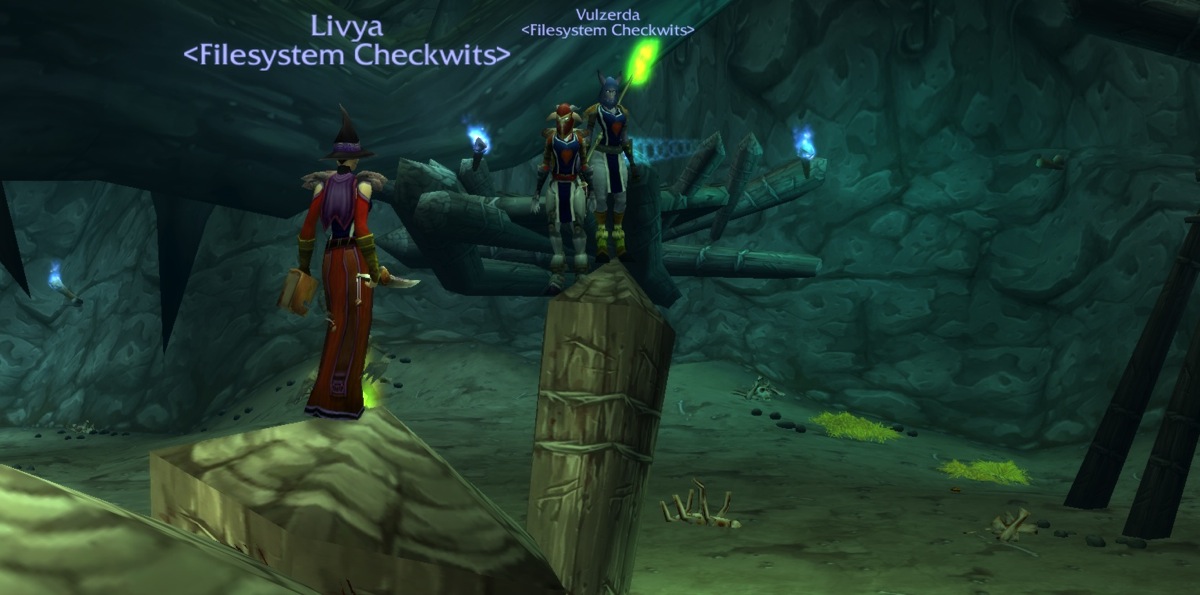
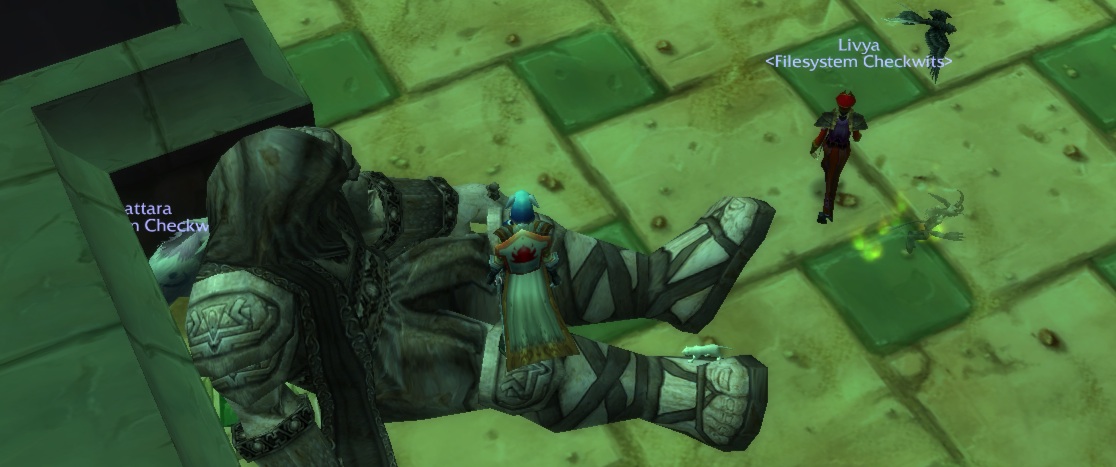
In true Filesystem Checkwit style, the run through Uldaman is not without a little melodrama. Shortly after entering the instance we find a dead statue, which is an odd description but I can't think of one more appropriate, and Livya and Qattara leap atop it. I am called back for a screen grab opportunity, away from my impetuous tanking nature of running ahead in to two groups of mobs. I'm not sure what exactly is supposed to be happening, but I capture the moment for posterity anyway. And then Qattara mentions that she is stuck, having tried to jump on to the statue's head and sailing over the top. Now she can't get out from behind it. I imagine Livya wasn't in the same danger, being too short to make the same jump. But it's good that Livya is so short this time, as the warlock holds the power to summon Qattara the necessary ten feet back in to the room. Our healer is rescued.

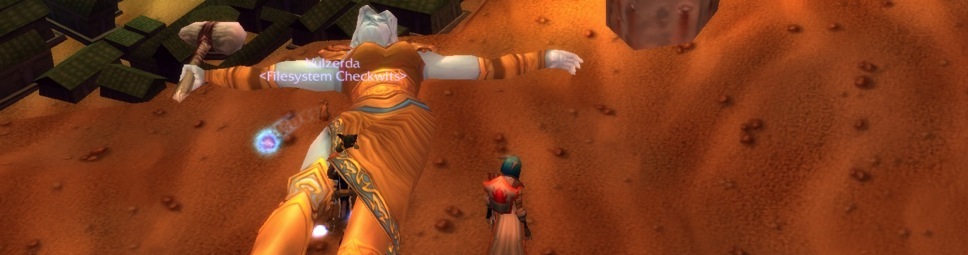
We clear our way to the minor trogg boss who drops a staff, which reminds me that we have to visit some dwarves in an antechamber to get the headpiece. The dwarves couldn't open the hidden chamber in the map room themselves, but that's because they misread the headpiece and their staff was too short. In the map room, with the real staff gained from the trogg boss, and us humming the theme to Raiders of the Lost Ark, a beam of light shoots to the chamber door from the carefully positioned staff in the map, causing the door to open. And out comes Ironaya, a towering iron lady whose main attack now is crushing anyone she falls on when easily defeated. To complete my quest, I dutifully enter the chamber whence she came. 'I have explored the hidden chamber. It's dark, kind of damp, and there may be some kind of fungus growing.'

'Okay, hold on', says Vulzerda, 'I'm coming in after you'.

I think Uldaman peaks too soon with the map room and its glorious recreation of the scene in Raiders of the Lost Ark. Whilst it encourages characters to return to experience the visuals again, and is close enough to the entrance not to be a chore to reach, the rest of the dungeon tends to blend together. I know I've mentioned that there are differently themed areas and is plenty to see, but blasting through scorpions, bats, dwarves, and golems doesn't hold quite the thrill of the map room. Even when we accidentally pull bosses along with a group of mobs, we simply treat it like a normal encounter, barely resting before moving on to the next corridor or chamber. It doesn't seem long before we reach the final chamber and face Archaedas, before defeating the epic quest text in the treasure room by clicking through pages of it in order to be awarded the completion.

We run out of Uldaman, retracing our steps rather than using hearthstones, so that we can hand in quests outside in the Badlands region rather than having to travel back here later from a city. Despite not being keen to return to the dungeon to further quest chains, we turn around and go back in, as Livya wasn't aware of the significance of the hidden chamber as part of a current quest. Getting back to the chamber should be easy enough with the dungeon cleared, we only need to run down a few corridors to the map room. Except the instance server rejects us a few times, and then when it lets us in we have a new instance, complete with full mob and boss spawns. So we talk to the dwarves again to get the headpiece, grab the staff again from the trogg with delusions of grandeur, and summon and defeat Ironaya again. And, with a quick poke in to the hidden chamber, we leave Uldaman behind us.

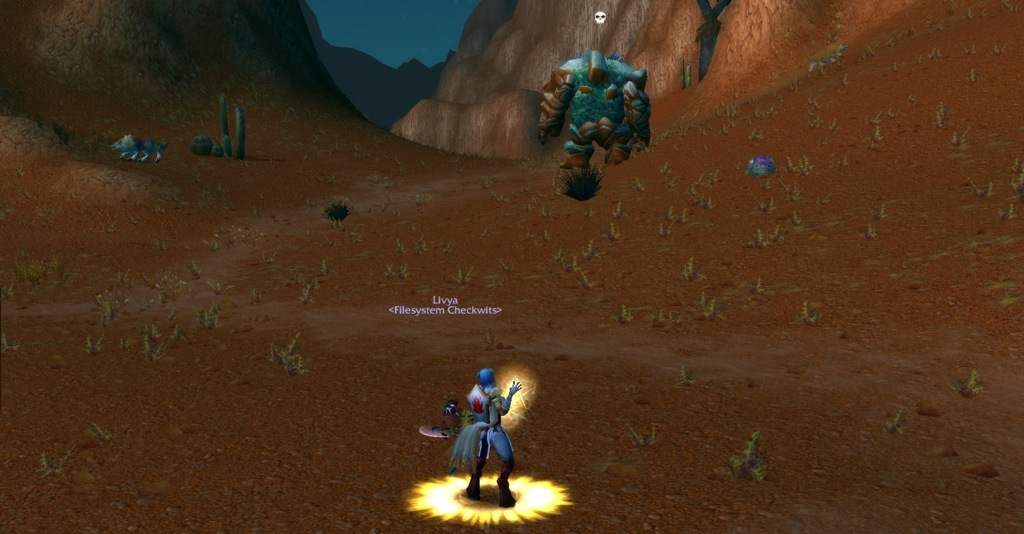
The run through Uldaman is surprisingly clean, so it stands to reason our confidence will lead to our downfall sooner or later. Sooner, as it turns out. In the run's aftermath of sorting out quests in Badlands, Livya spies rare mob wandering around. Being a 45th level giant, Anathemus is a few levels above us still. Livya calls for assistance, both to make the kill easier and to share in the superior loot the rare mobs generally drop, and I take my new, swift charger for a ride across the region. Anathemus is shown as a rare mob, but not elite, so he should be straightforward to defeat with two of us near his level. I enter the fray.

As my rapidly dropping health and Anathemus's solid green bar highlights, he probably is elite as well as rare. Once he stomps me solidly in to the red dirt, Anathemus turns to Livya, who is trying to take care of some of the local ogres who are happy to join in the fight. 'The problem is that we're using the martial arts technique', Livya's twitching corpse gurgles, 'of throwing ourselves at him one at a time'.

Yeah, that's it, run away, you big coward. Quests are handed in, levels gained, new ranks of spells learnt, and our next target is picked. As Uldaman has been downgraded somewhat, our next adventure is a little uncertain, as there is a bit of a gap in levels between us and the next dungeons. With a bit more questing in Azeroth and another couple of levels, we should be able to attempt either Zul'Farrak, and its own interminable quest chains, or Maraudon, after which our path is clear towards Sunken Temple and the monstrous Blackrock Depths. Fun times ahead!

The Joy Formidable at Camden Barfly

22nd December 2009 – 3.24 pm

I don't much care for the current trend of 'branding' venues, and I won't refer to a venue by including its ephemeral brand. But Sailor Jerry Rum is not merely adding its name to an event, it is throwing a series of Christmas parties. Each gig, including tonight's with The Joy Formidable, has free admission, a free drink offered for everyone, and a free miniature bottle of Sailor Jerry Rum given to all on the way out. I'm not paying to be advertised to, a company is showing some Christmas goodwill, and I certainly appreciate it.

London has been hit by snow. Although it is hardly blizzard conditions, getting on average only one snowfall a year means that our infrastructure has little opportunity or real need to acclimatise to it. An inch or two of snow can cause considerable problems for our public transport systems. But even if there is some inconvenience in travelling in to Camden for tonight's gig, The Joy Formidable have returned from the playing gigs on the continent to be here, passing through a couple of countries and crossing the Channel overnight. That they are working on almost no sleep for the past couple of days doesn't show when they get on stage, being as vigorous and electrifying as ever.

The set opens with the amazing While the Flies, and immediately it is obvious how important The Joy Formidable are. Although some songs from the band's mini LP A Balloon Called Moaning are played mostly unchanged, The Joy Formidable play to the expectation of a savvy audience. Songs are extended, modified when played for an enthralled crowd, never letting attentions drift in to automatic mode. The studio versions of the songs are shorter, punchier, perfect for home listening, and the live performance rewards an assembled audience by offering a measured extended version, just enough to add extra effect without devaluing the recordings. The Joy Formidable realise the art of performance.

The set list for tonight's gig is not much changed from when The Joy Formidable play the Garage, which doesn't come as a surprise considering they have not stopped touring since then. The order of songs has changed a little, though, with While the Flies opening instead of closing, after which the set quickly moves through Cradle and The Last Drop to Austere. That's not to say The Joy Formidable are simply bashing out some songs. Each one is played with passion and verve, with the audience right there in the moment, even starting the vocal calls before the band on Austere, as soon as they recognise the song.

Ritzy thanks everyone for making it through the adverse weather conditions to be at tonight's gig, adding that 'if you can't get home, maybe we'll just have a lock-in here', before finishing with a huge version of Whirring. The guitars are left in front of the amps, producing booming feedback that only dissipates when The Joy Formidable return to the stage for an encore. 'As we're snowed in, we'll play one more song.' With the feedback now gone, Ritzy realises that 'we're loud tonight. Are the people at the front okay? I hope you don't get tinnitus', although it would be 'an early Christmas present' from the band. It's loud, but it's beautiful. The Joy Formidable end the evening and their last gig of the year with the amazing The Greatest Light is the Greatest Shade, further justifying their place as my favourite new band.

Testing tower defences

21st December 2009 – 5.41 pm

An exit wormhole collapses behind our engineers. They have ventured back to New Eden to get fuel for our tower. It's not a problem, our scanner man jumps in to his Cheetah covert operations boat to find a new wormhole through which the refuellers can return. It doesn't take our expert much time to reconnoitre the connecting w-space system, finding a corporation's tower, a Manticore, and a mining Hulk. The new exit back to known space is also found and leads to high-sec, reducing the refuelling run to a matter of logistics.

'Shall I tell him it's okay to keep mining?' Our scanner doesn't want to spook the pilot of the Hulk, as we're only interested in using the neighbouring system as a thoroughfare. Because our Cheetah may have been spotted, and the scan probes used certainly must have been if the miner is paying enough attention, it's better to open peaceful negotiations than leave the locals no option but to adopt a more aggressive posture. Of course, they don't have to believe our stated intentions, and pointing out that haulers will be passing through soon could have negative consequences for us, but as hiding is much easier in w-space than elsewhere, being open at least makes us look trustworthy.

It all becomes moot soon enough. 'I just did something dumb.' We tend to do dumb things fairly often, so more clarification is requested. 'Dumb enough to rival Riyu. I warped to their tower, but wasn't cloaked.' Okay, yes, that's not the smartest manoeuvre, as tower defences tend to be quite powerful and cov-ops ships quite flimsy.

'Looking on the positive side', I point out, 'at least the Hulk pilot probably now realises it's safe to keep mining.' It would be quite a ruse to throw an expensive ship at a tower as a sacrificial lure just to snare an exhumer. Our inexperience is revealed once again, although we grow stronger with each mistake. Today we learn to ensure the cloaking device is engaged before getting in range of a hostile POS.

The engineer's pod returns unscathed to our system and tower, promptly leaving again to go shopping in high-sec. At least he finds the exit before exploding. Unfortunately, he makes the mistake of asking too soon to the loss of his ship for a name he can give to his new Cheetah. Suggestions of 'Cloak plz', 'POS Fodder', and 'Structurally Unsound' are not likely to be announced when the bottle of champagne smashes across the ship's bow, however appropriate they may seem.

Going deeper in to w-space

20th December 2009 – 3.34 pm

The man with the scanner finds an opportunity. A wormhole leads to a class 4 w-space system that itself holds a static wormhole to another class 4 system. Having access to a wormhole that leads to an arbitrary class 4 w-space system is a big improvement from our current situation, living in a class 4 with a static wormhole to a class 3. We currently clear the anomalies and other signatures in our class 4 system quickly, and then we are left with either class 3 anomalies or a longer journey through multiple systems to find something better. Moving in to the system newly opened to us will give us constant potential access to class 4 signatures, and the challenges and profit that comes with them.

Moving from one w-space system to another can be awkward. We need as many people available as possible, not so much to move ships and equipment but to ensure that no one is left behind. Returning to your pod to the discovery that the corporation tower is no longer anchored in the system will come as a bit of a shock, particularly if you are in a ship that has no capability of scanning for an exit. Luckily, we have nearly every wormhole engineer on-line and ready to help with the move, and a scanning alt is volunteered to remain in the system to help the one or two stragglers.

All of the arrays, batteries, and other defences need to be taken off-line and unanchored from the tower. The corporation hangar needs to be emptied and have its contents moved. The ship maintenance array needs to be emptied, the ships moved, and the array and hangar repackaged and taken to the new system. And the tower itself needs to be taken off-line, unanchored, and moved. We have a second tower lying around, which helps with getting everything transferred, as this second tower is anchored and brought on-line in the new system whilst the first tower is being torn down. Moving ships and modules is easier when a coporation hangar can be anchored at the other end of the move, and there are tower shields offering protection to unpiloted ships.

The move almost forces us to take loot back to New Eden, as it seems rather a waste of effort to drag Sleeper salvage and loot, and tonnes of ore, to the new system for it to be put back in to a hangar. And whilst the loot is shipped out, the hauler may as well pick up some fuel on the way back to keep the new tower running for a while. The trip back to k-space is complicated a little by the wormhole exit leading to low-sec, but a suitable protective fleet is formed. The man-power is better suited to protecting our assets, as moving equipment to the new system is hardly intensive, and a few of us manage to transfer the modules with a Crane and Bustard, whilst also having the skills needed to pilot most of the ships across.

It takes a little while, but we move ourselves in to the new w-space system with little fuss. The connecting wormhole holds up to the mass passing through it, the low-sec journey isn't interrupted by pirates, and the capsuleers unfortunately left behind in the old system are eventually guided out by the scanning alt. We even start to refill the hangar, although it is with rather unprofitable gas. But Fin's mining of the ladar site lets me get the first wormhole engineer Sleeper kill in our new system, as I protect her Exqueror from the Sleeper rats that inevitably arrive. I think we're going to settle in fine.

Multitasking and elite core targeting

19th December 2009 – 3.59 pm

Back when the certificate system is first introduced to capsuleers in New Eden, I wonder why the multitasking skill is required for certification in core targeting, particularly at only the standard level. As much as I would like to lock on to a dozen targets, all ships have a hard limit to the number of targets they can lock. None of my current ships can lock more than six, so training multitasking to the first level, to be able to lock eight targets, seems redundant. Then I realise that my Drake battlecruiser can actually lock eight targets, and I keep my grumbles quiet whilst training the multitasking skill.

Getting the multitasking skill to level three won't take long, less than a day, but it seems a waste of time, even if it grants the elite core targeting certificate. I could fit a module that allows my ship to lock more targets, but that would be at the sacrifice of DPS or tank, and PvE combat is straightforward enough that locking eight targets in the Drake is a more of a convenience than necessity. With missiles launched at one target and drones on another, and my next targets locked and ready once the current ones are destroyed, I only really need to have four targets locked at any one time. Having more targets locked simply serves to make target selection easier.

Now I have my Guardian. The logistics ship has the integral capability of locking ten targets simultaneously. But the wormhole engineer fleets are small, and whilst I am only repairing I don't need to lock on to any ships apart from the fleet, using up around half of the targeting capability. This serves me well whilst I am getting used to managing my reppers and transfer arrays across the ships. When I am comfortable with repping, I have my drones to consider. The drones perhaps don't add much to the overall DPS of the fleet, but they still add damge, and are quite useful against frigates. To deploy the drones I need to target hostile ships, which uses up my targeting capability quickly when combined with needing to keep the fleet targeted. My targeting capability, but not the Guardian's.

Having a legitimate need and a spare day, it is time to train multitasking up to level three. I may be rewarded the elite core targeting certificate, but that is secondary to being able to use the systems of the Guardian logistic ship more effectively. I need to keep training other support skills to the same end.

Slow Club at Union Chapel

18th December 2009 – 5.49 pm

I arrive early for tonight's Slow Club gig. The promoters didn't send tickets to the agencies in time, so I want to leave enough time to pick up the tickets on the door. The gig is in the Union Chapel and has unreserved pew seating, so getting early should let me get a decent seat without much fuss. And my planning works out, gaining admittance easily enough and finding a pew near the front with a decent view of the stage. Being able to sit down makes waiting a couple of hours for the headlining band more comfortable, and I also get to hear the support acts. The only problem is that the second support act is Cate Le Bon. Seeing her once was academically interesting, twice was enough to form a firm opinion, a third time is too much. I can't sit through the dreary droning again, so I plug in my headphones and crank up the volume of my iPod for thirty minutes.

There are three support acts tonight, one of which I catch only three songs from, one I ignore as best I can, and the other can't decide if he's a musician or stand-up. He's a pretty good musician, so it's a shame he doesn't stick to that. I end up really quite bored before Slow Club turn up, giving them an unfair struggle to perk me up again. But they manage it with ease, welcoming us to the chapel with a harmonious duet over an organ before launching a more traditional set. Or, at least, they would continue, but Charles tells us that 'Becky has forgotten her sticks'. As Rebecca dashes off the stage to get her drum sticks, Charles remains somewhat amused by their 'great start'. Once Rebecca returns, the pair get in to full swing with the excellent Trophy Room.

The Union Chapel is full to the brim, and it doesn't go unmentioned. 'There's loads of you', Rebecca says, noting that the gig has 'actually sold out, we don't have to pretend'. She is overwhelmed by the response Slow Club are getting, even if all the fans know it is deserved. We are told that the band are going to play some songs from the album, some new songs, and then some Christmas songs. Album tracks include There is no Good Way to Say I'm Leaving, I Was Unconscious, it Was a Dream, and It Doesn't Have to be Beautiful. There is a slight hiccup when Rebecca realises that they haven't played Because We're Dead for a while, and she and Charles need to briefly remind themselves how it starts before playing it as wonderfully as the rest of the set list.

'We're going to go off stage now', says Rebecca, 'and when we come back in a minute or so it may be 25th December'. But before they go, Charles and Rebecca unplug themselves and come to the front of the stage. There is a slight delay, as Rebecca is a little upset to notice the 'Slow Club' design on the front of the kick drum has peeled off, and she pushes it back in to place. The duo then play a purely acoustic number, taking advantage of the fabulous chapel venue and the polite quiet of the audience. The leave to a huge round of applause, returning with a string accompaniment and the drum and bass player they've used a couple of times already during the set.

For the encore, Slow Club play a few Christmas songs from their Christmas EP. The first song has them accompanied by the extra musicians and strings, but then it's back down to just Charles and Rebecca. Wondering about the lateness and the licencing laws, Rebecca asks if they are good for time, only to stop mid-way through the next song. A thump is heard and she wonders if the cops are about to storm the chapel, to Charles's alarm, but she's just teasing and picks up right where she left off a few seconds later. As a finale, all the musicians return to stage, including the three support acts, and Rebecca calls for everyone in the audience to stand and bop along to a final Christmas song. It's wonderfully uplifting and merry, and Slow Club gives the gift of festive cheer to everyone lucky enough to be at the Union Chapel this evening.

On salvaging

17th December 2009 – 5.55 pm

Several times now I have been volunteered for salvaging duty in w-space, looting and clearing up the wrecks from the sites of specific Sleeper interest we visit. I could try to claim that my focussed skill training has made me best suited to salvaging, but being volunteered more suggests that salvaging is seen as a less glamorous task than the testosterone-fuelled destruction that produces the wrecks. And salvaging is much more of a necessity in w-space than k-space, as Sleepers have no bounties placed on them; the only profit is from loot and salvaged electronics. It is good, in that case, that I really enjoy flying a destroyer around a wreck-strewn site and cleaning up.

In my early days as a capsuleer, I learn about the tactical overlay, using it to visually determine ranges to hostile ships in relation to my targeting range and the effective range of various modules. Over time, as my experience and skill training improves, combat becomes rather static. Unless there is a specific object I need to approach, my systems can target and hit almost any ship in the battlespace, after which they generally approach me at speed anyway. The tactical overlay remains useful for its visual display of a three-dimensional area on a two-dimensional display, keeping my sense of aesthetics happy. But unless there are multiple separate groups of hostile ships, I could just as simply use the overview and pick targets at will.

Efficient salvaging of more than a handful of wrecks, on the other hand, relies on good use of the tactical overlay, and I strive for greater efficiency in tasks. The basic method of salvaging is to fit salvager modules and tractor beams, locking on to wrecks and tractoring them in to range of the salvagers. But although the hostile ships may all be in range of your weapons, their eventual wrecks can end up tens of kilometres apart, as combat occurs in an arc subtended from your fleet's position. Even NPC ships aren't strategically ignorant enough to cluster within 5 km of each other, putting them outside the range of salvaging modules, and beyond level two missions many wrecks will be mutually out of the 20 km range of tractor beams. An efficient path needs to be found to visit all the wrecks, to at least within 20 km, and this is where it starts to get interesting.

Before I leave the site to swap in to a salvaging destroyer, I make a bookmark. It is likely, particularly in w-space, that I will already have a bookmark to the site, but an arbitrary point in space is not what I am after. With the tactical overlay on and zoomed out sufficiently, I rotate my view to find a suitable wreck to bookmark. I am not looking for a wreck central to the site, but rather a wreck that is central to the periphery of all wrecks, one from which my tractor beams will reach an optimal number of wrecks without my ship having to manoeuvre. Then I warp out to get the destroyer, returning to clean up.

Salvaging is not only about getting salvaged components, but also looting modules and other interesting items not destroyed in combat. This adds a further complication, because although the salvagers operate out to 5 km a wreck can only be looted when it is within 2·5 km of your ship. Not only that, but if a wreck is salvaged without the loot being taken, the loot is preserved by being jettisoned in a canister. As the jet-can is a separate entity and your ship initially targets the wreck, you need to re-attain lock if the canister is not within the looting distance or your ship is moving. This takes extra time and binds one of the targeting slots of your ship, which has a limited number, making it important to ensure the loot is removed from a wreck before the wreck is salvaged successfully. But you don't want to loot the wreck before starting the salvager module's ten second period, as that wastes time. A balance must be found, again striving for efficiency.

My return to the site in the salvager will place me almost on top of the bookmarked wreck, and I start locking on to targets. The initial selection only needs to ensure that all my targets are within 20 km, and that one of the wrecks is the bookmarked one. I will be close enough to the bookmarked wreck to let me loot without needing to tractor it, letting me use all the tractor beams to start pulling other wrecks in to optimal range. Now I need to strike another balance, a more dynamic one that ensures the salvagers are being put to optimal use. With the tractor beams operating at four times the range of the salvager modules, there is time spent pulling the wrecks when the salvagers cannot be used on those wrecks. However, once wrecks start coming in to range of the salvagers, which begins with the initial bookmarked wreck, I can gauge how many salvagers to dedicate to each wreck. This is not entirely straightforward.

The salvaging process is not guaranteed. After the ten second activation period, there is a chance that a salvager module will extract any available components. The odds of a successful cycle depend on the size of the wreck, the skills of the capsuleer, and any fitted salvaging rigs on the ship. Any number of salvagers can be trained on any one wreck, increasing the chances of a successful cycle by quantity, but it also increases the chances of a wasted successful cycle that could have been used on a different wreck. The task here is optimise the activation of salvagers on wrecks, such that all salvagers are being used on the maximum number of wrecks in salvaging range, which needs to take in to account the number of wrecks within salvaging range, the number of salvager modules available, and the speed with which further wrecks are being pulled in to range by tractor beams.

Personally, I don't want to see more than one salvager module being used on a single wreck when another wreck is sitting within range and without a salvager working on it, because if each salvager happens to be successful on that cycle, one of those cycles will be wasted. A wreck can only be salvaged once. And once a wreck is salvaged the debris disintegrates, freeing up another target lock, salvager module and probably a tractor beam too. So whilst modules are being pulled from wrecks and salvagers are being managed, new targets also need to be selected, locked and queued for tractoring, maintaining the maximum number of locked targets when possible, and preferably ensuring that targets opposite the projected course are pulled in for salvaging first. And I am already plotting a course.

Once all the wrecks within initial tractor beam range have been picked up, it is time to pilot along the plotted course. With four salvagers and four tractor beams, I can start moving once I have the last four wrecks within 20 km engaged by tractor beams, as I can tow as many wrecks as I can salvage. The added speed of the ship increases the complexity a little, as tractor beams pull objects at 500 m/s, so a destroyer moving at approximately half that speed will create different velocity vectors for each wreck, with those behind the ship taking longer to get in to range, and those in front approaching more quickly. The target of the ship's movement also needs to be taken in to consideration. Selecting the next closest target to move to may seem more efficient, but once the ship reaches that wreck it will slow down and stop, which will not be where the wreck initially sits once the pull of the tractor beam is taken in to account. Either a more distant yet equally convenient wreck needs to be selected, to ensure ship movement continues fully in to the next cluster of wrecks, or the selected wreck is not pulled by a tractor beam, instead pulling the wrecks around it and letting the ship naturally come to a stop next to the selected wreck.

Eventually, the clusters or wrecks will clear, leaving perhaps a few scattered wrecks still to salvage. These can be reached quickly by making use of a micro-warp drive. Again, the use of the MWD needs to be balanced. Rather than waiting for all wrecks to be salvaged before moving on, use of the tractor beams can drag wrecks along with the ship. At normal ship speeds, this is fine. But with the MWD active, a destroyer can reach speeds well in excess of the 500 m/s pull of the tractor beam, where the differential will soon move the ship further away from the wreck than the operating range of the salvager module and, eventually, the tractor beam. The speed of the ship can either be maintained to keep the wreck within salvaging range, or set to full speed to reach outlying wrecks more quickly. I prefer keeping wrecks close, as more salvager modules can be dedicated to each remaining wreck as others are salvaged themselves, speeding up the salvaging process. As soon as all towed wrecks are salvaged, full ship speed can be set to the farthest wrecks.

Once the final wrecks are salvaged, the task is complete. I head on to the next site to clear, or back to the tower or station to drop off the loot. There are also methods to optimise the salvaging process when there is more loot than can fit in the ship's hold. Of course, it is possible and adequate to salvage far more simply, but it is precisely the complexity of the strive for efficiency that appeals to me. I take in to account the ranges of separate modules, absolute and relative ship velocities, cycle times of salvagers compared to reaction times of looting wrecks, the relative position of wrecks to my ship and to each other, and try to optimise all the factors to speed through the process. To me, salvaging is normally more of a combat exercise than actual combat.

Relying on one Guardian

16th December 2009 – 5.46 pm

I take the Guardian out to face Sleepers again, this time without its twin. Although two Guardians combine the ship's synergies to become significantly more effective to the point of being overpowered—and this extra power really ought to be illustrated by the ships physically connecting to become a giant flying robot—a single Guardian should still be an effective support ship. I will need to mutually transfer capacitor energy between a second ship, as I rely on an external source of energy to run all the repair systems, and a fleet member's Dominix re-fits to accommodate my lone Guardian. He also fits a remote armour repair system in case I get targeted by the Sleepers, as I have no means to repair my own ship.

We jump through a wormhole to a neighbouring class three w-space system, where there are anomalies and more to plunder. A single Drake appears on the directional scanner, but with our small fleet we feel suitably unthreatened. An anomaly is chosen first, as the lone Guardian as sole repairer is still an unknown factor and anomalies are the simplest of Sleeper sites to encounter. Warping in, I lock on to the other fleet members, get the mutual energy transfer running between myself and the Dominix, and start monitoring for incoming fleet damage. It turns out that it's not difficult to trace the Sleeper fire when I am the primary target.

My poor Guardian becomes the primary target of the Sleepers a few times, being battered by barrages of blows. I think if I could intercept the Sleeper communication channels it may be possible to decode their language by using as a key the phrase 'in this galaxy, we obey the laws of thermodynamics'. Either that, or my complement of reppers really agitates the Sleepers. Thankfully, the Dominix is capable of repairing my armour, letting itself or the Harbinger attract the attention of the Sleepers once more. I am not sure my Caldari heritage will ever let me get used to one of my ship's shields turning completely red so quickly, though.

The anomaly is cleared fairly easily, and we move on to a radar site, with more aggressive Sleeper defences. In-between getting buffetted by Sleeper fire, I need to keep the fleet running. Repping the Dominix isn't too difficult, but the damage-optimised Harbinger requires the full output of staggered remote repair modules occasionally, as well a regular injection of energy to keep the micro-warp drive from draining its capacitor. I have an awful lot to manage, but it's curious that I don't have to worry about my own status, relinquishing an uncomfortable amount of control to my fleet in ensuring my systems and armour integrities are maintained. I suppose the situation is equivalent for the DPS ship pilots, relying entirely on my reppers to keep them from being exposed to vacuum.

When the final two Sleeper battleships pick on the Harbinger they hit for an awful lot of damage, and between my switching of targets and the delay of the repair module cycle times finishing and restarting, a tiny amount of damage is inflicted on the Harbinger's hull. The capsuleer complains that he 'almost died', which I think is a little dramatic, but it highlights how much we are relying on each other. No one in the fleet has a ship fitted to be self-sufficient. That we co-ordinate our effort to defeat Sleeper encounters shows how effective we have become as a group. Personally, I am pleased that the flimsy-looking Guardian can withstand simultaneous Sleeper attacks, with a good wingman.

Escape from Razorfen Downs

15th December 2009 – 5.31 pm

It's back to the Horde continent of Kalimdor and the dry heat of the Barrens for the Filesystem Checkwits. Heading close to the Thousand Needles boundary we take a sharp left for our expedition in to Razorfen Downs. At least, that's the idea, but Livya has somehow found herself in Desolace. That's okay, Vulzerda and I can use the summoning stone to transport our warlock to us. Despite possibly being able to wait for her to ride across a region, and Livya's refusal to use 'such witchery', we need our warlock. It's unfortunate timing for a static group to play on patch day, as it means we are again sadly missing Qattara. Having to install a 600 MB patch and then download and configure various add-ons can somewhat stifle the normal schedule.

Our first task is to find the entrance to the instance, and in typical Filesystem Checkwit fashion we instead fight our way through mobs to appear at the top of a cliff overlooking Thousand Needles. It looks to be a back route to the region, allowing the Horde guards at the Great Lift to be avoided, although I fail to see the fun in that. Finding a way down to Thousand Needles from the Barrens is better when a challenge. Going back in to the brambles finds us a stranded night elf, who wants us to slaughter some quillboar, but only the ones outside the dungeon. I don't think anyone's told him they are no longer elite mobs and he could just wander back to Darnassus without being troubled, but we're happy to get the quest XP.

Hunting pig-men lets us find the ominous entrance to Razorfen Downs, a large maw carved in to the rock face, and we enter. No sooner do we get inside than we are met by a fork in the road. It is another dungeon that is not deceptively linear, as Wailing Caverns before it. This confuses my alliance sensibilities, so I instead trust my paladin instincts. I pick the right-hand path to despatch undead abominations instead of turning left for the more banal quillboar pig-men. Rounding a corner, I bump in to an actual abomination, the wandering boss Glutton. At Glutton's inevitable demise, Vulzerda helps herself to the fleshhide shoulders he was wearing, which is a little disturbing, as the type of flesh the shoulders are made from is not specified. When Vulzerda soon complains about not being able to remove the skins of the zombies, I get somewhat concerned that maybe she's turning in to Leatherface. At least she's on our side.

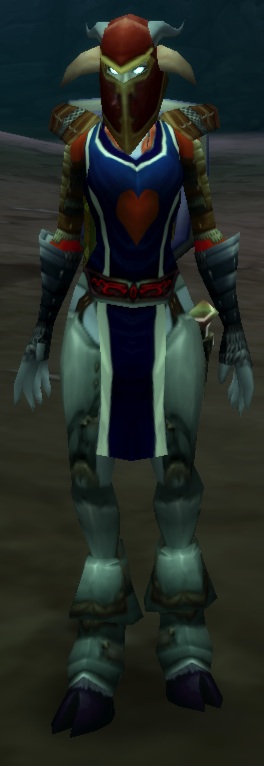
The next boss encountered is somehow the final boss of the dungeon. Even with her traitorous Horde knowledge, Livya has no idea how we reach this boss without encountering the other bosses. Vulzerda points out that 'only alliance know this route', as we obviously took the righteous path. Joining the fray, there is a bit of trouble with the boss's summoned spirits, but my taunts and consecrations help us prevail, Amnennar the Cold leaving behind a plate helmet. This is excellent, as I have my first piece of armour ready for when I reach 40th level and train in wearing plate armour, then having to entirely re-equip myself. Until then, I even have Herod's hat to look forwards to, once I reach 37th level. Um, which I did earlier. Let me put my new, superior hat on, which probably would have helped with every combat since Glutton. Herod's hat has horns. I have horns. With Herod's hat, I am one horny draenei.

On the way out of RFD, we visit the rest of the bosses in no particular order. Although it seems some of the skeletal moshers around Mordresh Fire Eye can be pulled separately from the boss, not all of them can, as we find out as the big fellow joins the fray unexpectedly. Caught off-guard and in the midst of lag, my health drops to somewhat below zero, leaving Livya and Vulzerda to suffer the complete lack of melee damage. Being a caster, Mordresh poses relatively few problems for a duo without a tank, and the DPS and healing of warlock and shaman are enough to defeat him without needing a paladin's monotonous auto-attack. A new belt for Livya is gained for her efforts.

Reaching the holding pens, we release a cook who is happy to teach us how to brew tea, but otherwise seems content to stay in the company of pig-men. Belnistrasz, on the other hand, can't wait to escape this foul place. So keen is he to flee that, unlike any other escort quest, the bastard runs at full pelt towards the exit. As refreshing as it is to escort an NPC who doesn't exhort the importance of escape from the enemy's lair before casually walking at a pace that suggests it's a lazy Sunday stroll through a fête, the speed of Belnistrasz is such that he isn't able to stop in time to encounter only the first group of mobs he walks in to. And as we approached him from the wrong direction, his path to the exit is fully populated with quillboars.

Belnistrasz hurtles through the first group of razorfen pig-men and straight in to the second, only then pausing to consider not dragging half the instance behind him. His tactic of inadvertently aggroing a couple of groups of mobs, calling for help, then running onwards before waiting for the rest of the party to rest adequately makes me wonder if perhaps the cross-realm LFG tool is working and we have a PuG fourth member. After we fail to escort the PuG NPC to the exit by rudely wiping, we clear our way back through the mobs to him, where he again pelts off, Vulzerda's warning that 'he's going to go again, grab his legs!' being sadly too late.

Eventually Belnistrasz stops and begins a little ritual, which draws the attention of many more quillboar, and we wipe again. Livya's soulstone doesn't quite help us this time, as she accidentally cast it on herself, but Vulzerda reincarnates and then pulls my spirit back in to my body. Going to Look for Livya's body causes me to pull the boss hog, and we have to defeat him slowly as tank and healer. Livya's faux-corpse chuckles and mutters 'I bet my DPS doesn't look so bad now', but the boss eventually dies and we mostly complete the quest. There's no sign of Belnistrasz, presumably because he ninja-looted and used his hearthstone.

All that's left is the spider boss, called by banging a big gong. Our cunning plan of ringing the gong and standing on a tall stake to avoid attacks fails when Livya's stubby legs let her down again, unable to propel her to jump far enough to get on to the stake. Come on, you can make it!

'Damn you, and your pogo stick, mountain goat legs!' I think we're actually space goats, shorty. The spider boss doesn't prove much of a challenge, at least compared to jumping more than six inches in the air, and we finally conquer Razorfen Downs, despite getting the achievement about an hour earlier.

We can't get back to Stormwind quickly enough for Livya. Lorr remains absent, but she thinks she has found a replacement. Remembering that Lorr walks around half-naked, I ask if her latest obsession also happens to be shirtless. 'He has trousers on, yes', Livya replies. Vulzerda and I spend our time more fruitfully, getting training for reaching 38th level. We also prepare for our next adventure, in to the ugly dwarf dungeon Uldaman, by collecting quests for the dungeon, and planning the push to the landmark 40th level, where many new options are opened. We'll also start speeding along the ground on our swift mounts, changed from being acquired at 60th level. Other Uldaman preparations include pretending to be swamped in the mire of patch downloads and add-on configuration in an attempt to feign unavailability. Let's see how that works out.