
Leaving it all behind

12th August 2009 – 5.14 pm

I was finding less and less to keep me entertained between my 80th level warrior and death knight on the US server. I had levelled brand new characters up to the level cap, abandoning a rogue in Zangarmarsh along the way, got the Northrend Dungeonmaster achievement for both of them and participated in enough PvP to be awarded the Wintergrasp veteran achievement on my death knight. Both have epic flying mounts, my death knight has the best PvP gear for her efforts, complementing it with self-crafted items. My warrior hasn't quite managed to peak in either jewelcrafting or enchanting, but has over fifty pets, along with Stinky the skunk, and completing the Argent Tournament with aplomb.

In the end I was finding excuses to log on, but without actually doing anything. It was time to move on. My choice of progression could be seen as a step backwards as I return to my old EU server to level up my 70th level warrior alongside a friend's druid, adventuring in Wrath of the Lich King as a new experience again. I even roll up a new alt mage to satisfy my urge for quick progress without endangering the primary aim of keeping the two 70th level characters synchronised.

I have made a similar move before, when going from the EU server over to the US. I left behind my epic warlock and the superior warrior, with all their gear and professions, for a completely new start. It is a cleansing process, one that helps to remove the irrational attachment to virtual items with incredibly narrow significance, and knowing this I don't even log in to empty the postboxes of my characters before letting my account lapse. The items left in the postbox will get deleted automatically within a month, but they have no intrinsic value and can either be replaced or will be forgotten. It is good accept this. However, there is a real loss involved with moving servers, and games, and that is leaving people behind.

One of the defining characteristics and attractions of the MMORPG genre is the 'massively multiplayer' aspect, where many of the inhabitants with whom you can interact are other players. Whether you are looking for a casual hobby, hardcore progressive gaming, or a primarily social experience, that the games are 'massively' multiplayer almost ensures that there are like-minded people to engage with, it's only a matter of finding them. The problem is that once you find some friendly players with whom you can share good times, fun experiences, and interesting challenges, it can be difficult to say goodbye.

If it weren't for my friends on the US World of Warcraft server I likely would have quit my characters there a while back. If it weren't for teaming up with a friend on the EU server I might not be playing World of Warcraft at all for now. And it is true for all the games in the MMORPG genre I've played. As long as I have friends in the game I enjoy playing and socialising with them. If the people leave, my fascination in the game dwindles significantly, and if I decide to leave I always have qualms about leaving behind the people whose company I have enjoyed sharing.

That most games are split over continents, and servers within continents, doesn't help. In the nascent age of borderless relations, where distance between people can almost be ignored, if it is even realised, dividing players in to arbitrary groups seems almost anachronistic. Rather than being able to pick a game and know that I can play with any of my friends I also have to make sure I am on the right cluster of servers, as well as the specific server, or I am locked out of the group. As social groups expand it soon becomes impossible to be able to play with all of my friends in the same game without either extremely good luck in previous server choice, far too much forward planning than should be required, or a system architecture that is considered more novel than it ought for a world-spanning game.

But to place the blame on multiple geographically split servers is to ignore the real issue of game choice affecting relationships. I am not only moving from one World of Warcraft server to another, I am continuing to play EVE Online. Yet even with EVE Online's single server architecture, apparently solving the issue of server choice, I am leaving behind my US friends in World of Warcraft. Likewise, should the time come when I stop playing EVE Online the friends I make there will be left behind, and the converse holds true for other players who leave EVE Online whilst I continue to play. In each case I will feel a personal loss.

I understand that there are plenty of options for communicating outside of the games themselves, with many versions of instant messaging, journals, blogs, and other internet communication channels, but despite this it seems that the friendships do not endure outside of the game. This could be because the player moves on to a new game and forms new friendships, which can hardly be condemned, or there is not much basis to the friendship outside of the context of the game. I imagine my own problem is the latter, as I have considerable trouble relating to other people, whether this effect is real or imagined. I suppose this is why I tend to roleplay a character, so that I can hide behind the character and use that as an excuse as to why any friendships do not last beyond any one game. Leeching off my friends' expanding gaming circles hints that perhaps I am a little delinquent in this respect.

Never the less, changing games or servers always gives me pangs of angst as I know that as much as I would like to sustain at least some of the relationships I have been lucky to become involved with I am just as likely to find the connection severed, as if the game server is the only feasible line of communication. Perhaps I just need to work on my social skills more, to develop more meaningful contact with the players I meet, but I continue to struggle to achieve this. For now, I never look forwards to leaving a game or server behind me, as it inevitably means losing contact with people I like to call my friends.
Hardening my Drake's passive tank

11th August 2009 – 5.49 pm

I am back out in high-sec known-space again and I get to try out one or two more fittings for my battlecruiser, trying to improve my current passive set-up. After I complete my previous look at Drake fittings it is only when I'm a few jumps in to my journey back to w-space that I realise I overlooked an obvious option, also pointed out as a reply to my post. Instead of fitting several invulnerability fields I could use specific hardeners. An omni-protective invulnerability field sucks twice as much juice from the ship's capacitor as a damage-specific hardener, so it is possible to fit four hardeners—one for each damage type—whilst requiring less capacitor charge than three invulnerability fields.

Essentially, I am replacing the four shield amplifiers with their active counterparts, which will provide better damage resistance at the expense of needing to be energised to be effective. However, my capacitor doesn't quite have the recharge rate to power all four hardeners indefinitely, so I need to swap out a low-slot module for a capacitor power relay.

mid-slots
4 × shield hardener (one for each type of damage)
2 × large shield extender

low-slots
2 × shield power relay
1 × capacitor power relay
1 × ballistic control system

The shield resistances are improved in every respect, which is only to be expected when moving from passive amplifiers to active hardeners, and the capacitor power relay brings the recharge rate up to make the fitting stable. Unfortunately, sacrificing the shield power relay leaves the Drake with a lower shield recharge rate for the same shield capacity, making it a sub-optimal fitting. Swapping out the ballistic control system to return the third shield power relay destabilises the capacitor and so is not an option for improving the fitting. Maybe training a capacitor skill up to level five could eventually remove the need for the capacitor power relay and make this fitting attractive.

Fin's comment about only needing to plug the shield resistance holes to create an omni-tank is a good idea too. Knowing that I can run a stable capacitor with four hardeners and a capacitor power relay, and that an invulnerability shield is twice as thirsty for charge as a single hardener, I wonder if I could perhaps concentrate the hardeners on the weaker resistances, topping up the overall shield resistance with an invulnerability shield, and use the spare mid-slot for a shield recharger to compensate for the missing shield power relay.

mid-slots
1 × shield hardener, EM
1 × shield hardener, thermal
1 × invulnerability shield
1 × shield recharger
2 × large shield extender

low-slots
2 × shield power relay
1 × capacitor power relay
1 × ballistic control system

Whilst the fitting gives better EM and thermal shield resistance the explosive and kinetic resistances suffer a little, and I find I still am left with a lower shield recharge rate, making this a rather poor option. However, again I am overlooking an obvious improvement. Instead of trying yet again to squeeze as much use out of my capacitor as possible I only need to use what is available to improve over my standard fitting of passive shield amplifiers. I already know that I can power two hardeners whilst maintaining a stable capacitor, and Fin's suggestion to plug the resistance gaps offers an obvious route to improvement.

mid-slots
1 × shield hardener, EM
1 × shield hardener, thermal
1 × shield amplifier, kinetic
1 × shield amplifier, explosive
2 × large shield extender

low-slots
3 × shield power relay
1 × ballistic control system

This simple change offers equal or better resistances to a fit with only shield amplifiers, has a stable capacitor, and does not sacrifice any shield capacity or recharge rate. It may be only a minor improvement, but it clearly is an improvement. Having the same shield figures and better resistances means I don't even need to test it to know it is better. Not only do I have a slightly more capable shield tank on my Drake but selecting suitable fittings has given me more experience on how best to match modules to a ship's specific attributes.

A shock to the system

10th August 2009 – 5.29 pm

It's quiet in the w-space system. Too quiet. But then another engineer turns up at the tower and we decide to strike hard at some of the more exotic asteroids lurking in one of the gravimetric sites. The rather large arkonor asteroid that was in the site has already been ravaged by lasers, but rocks starting with most other letters of the alphabet are still present. My companion engineer for the trip has even specially trained in mercoxit mining because of the availability of this rare ore in these frontiers. When selecting my ship I find have a brand-new Retriever waiting for me, a gift I was unaware of when I suggested going mining, which is a super surprise and a great start to the day.

After setting up a staging point, from which it is possible to warp to any asteroid in the field, I start extracting ore from a large bistot rock, in case we need to make space gravy, whilst my companion targets the mercoxit, to make use of her new skills, and mining drones busy themselves around an adjacent asteroid of gneiss. We're eventually joined by another engineer, who helps in mining the gneiss, soon causing us to have to grab an Orca out of the tower to haul back our full cans of ore. The operation is going swimmingly, and we even witness the mercoxit outgas to create a yellow cloud of explosive particles surrounding the asteroid, although we have been careful not to get too close. It's a most pleasant afternoon.

The soothing pulse of mining lasers is interrupted with a shout to warp out, warp out immediately, and different and more destructive noises shatter the tranquility. It is only then I see the intruding ship, but realise I can do nothing in a Retriever and obey the order to warp back to the safety of the tower, all the while my colleagues being attacked. One Hulk is lost, the pilot fearing for her pod, a second follows soon afterwards, this pilot not being as lucky as his pod fails to escape the pirates. Back at the tower the few of us around jump in to attack ships, but there is little we can do. As much as I want to repel the attackers I realise that getting more ships destroyed is no help—a lone PvE-fitted Drake is hardly a force in PvP—and by the time we are organised with enough attack ships the pirates have looted and salvaged the wrecks and moved on.

The ambush was quick and brutal. Sometimes the deceptive solitude of w-space can make you forget you are in a null-space system. Even though passages in and out of the system are variable and not straightforward to locate, they are there and available for anyone to use, and the lack of intelligence available by monitoring the local channel means extra vigilance needs to be paid to other means of surveillance. In the frontier systems of w-space there is no law enforcement to respond to unprovoked attacks, so we need to be prepared ourselves.

Apart from continued use of the directional scanner to monitor for other ships and probes, there are probably a few steps that can be taken to avoid further loss of clones and ships. A battleship can escort the miners, even if it is only parked in the asteroid field, as a show of force, because surely the sight of only unarmed and poorly defended mining ships in the area was a huge temptation to the attackers. We perhaps could mine asteroids in completely different sections of the field, so that multiple losses could be better prevented, although I would doubtless feel like an onyx at a watering hole. The jet-cans could even be given bogus names, discouraging the careless pirate whose glance at the scanner shows several extra Ravens in the system.

One idea that might be worthwhile, even if it sticks in the craw, is to sacrifice some yield for survivability. This isn't high-sec mining, where the only real danger is having your can flipped, and the goal is to tailor skill training and fit ships to squeeze as much ore out of a rock per optimised cycle time. But the ore is not worth anything if it doesn't make it back to a station to be sold, and in null-sec this is clearly a danger. Perhaps it would be better to fit survival modules to the mining hulls, such as warp stabilisers and shield boosters, to provide the capability and the extra few seconds of shield or armour that enables escape. The yield per cycle would be reduced, but we'd get it all. A miner may view this opinion differently, though.

Above all, the attack reminds us that we are not as safe as we sometimes feel. I feel lucky that I escaped unscathed again. I wonder if perhaps I am a little too quick to run, but I know that the doubt is caused by a feeling of helplessness and try to shrug it off. There is little I could have done to help in a Retriever. Part of me thanks my friend for naming the ship for me, as I can't help but feel that piloting a ship called Lassie Comes Home was like a protective talisman, however silly it sounds. Even though we are a little shaken from the attack we are not deterred, everyone active in the w-space system and taking our aggression out on Sleepers in short time. We will endure.

Deserted Talocan cruiser

7th August 2009 – 5.37 pm

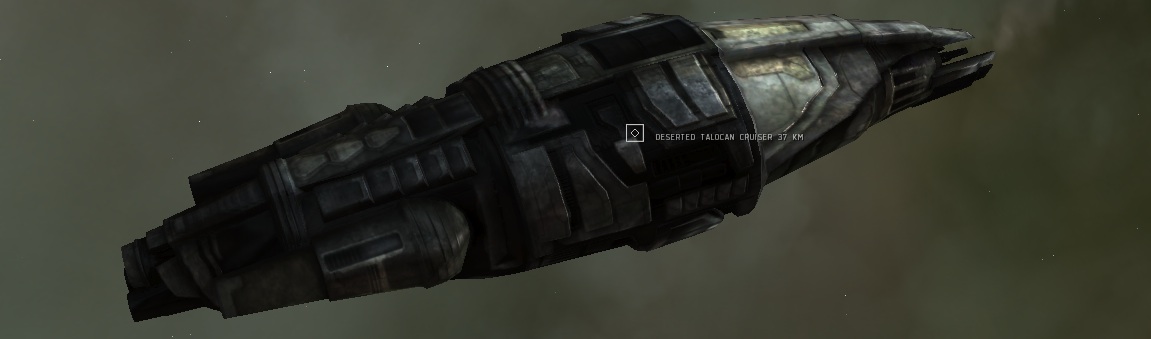
Ooh, this is exciting. Investigating a magnetometric site in w-space, our engineering fleet reveals not only the usual Sleepers and abandoned artefacts but, off in the distance, a deserted Talocan cruiser hull! The thrill of finding something so unusual almost makes me forget to question how the artefacts can be considered abandoned if there are Sleepers defending them. As laser fire and missiles blast against the armour of my companions' ships I realise I probably should be firing missiles at something, but everyone seems to cope regardless as my mind wanders to what significance the hull could have.

Maybe we could scoop the hull in to the hold of a hauler and get to work reverse-engineering the materials and design to make our own versions of the hull. Perhaps a warp drive and some electronics could be dropped in to the hull to make it a functional ship, albeit of hybrid technology. Or it could be more than a hull and have the remnants of its own drive and electronic systems inside. After securing the site we could get to work on its internals, stripping it down and rebuilding it as best as our technology allows, giving us direct access to a Sleeper ship!

Once the Sleepers are taken care of I speed back to our tower and switch ships, hopping in to the Buzzard I borrowed previously, before returning to take a closer look at the discarded hull. I drop out of warp and as my engines push me quickly towards the vessel I get ever more excited by the possibilities in store. This hull could be automatic. It could be systematic. It could be hydromatic! Why, it could be greased lightning! Greased lightning! Go, greased lightning!

Sadly, the hull cannot be scooped in to my hold, hacked for technological secrets, or dragged back to the tower to be renovated. My ship's computer informs me that the hull is a simple wreck to be salvaged. Well, maybe not 'simple', as the salvage recovered is rather shiny, but my daydreams quickly evaporate. It's back to the non-musical theatre blasting of Sleepers and stealing their salvage to work towards Tech III hardware, there's no racing for pink slips here.

Test-piloting the Crane

6th August 2009 – 5.46 pm

In our rich little w-space system another radar site crops up on the scanner, waiting to be plundered. Again, a host of Sleeper ships are alert enough turn up to attack, showing that we really ought to have thought of a better name to give them. Even facing three Sleeper battleships our stronger fleet is in no danger, never having to warp out to replenish shields or capacitors, which we also could have done as the Sleeper frigates don't bother to scramble our warp drives. A new tactic of our battleships shooting their battleships and battlecruisers fitting assault launchers to destroy the frigates works effectively.

At the end of the fight we have wrecks to salvage and data banks to hack. I warp back to the tower and borrow a Buzzard, probably with permission, this time actually helping with the hacking instead of being nosy. My rudimentary skills let me crack each data bank open and I nab the contents, zipping around in the superb camouflage-coloured Buzzard, before returning to deposit all the loot in the hangar back at the tower. But the loot doesn't become profit by sitting in a hangar, it needs to be taken back to known-space to be sold. As I need to head out to maintain some industrial jobs I volunteer to make a stop at the corporation headquarters.

Ore may be bulky, but salvaged, hacked and analysed loot fits quite snuggly in to a normal industrial ship. It fits even better in to a sleek transport ship, one that can speed across the vast vacuum of space at eye-watering speeds, if only I had one. I may have trained my industrial ship skills adequately but the cost of buying the transport ship skill book as well as the ship itself, costing over ninety million ISK in total, deterred me somewhat when I was still working towards my first hundred million. But the profits from the wormhole operations have been good, and having someone toss me the keys to borrow their Crane for a day is an excellent motivation. I pop out of w-space and find an NPC selling the transport ship skill book and set the skill to train overnight, ready for the next day's travel.

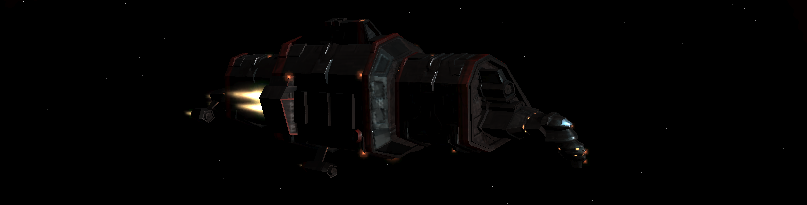
Honest-to-goodness, that night I have a bad dream that I pilot the borrowed Crane in to the warp bubble of a gang of pod-thirsty pirates, waiting to snare unwary amateurs. Needless to report, I don't sleep well. It all turns out to be okay though, and it really was quite irrational to be worried about making a short trip in a blockade runner that I normally make with a Drake. And once out of the wormhole and back in to high-sec space I am free to blast my way from gate-to-gate at amazing speed! The Crane is a quite fabulous ship indeed. I even find myself targeted a couple of times when flying on auto-pilot between gates, maybe by curious capsuleers, maybe by opportunists, but flicking on the microwarp drive hurtles me towards the stargate to avoid any unwanted attention, as well as showing off quite blatantly.

It is not just the speed and agility of the Crane, the colours and details are most alluring too. The dark body with sheer red highlights makes the ship the ninja of New Eden, slipping between gates almost unnoticed, revealing only traces of its being in the system. I get carried away simply flying the ship around, even on auto-pilot, that I take an extra trip from the corporation base to my mission base to check on market prices for my sale orders, before heading back to the corporation base to install a new BPO copying job. I then head back to w-space, picking up a few guns and several hundred drones for use against the Sleepers on the way. I pop the fabulous Crane back in to the maintenance arrary, but I know that soon enough I'll be buying one for myself.

Practice drumming pad

5th August 2009 – 8.38 pm

Unlike learning a foreign language or playing the guitar I am not disheartened when the task of learning to drum becomes difficult, but challenged. I want to push myself to accomplish more complex patterns and achieve increasing levels of competence. I think this is partly because of the excellent tool in learning to drum that Guitar Hero: World Tour is offering me. There are plenty of interesting songs to play along to, which have vivid scores and progressive difficulty levels, with no page turning required, and an interactive practice mode that allows for the speed of play to be adjusted either almost to a stop, to help get limbs working as desired through conscious effort, or only a little slower than normal to memorise patterns and sections of songs.

Never the less, there is still technique to learn and I am painfully aware of my left hand being nowhere near as under my control as my right. The stick in the right hand feels comfortable and secure, whereas that in my left often looks like it is trying to escape whenever I hit the snare. My rolls also lack a certain consistency, another fault I attribue to my weak left hand. It isn't convenient to set-up the fake plastic drum kit to practice outside of the game, and without the electronically augmented game sounds the fake plastic thomps are sufficiently loud and unlike that of a drum that they discourage casual practice. But there is a solution.

In a continuing bid to take Guitar Hero drumming too seriously I pop in to Denmark Street on a trip in to London, or Musictown as it could be called if musical instruments were an immigrant race. I pick one of the shops that doesn't deal exclusively with guitars and am guided by a sign downstairs, away from the real musicians to the drum section. I feel a bit of a fraud asking for a practice drum pad, but I know that is more my lack of confidence surfacing rather than the truth, so I do my best to ignore the feeling as the assistant hands me a pair of sticks to test the two practice pads he has for sale. I have never liked trying instruments in shops where there are potentially competent players around, and I feign having to carry my shopping bag as a reason to try the pads with only one stick. I know I shouldn't worry, music shop assistants have only ever been helpful in all my experience, but my shyness remains a problem.

Trying both practice pads, one cheap, one slightly more expensive, the difference between them is startlingly obvious even to me. Having a quick rap on the more expensive pad gives good feel and bounce as I pretend I know what I'm looking for, but moving over to the cheaper pad immediately feels like I am hitting nothing more than a block of plastic. I don't need to continue past the initial couple of strikes, knowing that I could simply hit a hardback book to get the same experience as the cheaper pad, and gladly hand over the more expensive practice pad to buy. I even get a couple of minor tips from the assistant, for which I am grateful.

I can now work on my sticking technique whilst watching TV, or waiting for my ship to cross the galaxy in EVE Online, able to monitor what both hands are doing instead of focussing on the stream of notes scrolling down the TV screen. I can switch between improving my right hand technique and trying to get my left hand to copy it better, without worrying about missing beats, matching speeds, or displeasing a virtual audience. I know I will spending some time working on my rolls, working to increase their speed whilst remaining smooth, and I will continue to show progress in drumming ability.

My first battleship is not mine

5th August 2009 – 6.09 pm

Before I leave the current w-space system behind me I have one last task. There is a Rokh that needs to be piloted out of w-space and its owner is not available for a few days. I may have postponed active training in battleship skills many months ago but I got enough initially for me to know which way a Rokh points—if you've seen a Rokh you'll understand why that needs level three of five in battleship piloting skills—so I volunteer to take the ship back to known-space. This is actually quite exciting, as it will be my first time in the pod of a battleship, so I get a bit tingly when I request permission from the computer to board.

And I'm in the battleship's hot seat. It's actually quite a bit bigger than I expect. I may have been flying in fleets with battleships recently but, having my tactical overlay zoomed out thirty kilometres or so, I apparently don't get a good impression of scale, as I realise when I try to turn the ship to the exit wormhole and smack in to a second battleship nearby. I suppose it doesn't help that the other pilot is coming to take a closer look at my inaugural battleship flight, and I'm sure the armour damage will buff out nicely.

I see that the ship has the default name still, of $pilot's Rokh. I take time to change to Not $pilot's Rokh, because it's a dreadful faux-pas to be seen in an unnamed ship.

It is then a simple matter of warping to and jumping through the exit wormhole, docking in the closest station and contracting the Rokh to a corporation member with a freighter. And so my epic first flight is over. It was really cool, though. I hope my Drake battlecruiser doesn't feel small after this. Then again, some people may criticise me for having double-standards if I turn around and complain that size does matter.

When the end comes

4th August 2009 – 8.35 pm

Maybe I like the film TRON too much, but I am filled with existential musings, primarily angst, as Kinless descibes how one character of his met his end as he

finally, and cleanly, sat down, logged out, and got deleted.

I wonder if the character thought it was merely another brief log-out between periods of consciousness, or was somehow aware of his impending oblivion but does as instructed anyway.

How normal it must seem to characters as every hour dozens of them fade out, only to reappear later in the same place. But how many secretly panic inside as a character fades out, worrying that they will never be seen again, either from neglect or permanent deletion. Perhaps this is why they choose calmly to sit in such times, to avoid the indignity of collapsing or feinting in fear of that moment, outside of their control, when they cease to exist.

Recovering abandoned ships

4th August 2009 – 5.12 pm

There is a spot of luck when a wormhole opens from the corporation's claimed w-space system in to Minmatar known-space. Admittedly, it is many jumps to the corporation's base, and to my stubbornly situated manufacturing base in the opposite direction, but the wormhole exit is only a few jumps from where I set up with my previous corporation and never took time to strip down properly. I may finally be able to grab a long-abandoned ship or two, or even remove an entire entry from my 'assets' tab.

The reason I haven't yet bothered to recover all my ships from the PvP base is mostly because the resources aren't entirely necessary. It was easier and much cheaper in time to head back to my old, now current base with what I could carry and buy replacements for what was left behind, particularly as I didn't actually need to replace two or three PvP-fitted frigates. I could have just sold them, but it looks like I'm more sentimental than I care to admit. But now I am close enough for it to be convenient to warp in my pod to one of the stations still holding my ships and return to the w-space POS, blowing the cobwebs out of a warp-drive and dust off a hull.

I am at least hoping to recover a salvaging Cormorant, which could be quite useful in sweeping up after our Sleeper safaris, and I notice a shuttle is sitting idly by when instead it could be an agile and fast transport for brief visits back to known-space to reinstall BPO ME research jobs or adjust sell order prices on the market. Even handier, I appear to have a mothballed Badger. I suppose I left the area in a Drake and didn't fancy the trip back all that time ago, although these days I am more inclined to endure an eighteen jump trip even in a slow ship, with the benefit of AFK auto-pilot flight and a drumming simulator to keep me entertained.

It is a simple matter of stripping the Cormorant, repackaging it and the shuttle, and throwing everything in to the hold of the Badger, which I charmingly named Truffle Hunter many months ago. I leave the PvP frigates where they are, selling them still not crossing my mind, and head back to w-space. It is good timing too, as shortly after I get back I find we are pulling down the tower and moving to a different w-space system. Having the Badger lets me be useful in being able to unanchor the gun batteries and carry them back to storage in the Badger's adequate hold.

After stripping down as many of the defences as I can I pick up my still-packed Cormorant and shuttle and send Truffle Hunter out to the nearest station, before returning to remove my Drake from the soon-to-be-abandoned w-space system. Although it doesn't really seem like I've gained much flexibility, as I still have two ships I need to transport around separately, at least the presented opportuntity combines with my new lack of antipathy towards long-distance travel to motivate me to recover some useful ships.

I send Truffle Hunter off to my corporation's base, where I am hoping it and its contents can be a useful asset, before travelling back to pick up my Drake and return to my manufacturing base, where I already have similar ships to those now recovered.

Skills progress versus ISK accumulation

3rd August 2009 – 5.56 pm

When it comes to replacing my Sleeper-destroyed Drake battlecruiser my instinct is simply to get a new Drake. After all, I've been piloting a Drake for months now, and it is comfortable, reliable and manageable. I like to think I know what I am doing in a Drake. But with the profits from my industrial efforts and the new wormhole expeditions it looks affordable for me to invest in a battleship, with the deadly silhouette of a Raven being a natural progression from the smaller Drake. As most of the damage both inflicted to and received from Sleepers in the wormhole comes from those engineers flying battleships it is perhaps time to upgrade. But I still pause to consider my options.

I remember my initial progress in New Eden, starting out in a frigate before getting excited about being able to afford training for flying a cruiser, and then the cruiser itself. It isn't long before I train in all the new ships my piloting skills gives me access to, learning how to fly destroyers, battlecruisers and even battleships at such an early point in my career in the Navy. My only disappointment is seeing the cost of battleships and wondering why I am able to gain the skills at a rate that far exceeds my ISK accumulation. I quickly find myself saving up for my first battleship, until I get distracted by wanting to join a corporation.

It is only later that I realise throwing myself in to a battleship would have been a mistake, made more evident with the introduction of EVE Online's certificate system. Whilst it is true I trained in the relevant starship skills until I had the requisite ones to pilot a Raven it was at the expense of neglecting other skills. The obvious skills overlooked—at least, they are obvious now—consist mostly of what are deemed core competency skills in the certificate system. Without sufficient core skills any capsuleer would struggle to achieve adequate performance from the capacitor, CPU and power grid from such a demanding ship, which is vital in being able to fit appropriate modules for defensive and attacking capabilities.

And it's not just core skills that are important, because fitting and using the modules that turn a ship from a naked hull in to an effective tool also require skills to be trained. Without training in the appropriate weapons, shields, armour, electronics, mechanics, drone and engineering skills, a new battleship could be reduced to being little more than a sturdier cruiser, because of substandard fittings, instead of a potent weapon of destruction. In turn, this could lead to the loss of the battleship from being overconfident about the ship's inherent abilities, instead of taking time to bolster them with the capsuleer's own skills.

Even now I am finding new skills that would benefit piloting my battlecruiser, partly because of my previous diversifications in to EWAR for PvP and then industry. Some of the skills simply need to be learnt from level four to five for maximum benefit of the available system capabilities, others make use of the ship's rôle bonuses to be more effective in combat or as part of a fleet. It seems preferable to become a competent, if not expert, battlecruiser pilot first so that when I am training the secondary skills necessary to fly a battleship effectively I can simultaneously put my learnt battlecruiser skills to active use as part of a fleet. And once I have learnt all the necessary skills I can make the transition to battleship pilot more fluidly. So, for now, I shall continue to pilot my trusty Drake.

Even though it first seemed to be that skill training times are quicker than ISK accumulation I find it is more an illusion based on ignorance of relevant skills. In reality, unless a capsuleer is heavily specialised, the relationship between skill training times and ISK is the other way around, and there exists a potentially deadly temptation to move as swiftly as possible to bigger hulls. It is important to understand the utility of the core competency skills, as well as all of the secondary skills that are used as part of fitting a ship effectively. EVE Online's certificate system can help guide inexperienced capsuleers in to training important skills that not only prepare the pilot better for future ships but can also make the current ship more capable.