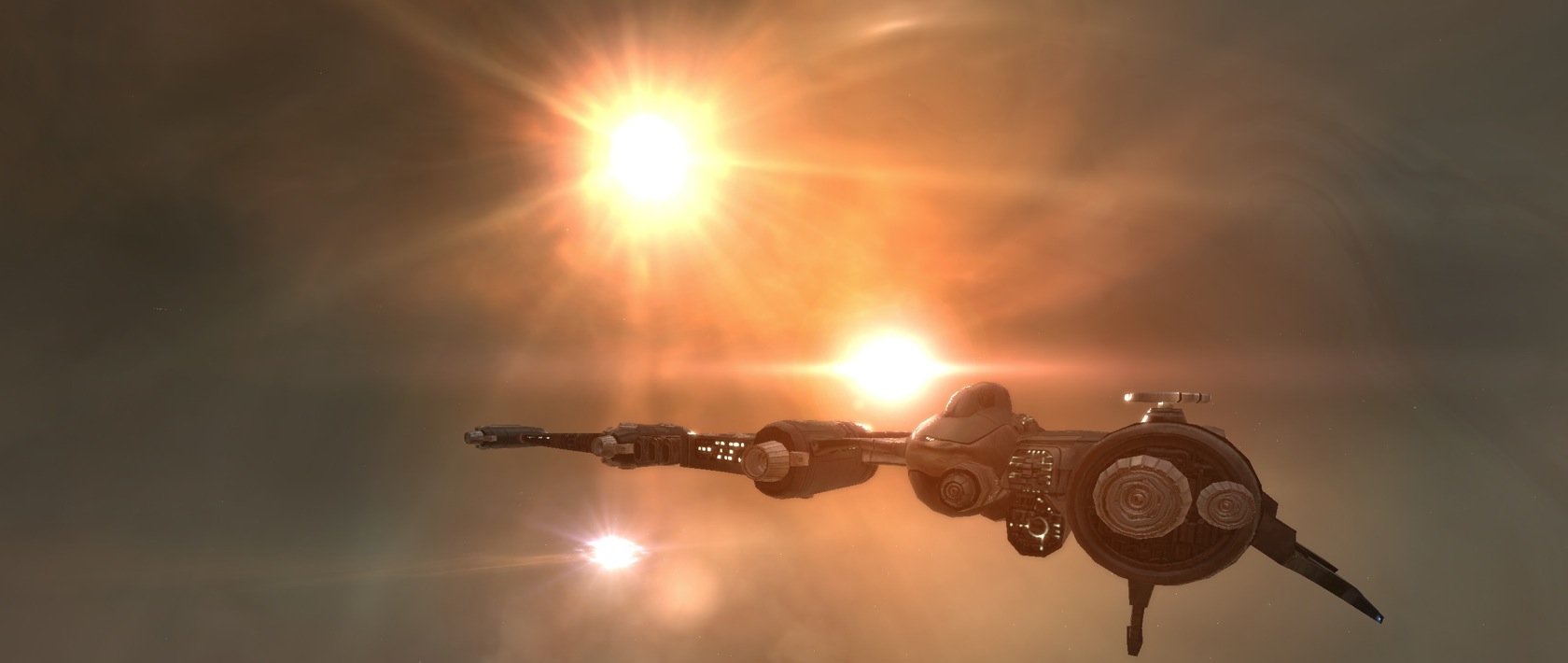
Deserting the deserted

23rd October 2009 – 5.52 pm

The strain of running towers in two w-space systems is showing. The main tower is in a low class system with a static high-sec exit, allowing reliable access to k-space and the normal missions and industrial operations it offers. But we don't set up a w-space operation so that we can run missions for NPCs. We're in it for the iskies. The same convenience that a system with a static high-sec exit provides also reduces its utility, with fewer opportunities to plunder adjacent w-space systems. And once the Sleepers have been routed from the system there is little else to do but mine, which doesn't hold much interest for battleship capsuleers.

Now that the mobile tower has been moved in to a deeper w-space system we are seeing the benefits. Each day we find wormholes leading to a couple of systems new to us, one of which normally has an exit to k-space. The only drawback to the continual refreshing of encounter sites to run, of all types, is not being able to clear them all of profit quickly enough, which is far from a complaint. As long as we have a strong enough fleet we can hit the highest profit sites first and work our way down, until everyone is tired and needs to return to the tower to rest.

All the action is at the mobile tower, which is soon likely to be put up on bricks and wired in to the grid. Because of this, it comes as little surprise that the static tower is mostly deserted. It is understood that we need to maintain some presence, to keep the tower running, for access between k- and w-space, and to present a more credible threat to intruders than an empty tower, but when there is Sleeper destruction happening elsewhere no one really wants to stay there. It is probably time to pack up and move on.

Apart from running reactions needed for Tech III construction, which I am blissfully unaware of currently, keeping the static tower running is only dividing the attention of some of the engineers. I'm not sure what the plan will be when the static tower is dismantled. I hope we continue to work towards Tech III production instead of driving purely for profit. But it is definitely in everyone's interest to keep the wormhole engineers as co-operatively involved as possible.

Melting arkonor

22nd October 2009 – 5.17 pm

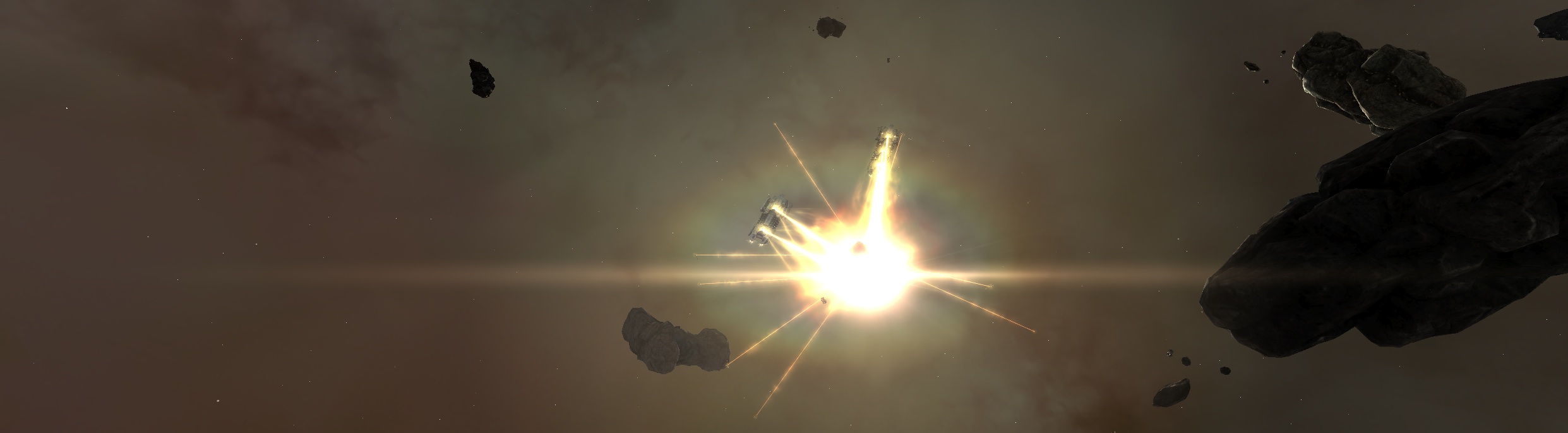
Arkonor can really glow! Granted, at least one of the capsuleers needs to have impeccable mining skills, and perhaps just the right camera angle is needed, but pulsing strip miners on two Retrievers and a full complement of drones results in an impressive light show. If there were gravity, the arkonor would be dripping in to our holds.

Conversely, a single Retriever running combat drones, to give at least a pretence of security, embodies the lyric that 'it's lonely out in w-space'. But there is no one else around in our w-space system and some huge rocks to be turned in to profit, so I take Fido for walkies. Mining is more interesting when there is someone to chat with, or a similar distraction, so that I don't have to pay attention to the actual act of mining. Maybe this reflects poorly on mining, but I prefer to think of it as a multi-tasking opportunity.

Mining in w-space is a rather intensive act, unfortunately, and not simply a matter of paying a little attention every few minutes to dump the mined or in to a jet can. A constant eye needs to be kept on a frequently refreshed directional scanner, watching for unknown ships and scanning probes, indicating that the idyllic pasttime may be interrupted by aggressive threats with murderous intentions. It's like fishing in Deliverance country.

There is the occasional false alarm, when unidentified flickering coming from my monitor turns out to be the targeting icon rotating around the arkonor asteroid, causing a few moments of tension, before full-blown panic breaks out as I realise someone is shooting Fido, and hitting! I relax a little when I realise my d-scanning has probably been vigilant enough, and I haven't missed the early-warning signs of scanning probes, as the shots are coming from Sleepers. Even so, a mining barge is no match for Sleeper rats.

I hit the warp button as quickly as possible to return to the tower. But Retrievers are not known for their agility, the shields dropping quickly and armour now facing the brunt of the Sleeper shots as still I turn. Luckily, I enter warp before the next volley of heavy-hitting missiles reaches me, and I get back to the tower still in one piece and really quite alert. I fit a repairer module and start running it to fix my armour damage, before once again cursing the lack of adherence to standard terms and removing the hull repairer to fit an actual armour repairer. If a ship's structure were called the 'hull', or hull repairers were called 'structure repair modules', I am fairly sure I then wouldn't get confused between 'hull' and 'armour' repair modules. As it is, I know I don't need to repair the ship's structure or shield, so I fit the hull repair module and wonder why it's not working.

With the Retriever's armour repaired, I tuck it away in the corporate hangar and launch Non-sentient Ship. Two Sleeper cruisers are no match for a w-space Drake battlecruiser of mine, as I prove. Another ship swap and I grab the loot from the Sleepers and salvage their wrecks. Before I know it, I am back in Fido, shooting arkonor and refreshing the d-scanner, hoping the radar catches the pings of duelling banjoes before I'm made to squeal like a pig.

My three suns

21st October 2009 – 5.09 pm

The w-space system holding our mobile tower is now a minimum of two wormholes deep, making it more awkward to enter from and exit to k-space. Although having a static high-sec exit is remarkably convenient for coming and going, once the system is cleared of sites of local Sleeper interest there is often little to do but wait until more sites spawn. Or, as we tended to do, pack up the tower and find a new system. With our deeper claimed system we by necessity uncover a greater number of wormholes that lead to other w-space systems, offering many more opportunities for destruction and profit.

Whilst certainly the case that in our previous w-space systems, with static exits, we found adjacent w-space systems, we tended to leave them alone. The logistics to plunder a remote system require scanning for sites in the second system, getting a small fleet in to eradicate any Sleeper presence, and sweeping all the loot in to our holds, all whilst needing to maintain the integrity of the connecting wormhole as battleships are sent through the mass-limited anomalies. It all seems rather involved compared to running sites locally. But now that we have found a prime system two systems deep for our mobile tower, necessity has made the same logistics common operations.

Preserving the integrity of wormholes is a standard concern, the mass of ships sent to and fro tracked, as is the natural life of the wormhole. Instead of committing every capsuleer to the encounter, a battleship fleet is sent ahead for combat, afterwards followed by a specialist ship, normally a frigate-sized hull, to salvage, analyse, or hack, and to return profit to the tower for later hauling. Other corporations sometimes claim a system as their own but, unlike us, they are clearly wrong. Even so, if a POS is present in the system, careful watch is kept on the directional scanner for hostile ships. The overall threat is not much greater than running sites in our own w-space system. Our neighbours could wake up, of course, but we can easily escape down the rabbit hole.

Although we are careful to maintain wormhole integrity, the same instability we try to avoid can be turned to our advantage. Entering an occupied system, clearing the high-profit sites of Sleepers and loot, then destabilising the wormhole is almost the perfect crime. We don't even need to collapse a wormhole to make good our escape. Pushing the anomaly so that the passage of a couple of battleships will destabilise it entirely is good enough, as it ensures only a small fleet can follow us back, and even then the pursuers may be on a one-way jump.

Visiting other w-space systems also offers tourist benefits. Wormholes appear and dissipate, different systems connecting to our own regularly. We can choose whether we want to visit a black hole or pulsar system, and if we would rather decrypt databanks or uncover artefacts in archeological sites. The background nebulae and stellar objects change every day, without us having to travel more than a couple of systems away, providing for some marvellous sights. I am even able to pilot a Catalyst by starlight by starlight by starlight, if only to make EVE Monkey envious. W-space life is rich, at the moment.

Filesystem Checkwits in Shadowfang Keep

20th October 2009 – 5.38 pm

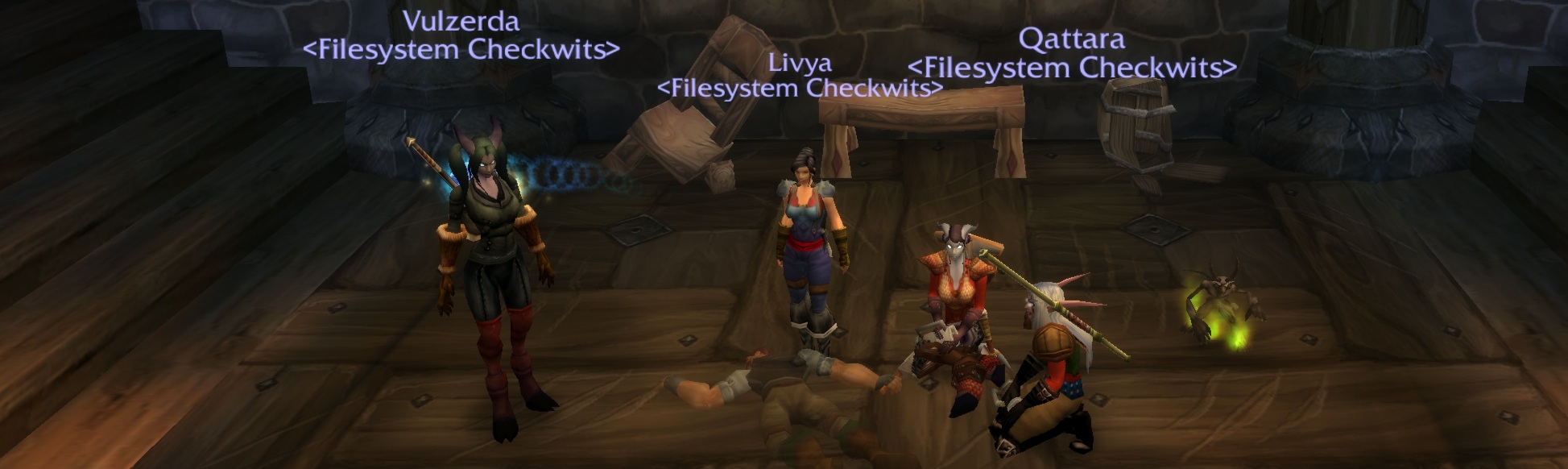
Worgen and wolves, wolves and worgen. There is so much potential leather in Shadowfang Keep that a tan mist falls over Vulzerda's eyes. Indeed, after the first couple of rooms are cleared of worgen and wolves, wolves and worgen, Vulzerda uses her hearthstone to return to Stormwind and increase her training in the skinning skill. Summoned back, thanks to the warlock's new spell, Vulzerda continues skinning everything in her path that isn't standing up. Needless to say, this makes resting to regain mana a somewhat risky endeavour. Chain-pulling mobs works well, keeping ourselves busy and Vulzerda behind us skinning. When we finally need to rest we offer a ghostly corpse for her to skin, hoping that the incorporeal body will confuse her long enough for us to drink and move on.

Sadly, the ghost provides no distraction for Vulzerda, who grabs the warlock's imp to skin instead. But Livya can always summon another imp! Writing of which, Livya's flirtations with personal responsibility continue from the Deadmines jaunt. After showing some regret over corrupting poor Colin Woodcarver, her mind goes even more loopy when she bumps in to Tormented Oliver in Shadowfang Keep. The humanity tugs at the remnants of her emo soul, trying to reconcile acts of terrible violence against innocents. Of course, we could tell her that they were, in fact, a goblin woodcarver and tormented officer, but there's no fun in that.

The needlessly tedious weapon skill system taunts me yet again. I equip a neat one-handed mace looted from Baron Silverlaine only to find that my 'skill in maces has increased to 14' the first time I use it, so far away from my maximum skill of 110. And realising that a shield is useless against spell-caster Arugal, I switch to a newly acquired and powerful two-handed axe only to find that I haven't wielded that class of weapon before. With no weapon skill I won't hit my target, upsetting my plan to swap the useless extra armour for maximum damage. But the important factor in the final fight is water breathing.

Although water breathing is missing in the first, failed attempt, we are fully buffed for the second assault on Arugal's chamber. 'No, arch mage, we don't think that's air we're breathing', the new realisation allowing us to defeat our opponent with ease. All that's left to do to finish the evening is return to Stormwind and sit a space goat's elephant mount in the middle of some RPers having a picnic. Thus ends another successful Filesystem Checkwits adventure.

Where is Tank when you need him?

19th October 2009 – 5.10 pm

The current entrance to the mobile w-space tower is over twenty jumps through low-sec. I think I'll pass on that. But there is probably a better opportunity of getting to our large, permanent tower, with its static high-sec exit, where I could at least make myself useful and mine some exotic ore. All I need to do is find my way in to the system. Of course, it is easier to find the exit wormhole and be guided in than stumble on a wormhole leading to a particular w-space system. Luckily, I can pull the strings of a capsuleer at the large tower, so I just need to scan down the exit and I am on my way.

There is a suitably equipped Heron that I can pilot sitting in the corporation hangar, which I board. Warping to a safe spot in the system I launch some probes and punch the cloaking device, switching my attention to the system scanner. Resize the scanning range, position the probes, scan. A couple of precise hits turn up, probably old bookmarked sites in the system, and a bunch of weak signals to pinpoint, one of which must be the wormhole. Time to locate an exit!

I generally pick signals based on the aesthetics of the signature, although I missed the PJH anomaly a little while back. Plucking the most pleasing three-letter code from the list I narrow down my search. Position the probes, scan, resize the scanning range, position the probes, scan, reposition the probes, scan, resize the scanning range, position the probes, scan. Perhaps I shouldn't be trying this on a device with a small screen and lacking a secondary button, particularly with the rather fiddly interface.

There may be some use in scrolling the screen to centre on a probe when clicking on the probe's name, but as the names are long and intrusive, and there is no way to cancel such a selection, it can become frustrating having to scroll back-and-forth for every accidental click. Changing the scanning ranges of the probes by selecting the probe's translucent sphere and expanding or contracting it is handy, and it can be nullified by releasing without changing anything. Perhaps it would be better to double-click on a probe to centre it in the display, instead of the single-click, to remove the frustration.

Trying to work in three dimensions with a two-dimensional interface can also be fiddly. I like to think my spatial awareness is keen, but accurately visualising in a vast region of space a source with no shape or determinable size can get tedious. An improvement could be to add smaller screen partitions and allow three orthogonal angles to be shown simultaneously, although this may also exacerbate the multiple window problem that already exists in EVE Online. I think what I am trying to get across is that I am rubbish at scanning and need more practice.

I spend around an hour scanning down a handful of the weak signals. The first two I discard once I find out they are not wormholes. The third I think I ought to pinpoint properly, taking time to get a 100% strength scan to bookmark the location. As it is a gravimetric site, full of asteroids to be mined, and my plan once I am in the w-space system is to mine, it seems foolish not to make a note of this site. The fourth also isn't a wormhole, but when I finally find this out I have a strong enough signal that I may as well continue to get it bookmarked.

By the time I have narrowed down my search to the last couple of weak signals I am sufficiently demotivated by the lonely scanning process that I don't now want to spend more time mining by myself in an empty system. I recall my probes, without having found the exit wormhole, and head back to the tower before releasing the puppets strings. At least I can pretend that I have been productive, and I got more practice at scanning. Maybe with some patience, and a more suitable input device, my scanning will become swifter.

Hidden treasure

18th October 2009 – 3.02 pm

There is a strangely familiar feeling, comfortingly nostalgic, about running around Duskwood and finding the occasional metal-bound wooden chest incongruously jutting out of the grassy northen bank. I can't quite put my finger on what is causing the sensation of déjà vu, or why it is so strong, until images of Ghosts and Goblins, and its sequel Ghouls and Ghosts, pop in to my head.

It is the grassy, banked landscape and archetypal style of treasure chest that invokes the nostalgia, having years ago spent so much time hunting down the hidden chests in Ghouls and Ghosts, stuck on that first level for ages, that makes the Duskwood treasure chests so evocate to me. Having Raven Hill Cemetery within view only strengthens the connection, its wandering ghouls and zombies no doubt making me want to double-jump whilst hurling daggers in their direction.

Ah, good days.

'It's as it sounds'

17th October 2009 – 2.51 pm

The marvellous, national treasure that is Stephen Fry has released a new book, a collection of Oscar Wilde's Stories for All Ages. I am fortunate enough to get a couple of tickets to the book signing at the Bloomsbury Theatre in London, purely by the good timing of seeing his early tweet about the event.

There is rapturous applause when Stephen arrives on stage, and I must admit that I am quite dizzy to see him in person, a charming, magnanimous entertainer and accidental cultural ambassador. And what a treat I am in for. Stephen welcomes everyone before exploring the life of Oscar Wilde with us, on the 155th anniversary of Wilde's birth. It is fascinating and enlightening to learn of Wilde's life from the perspective of a compassionate admirer, to realise his influence, his extraordinary talents, and understand the tragedy of his ultimate treatment.

The injustice meted upon Wilde is being remedied, in some small way, by his continually rising popularity and recognition in modern times. The new collection of some of Wilde's stories, introduced as a whole and individually by Stephen Fry in the book, continues to show Wilde's relevance. We are even treated to Stephen reading us The Happy Prince, which is a wonderful experience. Stephen Fry reading me a story! It is like a dream. And there is more to come.

Stephen Fry leaves the stage briefly before returning, with illustrator Nicole Stewart, for the book signing. Despite just about everyone wanting to meet Stephen and get their book signed, creating a massive queue that winds around the theatre, and signs stating that it is likely there will not be time for everyone to have their book signed, Stephen insists on signing the book for everyone who waits. This is not taken for granted, and is truly appreciated.

I have to admit to being a little nervous, not just for meeting a personal hero of mine, but also because I want to do something silly, and I am normally rather shy. Having the organisers add post-it notes inside each book to aid the writing of dedications also foils my idea a little. Even so, I can't resist. When I get to the front of the line I show how I would have replied had Stephen needed to ask my name, which I do by dropping a tube of lip balm on to the desk, the balm a substitute for a cigarette lighter as I don't smoke and I been trying vaping instead with products from this jeeter juice review online.

'Ah, Derek', Stephen delightfully chuckles to himself. 'And how do you spell it?' His instant recognition of the moment from the sketch is amazing.

Skipping a punch-line, I reply in my best Hugh Laurie impression, 'N-I-P-P-L hyphen E'. Zoso warned me earlier that if I dared to do this it would only end with Stephen hitting me around the head with a cricket bat, but instead he smiles and says 'thank you for remembering', handing me my copy of his collection of Oscar Wilde stories, signed by him and Nicole Stewart. Thank you, Stephen Fry, for being such an inspiration and rôle model, and continuing to enlighten.

Breaking and fixing my Guitar Hero drums

16th October 2009 – 5.05 pm

My new, heavier drum sticks make missed registrations on the fake plastic drums less likely to occur, as each strike hits with a firmer thwack. I may be able to use lighter strokes to get the same effect, but nothing beats accentuating the right notes. It's great fun to pound away with solid thuds! Purely coincidentally, my red fake plastic drum pad stops working within a week of getting the new sticks. I wonder briefly how many songs make no use of the red pad, ostensibly the snare drum, before deciding that perhaps I should effect a fix.

Removing the lower cover to the main drum section reveals the problem: one of the two wires connecting to the transducer has broken. Nil desperandum! Stripping the insulation back a little lets me solder the wire on to the transducer again, giving me a solid connection once more. Assembling the fake plastic kit shows that the fix is good, the red pad registering my enthusiastic hits as before. But only for a day, until it breaks again.

The problem is that I only make half a repair. The solder joint is good, but the vibration from the sticks hitting the pad wears on the, frankly, puny wire between the insulation and solder joint. All the other factory-made joints are completed by a lump of glue, which covers the bare wire to secure the connection to the insulation, preventing vibration fatigue on the bare metal. Having no such glue I only make the solder joint, but I clearly need to do more.

I have some sturdy single-core tinned copper wire handy—bought a while back to help shape a new tail I was planning to sew—which will easily suffer my pounding. I solder a short section of the single-core wire to the transducer. The single-core wire is bent so that the soldered connection is flat on the transducer before angling upwards, allowing me to solder the drum kit's wire to it. With a generous section of single-core wire pointing upwards I can then wrap insulation tape around the wire-to-wire solder joint, performing the same function as the glue in preventing vibrations from fatiguing any exposed wire by virtue of there being no exposed wire.

I check the rest of the joints on the drums and they all seem to be intact, with no gap between the glue and the wire's insulation, so there are no impending failures. I am back to playing fake plastic drums, rocking along to Stevie Wonder, Duran Duran and Dire Straits. And, um, Motörhead. Yes. As Bez would say, job's a good'un.

Piloting-by a podding

15th October 2009 – 5.54 pm

The convenient cluster of Lai Dai agents is quite close to low-sec space. They are not so close to low-sec that I am unlikely to be able to pick up an encounter mission, rejecting anything that will take my PvE ship to hostile space, but courier missions run the occasional risk of heading through a low-sec system to the high-sec island beyond. In particular, storyline missions, with their significant rewards, seem designed to make you risk entering low-sec.

My Lai Dai agent wants me to make a delivery to low-sec. It doesn't sound like much but I always keep my wits about myself, as losing a ship, or even a clone, is never much fun when it could easily have been avoided. Piloting the Crane relieves much of my anxiety, but I don't want to do anything stupid. On a courier mission, in a blockade runner, my plan is generally to blast through the systems as quickly as possible. Scanning is for when I'm piloting more vulnerable ships and can be terminally stopped on the other side of a gate.

I make the jump in to low-sec and align to the target station, punching the MWD and cloak in quick succession, moving away from the gate towards my destination quickly before disappearing from scanners a moment later. But I don't warp, something has caught my eye as I scan the local area. Not only is there a naked pod sitting on the gate but also a ship, decorated with a red skull on my overview. I cannot help but stare, hopefully safe in my cloaked state, as the inevitable happens. The pirate ship opens fire and the pod disintegrates, blasting the clone in to the vacuum of space, where it quickly becomes a frozen corpse.

What was once a capsuleer no doubt wakes up in a clone vat in a system somewhere, oblivious to the hunk of frozen meat he was in moments before, and I can't help but reflect on the advances in technology. Many of us have been podded before, me included, yet here we are, still in space, still risking it all to become rich, famous or notorious. How soon we forget the panic and pain of our pod bursting open. Perhaps the inevitability of a pod's destruction triggers an injection of stimulants to surge through our bodies so that we experience euphoria during our last moments. Or maybe it is more morbid, and the structural disintegration of the pod severs all life support catastrophically, ensuring the transport of consciousness to our new clone as quickly as possible.

I try not to dwell on the grisly execution I have just witnessed, as it's best not to. It is but a minor event in a much larger galaxy. The Caldari guns firing on the pirate causes him to warp away, leaving nothing but my Crane and floating wreckage around the gate. I take my cue, disengaging the cloak and hitting warp quickly, reaching my destination to complete the mission.

Closer to Damnation

14th October 2009 – 5.36 pm

Training in battlecruiser V is complete. I can now sneak command ship skill training in to the queue, breaking the monotony of Amarr cruiser training. I first need to buy the expensive skill book from a war academy, which I do as part of a mineral shopping spree. It doesn't take long to learn the first level of the command ship skill, making the skill pre-requisite tree for the Damantion glow with green ticks.

Around three weeks of training for Amarr cruisers IV and V, followed by logistics III and IV, and I will have my Damnation pilot's diploma. Of course, that is not the end of my skill training, not by a long margin. Even if the lure of a heavy interdictor or heavy assault cruiser weren't calling me, or a carrier in my less lucid moments, there is plenty more still to learn. At the very least, training a few more levels of the command ship skill is beneficial, if not necessary and to be expected.

On top of the extra levels in command ships I still have some core skills that I could push up to the maximum level. I could squeeze a little more recharge rate or storage out of the capacitor, given more advanced knowledge of the system, and my missiles could probably pack a little more punch. Coming from a Caldari background means that my experience with armour-based defences is quite limited, a shortcoming when considering hardening the Damnation. I don't want my first command ship to last as long as my ill-fated first Crane transport ship.

There are plenty of skills left to train. I could also use a few ranks here and there in some PvP skills, should the death squad be called upon during wormhole operations. But as part of my current plan, not only do I get closer to the Damnation but I also pass the twenty million skill point mark! It's a little disappointing that I am training Amarr cruiser IV when I pass twenty million skill points, but it is still an notable milestone.