Mining interrupted by Sleepers

29th January 2010 – 5.23 pm

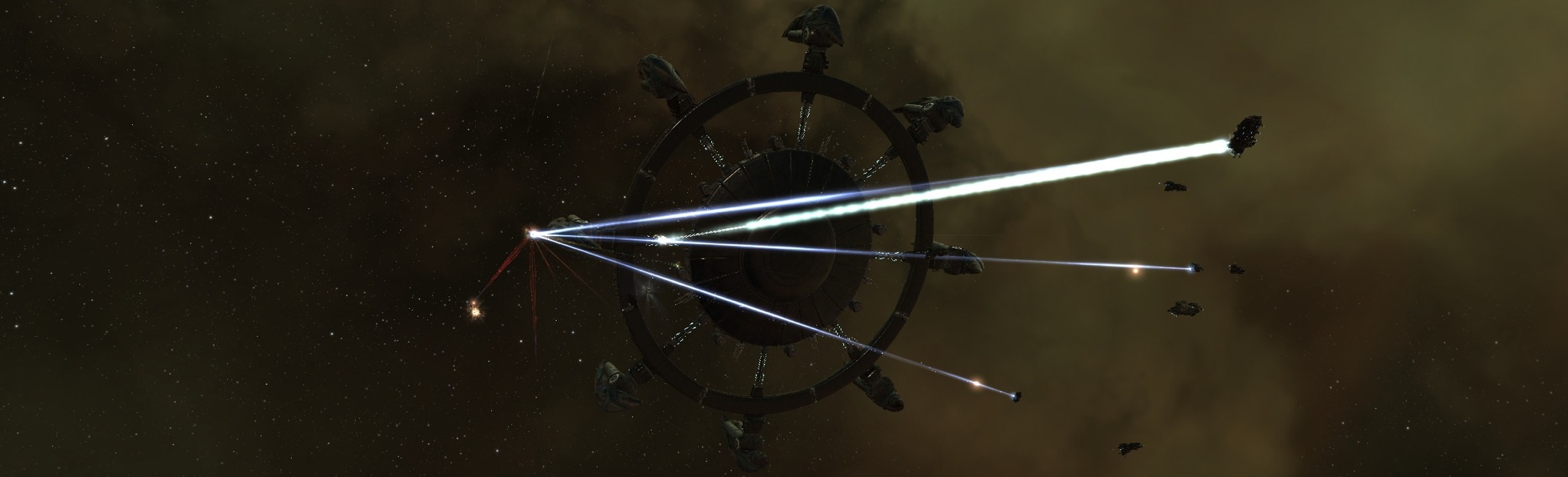
There are a couple of corporation capsuleers at the w-space tower, but not enough to attack Sleeper sites. One of the pilots is happy to find a gravimetric site and shoot rocks, which is a good plan given the pleasant company. Unfortunately, he cannot use the Tech II mining crystals in the borrowed Hulk, and we are shy of the Tech I versions to refit the exhumer. Instead, he borrows Fido, my Retriever mining barge, as he probably has better mining skills than me, although that's not saying much. Mining drones have better mining skills than me. I instead offer to act as muscle in a Drake in case Sleepers crash our party, which they inevitably do.

Standard rat ship threat management doesn't work in the same way against Sleepers, as they protect their assets as much as engage combat ships. Although I try to divide my launcher fire between the incoming frigates to keep their attention on my battlecruiser, the Sleepers take exception to the Retriever shooting what they consider to be their rocks and change targets. I call a warning, but am not sure if it is heard or not. Mining barges take an age to align for warp, and it can be difficult to detect the hint of one turning. I am glad to see Fido finally fleeing to the tower, thankfully in one piece, where the pilot swaps ships. He comes back with the big guns, a Raven menacingly swooping down to show the Sleepers who is in charge in this system. The frigates don't last much longer.

I ask about Fido's health, as he seemed to be under fire for a while and has all the defences of a mining barge. I suppress a startled squeak when I find out he was knocked down to 81% structure, probably only warping away with seconds to spare. But I can pilot a Guardian. A quick swap of fittings gives my logistics ship a remote hull repair module alongside the standard modules for armour. I fly out of the tower's shields to meet the Retriever, repairing all damage in only a couple of repping cycles, after which Fido heads off to continue mining. I grab a Catalyst and salvage the little profit from the frigates, before shuttling the ore back to the tower in my Crane.

Our colleague, meanwhile, has started scanning for an exit to New Eden, to resupply us with mining crystals and various other fittings we could use. But he stumbles in to a large, unoccupied system rife with signatures to resolve. I leave him to it.

Avoiding the Executioner

28th January 2010 – 5.44 pm

Another day of scanning. Without enough colleagues to engage Sleepers there is little else to do in w-space. I wouldn't mind the lack of w-space activity so much if it didn't take so long to scan an exit back to New Eden that I then can rarely take advantage of that exit. I really ought to collect the dozens of datacores that my R&D partners have accumulated, or perhaps run a few missions so that I can get the salvage required to manufacture rigs on my newly researched blueprints. But scanning an exit takes time, and ending a session outside of w-space risks not being able to be guided back in easily for the next. Hopefully, more experience at scanning will let me find exit wormholes sooner.

I find the wormhole out of our w-space system and start scanning today's neighbour. The neighbouring system is unoccupied, but cleared of any interesting sites. There are no opportunities to profit here, but at least the location of a connecting wormhole is quicker to find. The next system is occupied, the directional scanner revealing a Nighthawk, Basilisk, and a couple of Drakes present. What a sensible corporation this seems, with their Caldari shield-tanking ways. I'm sure they won't mind a Buzzard scanning in their system. Still in a class 4 w-space system, it is unlikely I'll find an exit to k-space, but I am surprised when I find one anyway. The wormhole leads to null-sec space in New Eden and has been bubbled on this side, presumably by the occupants of the system. No one seems to be monitoring the warp bubble, making it less of a deterrent, but I also don't fancy a trip through null-sec, so I return to scanning.

A second wormhole is found in the system, this one leading to a class 3 or lower system. As I am about to pass through the wormhole, a quick last check of d-scan shows a Loki now in the system, which is a little concerning. But the ship isn't local to the overview, so apart from my scanner probes disappearing from d-scan indicating that I've moved on, he won't know in to which system I've headed. The next system is unoccupied and full of signatures to resolve. The corporation won't want to head three systems deep to run Sleeper sites, even if there weren't a small fleet of powerful ships in the way, so I ignore any signature that isn't a wormhole.

Luckily, I find a wormhole fairly quickly, but this one also leads to null-sec space. Without the hindrance of a warp bubble on the wormhole, I consider poking my nose through to null-sec to see if anything is happening, but activity on d-scan changes my mind. An Executioner appears in the system. There are still many ship names and types I don't recognise, nor understand the relative capabilities of, and 'Executioner' sounds sufficiently dangerous to make me reconsider my actions. Judging from our own neighbouring system having been cleaned of sites, I imagine this is a scout for a fleet looking to clear this system too. I don't want to be caught on a wormhole when a fleet of Tech II and III ships is travelling for combat, so it seems like a good time to head home and drop off the bookmarks I have gathered.

Three scanning boats are better than one

27th January 2010 – 5.37 pm

Cosmic signatures having reference codes simplifies multi-capsuleer scanning. Rather than having to return to the corporation's w-space tower or jettison a container in order to share bookmarks, it can be more time-efficient to give the reference of a found site and let others interested resolve the signature independently. This is significantly helpful when one capsuleer is in an adjacent system with probes out, scanning for sites of specific Sleeper interest, and a second capsuleer wakes up at the tower. The reference of the connecting wormhole can be given to the new arrival, instead of having to recall probes and return to drop off a bookmark.

I start to feel a bit guilty after my colleague has spent the last five minutes scanning in our system. 'Penny said the signature of the wormhole is 'UYF', and I'm still looking for it.' Oops, that was my cat walking across the keyboard, coincidentally at the time you ask for the signature and also coincidentally hitting only three plausible letters. He finds the wormhole soon afterwards, once he ignores my help. But the idea of sharing references amongst scanners is sound. We then start a chain of scanning.

The neighbouring system is unnoccupied and full of signatures. A wormhole is found, and two of us pass through to the next system. But with so many signatures left to resolve, one colleague stays behind to try to find any interesting sites. The second system also reveals a wormhole quite quickly, and again we split our efforts. One chap takes point and starts scanning the new system, whilst I hold back and try to complete the scan of the second system.

The first two systems are scanned quite heavily, as they are more likely to be visited by us for combat with Sleepers. But the overhead involved in running a salvaging boat more than a couple of systems deep makes it much more awkward to recover any profit from the sites, particularly as we don't have enough bodies to run a dedicated salvager. So in the system ahead the scanning is concentrated on finding wormholes that could lead to an exit, and two wormholes have been found. One heads to null-sec in New Eden, the other a class 2 w-space system. Only looking for wormholes, our man at point ventures futher to find that the class 2 system yields high-sec exit.

The division of labour produces good results, without diminishing the satisfaction of the effort involved. The nearby systems present some decent sites to pillage for profit, and a good exit is found to New Eden. I take advantage of the high-sec exit to pick up some more suitable siege launchers for my Manticore, reducing the powergrid needs, and buying the Graviton Physics skill book, after which I return home to w-space safely.

Filesystem Checkwits delve in to Blackrock Depths

26th January 2010 – 5.38 pm

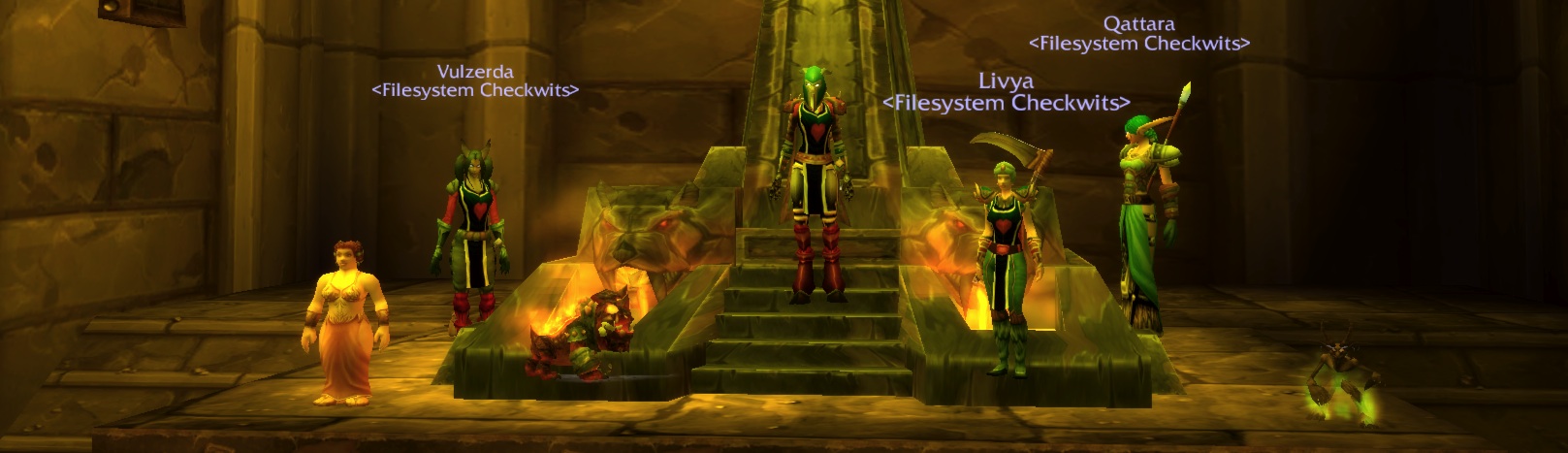
We return to Blackrock Depths, and this time we have the key. It's not much of a cinematic opening, but at least we can bypass all the areas we visited last time. Instead of marching in to the main reception area, where dwarves and hellhounds await, we sneak in through a normally locked door, where we can encounter, uh, dwarves and hellhounds. It's true that Blackrock Depths is the instance of midgets, which perhaps explains why Livya has spent over fifty levels looking forwards to coming here. Livya even claims that by coming to Blackrock Depths we have effectively completed the game and that she has nothing to come back to, but I suspect it's more because she's found 'her people'. She'll be back with us next week, particularly if we slaughter all the dwarves in here.

We make our way towards Bael'Gar, the molten giant standing at the end of a long and wide corridor full of dwarf guards. As we fight one set of guards, hugging a wall to avoid drawing the attention of a patrol, the curious nature of patrols not noticing fights happening ten feet away is somewhat accentuated having Qattara with us. It's possible that the patrol could think we are only performing rather vigorous manoeuvres, even if we are six-foot tall space goats, but, as Livya notes, 'you've got to worry about a patrol that ignores a tree in a cave'. It's true, our druid has her fabulous healing form of a tree, and she is somewhat incongruous deep underground. We could try to convince Bael'Gar that he needs more observant guards, but we kill him instead.

The first boss is immune to fire damage, making Livya somewhat frustrated about half her arsenal being useless, but at least Bael'Gar drops a nifty cloth belt for spellcasters, which Livya nabs. 'It's a pity you can't wear it yet', Vulzerda notices, with the belt requiring 53rd level to be equipped. 'Actually, you can', she corrects herself, referring to the traitorous extra level Livya sneaks in, blaming it on some nebulous questing. But it's all okay, and now Livya can wear a more powerful belt, making her fire spells even less effective against most of the mobs in the dungeon.

It is a surprisingly short run to the Grim Guzzler bar, a place I considered to be deep inside Blackrock Depths. In fact, the whole of the dungeon seems smaller now. Whether that's because this is our second visit over two weeks, or a result of the mobs being nerfed a little, the dungeon seems manageable. Of course, now that Marshal Windsor no longer needs rescuing, for the epic Onyxia quest chain, the cell wing doesn't need to be visited any more, let alone cleared a couple of times over two or three visits. Even so, the reputation I once had of Blackrock Depths being a sprawling monster of a dungeon is receding in favour of it being a wonderfully detailed facsimile of an undergound city.

Indeed, the corridors and rooms linked by overlooking ledges and windows gives a grander sense of design than in many other instances. It even feels much like a raid instance, and more so than the straightforward grind of Molten Core, with many well-designed areas that have particular themes and specific methods for progressing. The effect is adding a charm to Blackrock Depths that I've never really noticed since my early adventures in here. But the early time at which we reach the Grim Guzzler is not to say there is no drama in getting here. Upon reaching the area where gnomish engineers are constructing golems, the dungeon becomes interesting, and combat starts to go awry. Although most of the mobs in the room are not elite, the interesting aspect of singular mob patrols wandering around leaves us with a typical scene for any visit to Blackrock Depths.
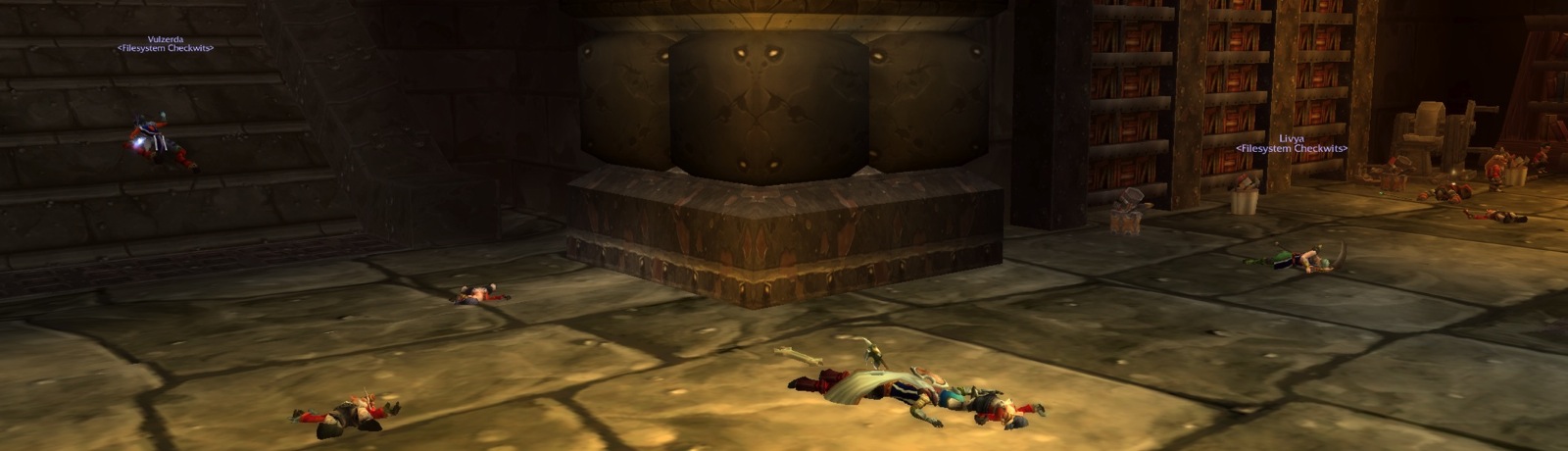
It isn't helped that I ignore my own intuitions. I have long been under the impression that early instances are much more straightforward to complete, only becoming a proper challenge when approaching old or new level caps. The lack of class abilities compared to later levels, and the ideology of 'training' players as they advance, requires the earlier instances to be forgiving. But the dungeons to be encountered at the end of levelling must offer more of a challenge, and we are now coming in to the first wave of dungeons designed for level-capped characters. Mobs have more abilities and greater relative hit points, making fights more involving and requiring more resources and co-ordination. Whereas before we could blast through two or three groups of mobs at the same time with cavalier abandon, now I need to ensure that everyone is ready for the next pull, even if it's just a casual glance at health and mana reserves.

On top of the increased challenge, we are slightly under the optimal level for the final sections of the dungeon, making mobs hit harder, and harder to hit. Combined with debuffs that reduce armour or add a stacking DoT, and having environmental effects to consider, we need to tread more carefully. As the tank, steadfastly at the front of the group, more responsibility rests on my shoulders to gauge the speed with which we progress. It is, therefore, a shame that only on reflection much later do I realise all of this, my carefree manner perhaps contributing to another couple of wipes. Yet everyone remains in good spirits, buoyed on by cheerful banter. Livya points out our deaths show how great Blackrock Depths is, 'it sorts out the men from the boys'.

Vulzerda agrees that Blackrock Depths is indeed spectacular, noting that the 'floor textures are great!', getting a good, long look at them whilst waiting to be resurrected. At one point when we have to make a corpse run back, there is a moment where the instance refuses to load, causing our ghostly figures to stand inside the instance a little too long for comfort. 'The instance server is so disgusted with us', Vulzerda says, 'it doesn't want to let us back in.'

'Yes', agrees Qattara, 'learn to play, noobs!'

Livya is optimistic as ever about her favourite instance, 'Blackrock Depths is so awesome they have to ration it this way, or we face an excitement overload.' We finally get back in to the dungeon to continue our adventure. Picking ourselves up, we tread more carefully amongst the gnomes, clearing the area before engaging the boss and his construct companions. None of us are engineers, so the schematics for the field repair bot are left on the floor of the boss's chamber and we make it to the Grim Guzzler. I ask if anyone is bothering to pick up the 'Love Potion' quest from the Succubus barmaid, as I doubt we're likely to return here. Naturally, Livya has picked it up before I've even asked. Doesn't it send you across two continents to get ingredients? 'Yes, it's the quintessential Alliance experience!' But we're pressing forwards first.

There may be several ways to open the door at the back of the Grim Guzzler, I honestly can't remember them from my early days in Azeroth. I'm sure engineers could probably blow it open with a seaforium charge, and I seem to remember there was possibly a way to make Phalanx, a golem guard, break it open. What I do recall is that if you buy all the ale from the barman and feed it to a particular dwarf standing nearby, he will blow the door open, so that's what I do. You need to be aware that such vandalism will be noted by Phalanx, who will change from being friendly to hostile, guarding passage through the door. Getting past Phalanx isn't too much of a problem, but we need to take care to cross the room first without catching his attention, or we risk dragging the whole bar of drunken patrons in to a brawl. A bit like the brawl Livya gets us in to. 'It must be my new turban', she claims. 'What are the odds of running in to a racist robot?'

Wiping when Phalanx and the Grim Guzzler gang up on us isn't so bad. At least when we run back in we start from a better position to fight our way through the bar and out the rear entrance—'We get to experience it in all it's glory!'—although it looks like Phalanx's blood lust is sated, as he no longer appears hostile towards us. Next we come to the Summoner's Tomb, another interesting room offering hints of larger scale encounters. Seven ghostly dwarves stand passively next to their tombs arranged around the large room. When one is engaged in conversation, the fight begins. One dwarf at a time challenges the group, the next joining the fray either when the current one drops or a certain time has expired. It doesn't matter how quickly you defeat the ghosts, more will come immediately, but if you take your time you can get overwhelmed. We choose the quick-and-consecutive option, the end of the encounter releasing the lock on the door ahead.

The path towards Molten Core doesn't tempt us, mostly because none of us are eligible for the attunement quest, so we avoid getting sidetracked this time. Ahead of us is the Lyceum, a room causing many frustrating wipes in its day. It may be nerfed a bit, but the Lyceum can still cause problems. We need to find the torchbearers, steal their torches and light two beacons at the far end of the room to open the door. But the dwarves in here huddle together and breed like rabbits. They may not be elite mobs, but they rely on overwhelming odds to defeat intruders. Our group sticks together, trying not to get separated, and make good use of our AoE to pass through the room without too many difficulties. The Lyceum is still not a room in which to dilly-dally.

Ahead of us is Magmus, a molten giant. I know that when engaged he animates the statues lining his enormous room to throw flames in large arcs. Even aware of this, the flames are not easy to avoid, as their appearance half-way up the room gives no obvious indication of where they are shooting. Having a giant fill up your field of vision also doesn't help. And, once again, Livya is frustrated that the boss is immune to fire. However, there is one creature in here not immune to fire, as Livya's Hellfire-for-Life Tap casting at the end of the boss fight shows. It was bound to happen sooner or later and, already low on health, Livya finally dies from an accidental Hellfire.

The only encounter left is to face the emperor and rescue the princess. The throne room is quickly cleared of mobs, and we stand before the emperor and his thrall. To complete Blackrock Depths properly the princess must not be killed, so we need to concentrate our attacks on the emperor and only focus on the princess to interrupt her healing spells. The fight is far more straightforward than I remember it ever being before, undoubtedly because of the blanket nerfing. Even several levels below our opponents we are successful in rescuing the princess, completing our full run through Blackrock Depths.
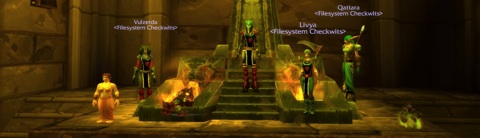
I would say that BRD got its reputation as being a sprawling monster of an instance fairly, as it was previously harsher and much more time-consuming. But this was indeed 'previously', as now its reputation probably hurts the appeal of this dungeon. Ignoring the convoluted quest chains, being able to bypass the tortuous cell wing, and accounting for the nerfing, Blackrock Depths can be enjoyed as an interesting and remarkable instance, offering plenty of differing encounters. But some care needs to be taken. Now that we've reached the end, the question is what to do next. 'Let's do it again!' cries Livya, but we vote with our hearthstones and head back to Stormwind for the evening.

We're coming to the end of Azeroth, but there are still plenty of dungeons to visit. The undead-infested plaguelands offer the atmospheric Scholomance and Stratholme, Blackrock Mountain holds Lower and Upper Blackrock Spire, and in the forest of Feralas are three wings of the crumbling elven structure Dire Maul. There is much of the world still to explore.

Scanning is computationally easy but manually tedious

25th January 2010 – 5.55 pm

Scanning is vital in w-space. You need to scan to find a wormhole to get in to w-space, and you need to scan to find an exit wormhole. You need to scan to find Sleeper sites to run, or to hunt down other capsuleers. It is unsurprising that the scanning system was overhauled for the Apocrypha expansion, drastically reducing the time and skills needed to perform scanning with probes, otherwise w-space would remain unexplored and uninhabited. And yet, despite it being simplified, I still have a problem with the scanning process.

The fundamental process of dropping probes and scanning for signals is sound. Locating signatures and determining their type is interesting and, to some extent, enjoyable. But resolving the signatures so that you can warp directly to them, or bookmark them in the scanning window, is unfortunately tedious. The problem is inadvertently highlighted in CCP's own EVE Online: Scanning Guide Tutorial video, created alongside the introduction of the specialised and limited Zephyr scanning boat.

When you find a bunch of signatures you want to resolve, you pick one, reduce the scan radius on the probes, adjust the probes' positions to triangulate the signature, and scan. The new scan result gives you a better reading, at which point you reduce the scan radius on the probes, adjust the probes' positions to triangulate the signature, and scan. The new scan result gives you a better reading, and, well, I think you may see my issue with the process. The tutorial video gets boring just to watch once it becomes a matter of resolving the signal from 'known site' to '100% scan strength'. Having to scan manually this way can quickly become a chore, particularly with a dozen or more sites to resolve. My qualm is not simply that scanning is repetitive, but that it is a process that can be automated easily.

Changing the scan radius and repositioning the probes to recentre the signature seems to me like a trivial task to delegate to a computer system. After all, computers are ideally suited to performing repetitive computational tasks, and are often touted as being able to relieve humans from such tedium. But capsuleers are humans too, and we are sitting in vastly complex spaceships with considerable computing power at our disposal. I don't quite understand why it is left to me to perform trivially computed operations until I get a 100% scan strength result. I could just as easily select a signature and punch a button, letting the ship's computer take care of resolving the signature.

I understand that effectively automating the process would simplify scanning too much, and that the current system is preferable to the old. But there has to be a better way to scan systems than by moving probes manually, chasing down individual signatures using a repetitive and ultimately monotonous method. Personally, all I really need is a method that doesn't make me wonder why my computer isn't doing the task for me, instead feeling that my judgement and experience is being used effectively.

Co-operative scanning

24th January 2010 – 3.27 pm

Scanning today is a team effort. It's helpful for each signature to have its own six-digit reference, common for anyone probing the system, as it allows the task of scanning to be split amongst more than one capsuleer. A signature is formed by three letters, a dash, and three numbers. When a signature is resolved by one capsuleer, she can state the three-letter reference and what type of site it is, allowing others either work on a different signature and cutting down on the time required to scan each system.

Being able to ignore signatures with certain references comes in handy today. The neighbouring system is uninhabited and full of signatures to resolve, which is normally good, but today we are only looking for an exit. Gravitational and ladar sites are ignored as soon as their type is revealed, as they are ore and gas mining sites respectively, and it is unlikely that we'll be visiting them. Magnetometric and radar sites are highly profitable sources of artefacts and databanks, so even though we probably won't get a combat fleet together these sites are worth bookmarking. What we really want to find are signatures of 'unknown' type, which are just wormholes being coy about their identity.

I find a wormhole that leads to another class 4 w-space system, and I jump through to investigate. On the other side of the wormhole, I use my directional scanner to see what possibilities are in store. The scan reveals defensive batteries and a tower, making it occupied by another corporation. There is also a Tengu, Wolf, and Jaguar in the d-scan results, all high-tech and mostly dangerous ships. I report what I've found to the other scanning pilot. I'm not entirely in the mood to scan in this system, so I head home for now.

Just as I mention that I'm heading back to the tower, another corporation colleague arrives. I quickly add, 'in my capsule' for his benefit. He has shown a penchant for throwing ships to their doom, whether it's flying a Tristan in to a warp bubble, or testing tower defences with a Nemesis stealth bomber, and I tease him about his new beloved Helios covert operations boat, making him think that I got it destroyed. I don't think he falls for it, particularly as his Helios is safely in the corporate hangar, and any illusion is lost when I arrive back at the tower in Fin's Buzzard. But it is fun to see his initial confusion.

Back home, I take time to salvage some Sleeper frigates from a local ladar site, that is having its gas harvested, before tentatively preparing for combat. There is some interest in clearing a radar site in the neighbouring system, but sadly we don't end up with enough pilots. It's been another quiet day in w-space.

Class equality

23rd January 2010 – 3.19 pm

Ancient Gaming Noob gains a level using the Looking For Dungeon tool and concludes that DPS classes are interchangeable. Running through an instance several times with the same tank and healer, but different DPS, could superficially make DPS look replaceable, but there are several factors overlooked. Lower-level instances are significantly easier to run than anything near a level cap, and Scarlet Monastery is no exception. There are few real challenges to be overcome for anything but entirely new players, making differences in class fairly irrelevant. It is probably possible for warlocks or hunters to tank and heal with their pets in such low-level instances, such is the lower level of challenge.

DPS characters are not the only classes that can be swapped around with no discernible difference. I have played as and run with warrior, death knight, paladin, and druid tanks, all perfectly capable in any level of instance. I have also run instances with druid, priest, paladin, and shaman healers, none of them struggling more than others. I can't enumerate the specific tank/healer combinations I've played alongside, but that's because no particular combination has been conspicuous for its competence or otherwise. This indicates to me that if DPS classes are interchangeable, then tank and healing classes are equally interchangeable. But this should come as no surprise.

The reason why the classes are interchangeable is because of all the specific effort made towards balancing the classes. Although there used to be an emphasis on classes filling certain rôles—different classes having different crowd control, AoE attacks versus single-target damage—most classes have been sufficiently homogenised so that one does not have a significant or obvious advantage over another. Many pages of internet text have been dedicated to ranting and whining about why one class is too powerful, or that another has been unfairly nerfed, so it's unsurprising that the approach to balancing the classes has been to make them more interchangeable. And it really should be no surprise that a game design aiming for balance should result in similar experiences independent of the core party composition.

Ancient Gaming Noob continues his thought by linking to a guest post at World of Matticus which suggests the controversial idea that tanks and healers should reap greater rewards than DPS classes. Because tanks and healers are necessary for any instance run, the argument goes, those players who take on these more important and stressful rôles should be given a greater incentive for their efforts. I find I must agree that the tank and healer are necessary. Although I have been in a few unconventional groups, most notably three mages and two hunters completing The Stockades at the right level, the only group that continues to be viable at any level will contain a tank and healer. Whenever I had successfully paired up with another player for some low-key instance runs, it has always been as a tank and healer duo, and we have always prevailed. I have no doubt that tanks and healers are vital for success. But it doesn't then follow that DPS are useless.

I remember receiving a vivid demonstration of the utility of DPS. I am running around Outlands killing pigs with my healer companion, and I am feeling effective and powerful. No pig can stand in my mighty warrior path! Whilst we are on our rampage, another friend turns up, playing a DPS class. My happy little sword-and-shield world of feeling powerful rapidly diminishes, about as quickly as the pigs fall under the dual blades of our newly arrived friend. Instead of each battle allowing me to practice my PvE rotation of abilities, I barely get a couple of hits on each pig before it drops. The DPS not only increases, but soars so that I am almost redundant. This increase in damage output is only amplified in instances against elite mobs.

As a quick calculation, based on abstracted numbers, if a DPS class doubles the damage output of a tank, the mobs are defeated in a third of the time. Adding that one extra player reduces an hour-long run to just twenty minutes. Filling the party with two more DPS classes increases the overall damage output significantly more still. Assuming DPS classes, along with tanks and healers, are interchangeable, a full party will complete a run easily several times quicker than if just a tank and healer attempted the same run. Quicker fights also make tanking and healing easier, less stressful. And this is without accounting for specific fights, where a boss mob will 'enrage' after a set amount of time and wipe the group if not defeated quickly enough.

I admit that healers and tanks are vital, but to suggest that DPS classes don't add an equal contribution to the group is ignoring the value of time. If your time is unimportant, it is likely possible to complete many of the challenges with only a tank and healer pair. But for most people, time is a valuable resource, and being able to make better use of time makes DPS classes just as necessary as healers and tanks. To suggest that DPS classes are anonymous or unnecessary is to ignore the relief of stress and time that comes with quicker combat. And this time is the greater reward that tanks and healers already receive when they are gracious enough to play alongside DPS classes.

A picture's worth a few repping cycles

22nd January 2010 – 5.56 pm

It's time to plunder more Sleeper sites. Our neighbouring w-space system is unoccupied, and full of cosmic signatures ready to be raided. We even have a solid fleet, with twin Guardians, three battleships and a heavy assault ship, to make combat quick and efficient. We warp as a fleet to the wormhole, jump through to the neighbouring system, and navigate to the first site. The fleet drops out of warp in the midst of what look like broken moons, but it doesn't hamper the start of our rampage through the system. I can already smell the profit.

There is a bit of trouble in the second site, but incidental to combat itself. With the fleet dropping out of warp near the Sleeper structures, and the waves of Sleepers approaching from further afield, there are opportunities to capture some excellent images. Although the lack of overview brackets can make spotting ships difficult, the best images are normally with the interface turned off, so that's what I do. I casually mention that I had plenty of time to turn the interface back on to repair the damaged Scorpion, and people get a little defensive.

I take care when a new wave of Sleepers arrives, because the incoming damage can move between ships a few times in the early stages of a wave, so I like to think that I am not being irresponsible. Besides, I get some fabulous images, even if they are mostly variations on a theme. It's difficult to capture different views from the same site, particularly as the Sleepers and fleet don't tend to be particularly mobile. But it's worth taking a little time, to capture the right balance of laser and missile fire, as long as my repairing duties are not shirked.

The problem with flying smaller hulled vessels alongside battleships is that we tend to enter and exit warp first during a fleet movement. Approaching the third site of the evening sees me and Fin alone for a few seconds, except for a couple of Sleeper battleships. We bounce off another structure, but there isn't time to navigate around it yet, as the Sleeper ships blast down our shields. The benefit of flying logistic ships is that instead of panicking about this, we simply lock on to each other and start our energy transfers and remote repair modules, repairing through everything the Sleepers fire at us. Our own battleships arrive soon enough, their damage distracting the Sleepers away from us, and the Scorpion's ECM jamming the Sleepers' systems.

We need to work on better warp-in bookmarks. The Zephyr has been used reconnoitre the sites we want to clear, the scanning ship ignored by Sleepers. The aim is to provide better warp-in locations, generally to place us within good range of any stationary Argos guns. But the limitation of only being able to warp a fleet to zero point means that bookmarking a nearby structure causes more problems than it solves, as we drop out of warp and bounce in different directions off the structure, our ships' emergency collision avoidance systems activating. It only provides a short distraction, though, as we can navigate around the structure. However, in the fifth site I forget that I am moving away from the structure until I am out of range of everyone. I move back towards the fleet again as quickly as I can, thanking the huge range bonuses the Guardian gets to its systems.

A sixth site is also cleared of Sleeper presence. We have no panics and only a couple of minor distractions. Although we don't clear the system of Sleeper sites, we come fairly close to doing so. All of the salvage and loot we swipe from the wrecks makes this a thoroughly successful night.

Sleeper suppression and salvaging

21st January 2010 – 5.49 pm

Fin quips that the spare Guardian brought in to w-space means there will be less of a delay when one pops. Tish and pish, we'll be fine. If anything, bringing in a spare almost guarantees that we'll never need it, taunting us in to thinking buying it was a waste of ISK. Either way, the extra Guardian acts as an insurance policy. And now that we are back with a full complement of ships, Fin is out for revenge. We form a fleet and warp back to the Sleeper site that saw the destruction of the previous Guardian, halting our earlier rampage through w-space.

The Sleepers have risen, we are told, 'and we're bringing them their morning coffee'. Having said that, I'm told I'm doing it wrong, and maybe that's why we lost the last time. Ah, okay. Let's shoot the Sleepers instead. Warping in to the site goes a bit awry, the bookmark made causing us to drop out of warp on top of a huge structure. As our battleships engage the Sleepers, and we repair the incoming damage to the battleships, we decide to get our Guardians paired up and away from the structure. But for some reason, neither of us can get clear of the structure. It turns out that we are both confused, thinking the other Guardian is ourself, and bumping in to the structure believing we're actually on the other side. With the confusion cleared, we pilot around the structure and get in to clear space.

There are no problems repairing through the damage this time, and the waves of Sleeper ships are soon destroyed with no losses. It's time to salvage, and I like salvaging. I have my warp-in wreck bookmarked before we even finish combat, and then I am away to the tower to get a salvaging Catalyst destroyer. I warp back in to the Sleeper site, now full of wrecks, and start pulling the wrecks back to my ship to loot and salvage, quickly getting in to a comfortable rhythm. There are a couple of wrecks lying distant from the main clumps, probably battleships shooting from range or fleeing frigates, which I'll leave until last.

As luck would have it, once I have cleared all but the last two wrecks, one of these distant wrecks is now over 150 km away, which means I can warp to it. And warping to the first distant wreck puts me now far enough away from the second to warp to that too. Instead of taking a couple of minutes flying with my micro-warp drive active, a couple of seconds of actual warp flight puts me immediately next to each wreck, ready for salvaging. The site is clear of loot and salvage, which is hauled back to the tower. I get a bit of a start when I approach the tower, thinking a warp bubble has been dropped, but then I realise it is only my tactical overlay. I have zoomed out so far that my targeting range sphere has engulfed the tower's shields, making the latter look like a bubble.

I swap back to the Guardian logistics ship and the fleet warps in to a second Sleeper site. This is also cleared smoothly and efficiently, followed by some more lovely salvaging. It has been a clean night of Sleeper destruction, just what we needed.

Collecting a spare Guardian

20th January 2010 – 5.47 pm

My colleague and I make a concerted effort to find an exit to New Eden today. Fin is outside of w-space and we need to get her back in, with a new ship or two. I hop in to a Buzzard and get ready to locate some wormholes. My colleague is in the neighbouring system. Instead of coming back to drop off a bookmark, he gives me the signature of the exit wormhole in our home system, making it quicker to find. Once I am in the neighbouring system myself, we split the work-load, sharing information on which signatures we are resolving and which ones are not wormholes.

My first pick of cosmic signatures is quickly discarded by my colleague as a gravimetric site, full of asteroids, so I choose again. I select a fresh signature from the dozen or so hits the probes return, and within a few scans the type is returned as 'unknown'. That's a wormhole! I may be getting good at scanning. I announce the wormhole's signature and quickly get it's location resolved to 100%. Warping to the wormhole lets me gain some information about it, the good news being that it leads to high-sec space, making travel convenient and safer for transporting ships.

I pop my nose through to the other side of the wormhole, the strangely uncomfortable populated space of high-sec New Eden, and find that the journey to corporate HQ is only fourteen hops. I am also able to get and relay the system's name, which lets corporation capsuleers start plotting their journey to w-space. As I am to pick up a ship, I head back to the tower in w-space and drop off the Buzzard, returning to k-space in my bare pod. High-sec travel is easy, and I am back at corporate HQ soon enough. My pod is inserted in to a spare Guardian logistics ship and I am already feeling more comfortable.

Whilst at HQ, I take the good opportunity to refresh my BPO research jobs, once more wondering when I'll make the time to get manufacturing flowing again. Industry has certainly become a secondary activity to living in w-space, but the steady flow of income is welcome and gives me a different focus for slower periods. As it turns out, people aren't readily available for Sleeper engagements, so once I successfully drop off the Guardian at the tower I have the time to pop out to New Eden in my Crane. Taking care of a little business is made easier considering the wormhole exit has materialised in the same region as my manufacturing base.

For the first time in a month of two, I buy a new batch of minerals from the market to restock my supplies and start a handful of production runs. I have to pay attention to the mineral prices, both to see how the market is fluctuating and to keep an eye on my profit margins. The inflated cost of nocxium gives me a little shock, and I am thankful I currently have enough for my needs, allowing me to install my manufacturing jobs. Delivering my first Badger Mark II ship off the production line, I put a handful more in to manufacture, taking the built ship to market, which is fairly exciting. It will be interesting to see how quickly it sells, as an indicator for the new ones.

With research and manufacturing taken care of, I return to my w-space home. I will need to get back to New Eden soon, to deliver my production runs to the market, but for now my appetite for high-sec space is sated.